Overview
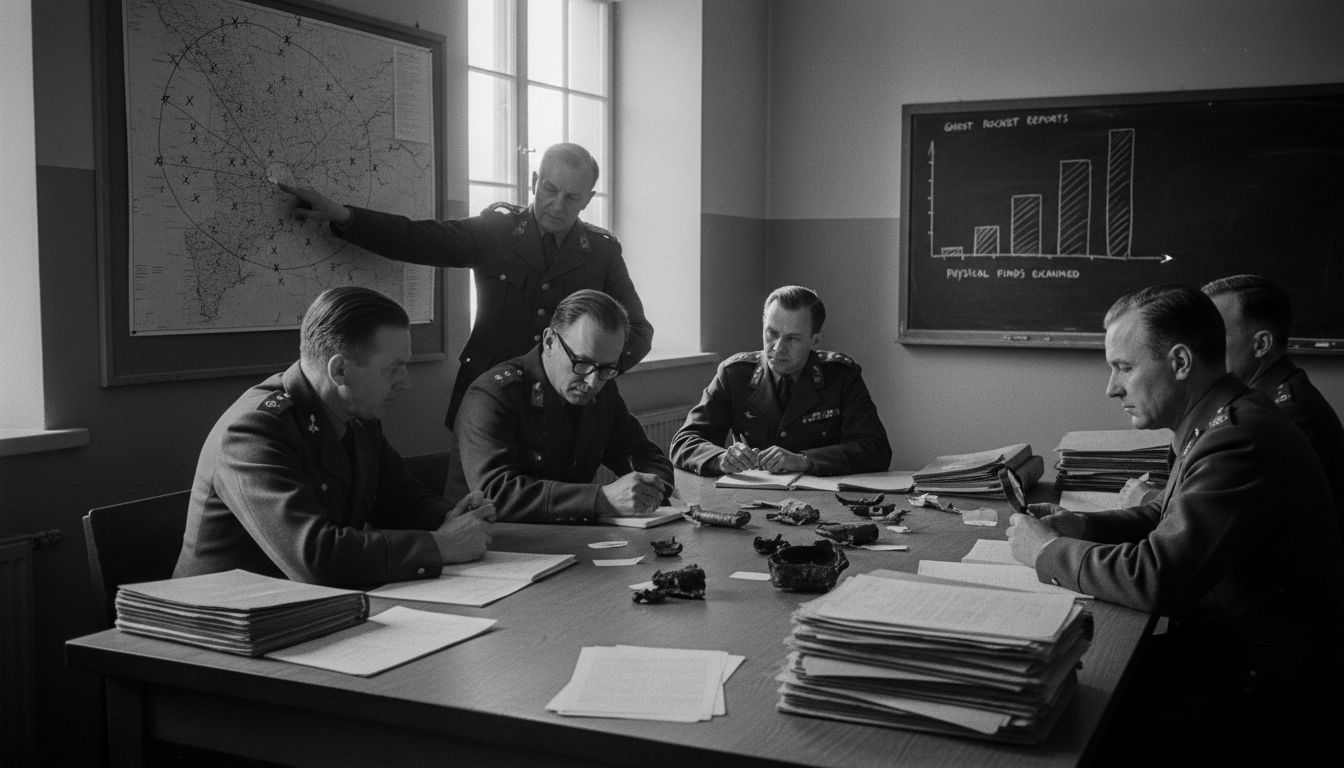
Sweden’s 1946 “ghost rocket” investigation produced a far more cautious conclusion than later accounts often suggest. By 1 December 1946, authorities had received 973 reports of unusual aerial objects, prompting cooperation between Sweden’s military and scientific institutions. Although the episode became associated with suspected German rocket technology and the so-called Peenemünde hypothesis, investigators did not establish that hundreds of rockets had crossed Swedish airspace. Of approximately 30 physical finds examined, none was conclusively identified as rocket wreckage, and only one case ultimately remained unexplained.
The frequently repeated figure of 225 objects also requires qualification. According to the review, it represented a reporting or classification category—not a verified tally of recovered or independently observed craft. The distinction is significant: wartime debris, aircraft, meteors, misidentified conventional objects and contradictory eyewitness accounts could all enter the wider body of reports without demonstrating the presence of a new or secret weapon.
The Bäckebo Incident
A key piece of background is Sweden’s earlier encounter with what officials identified as a German “air torpedo” near Bäckebo, in Småland, on 13 June 1944. A Swedish military report dated 22 July 1944 states that the object broke apart over an area of roughly four square kilometres north of Kalmar. Investigators collected about 2,010 kilograms of fragments, transported them to Stockholm and began reconstructing the device with assistance from the Swedish Aeronautical Research Institute and Professor Boestad.
The report describes a powerful midair explosion followed by a ground impact. Local witnesses reported several successive blasts and observed “a mass of silver-shining objects” falling from the sky. The resulting crater was approximately five metres wide and between 1.5 and two metres deep. The distribution of metal fragments, combined with recorded winds, led investigators to estimate that the aerial explosion may have occurred at an altitude substantially greater than 1,000 metres—possibly 5,000 to 6,000 metres.
What the Evidence Showed
The Swedish report concluded that the Bäckebo device was German, based on markings found on components including air tanks and radio equipment. Investigators found no evidence of wings, but did identify four substantial control fins. On that basis, the device was characterized as an air torpedo, rather than a conventional aircraft. Its major sections included an explosive warhead, a radio compartment and other structural assemblies.
That documented recovery has frequently been cited in discussions of the 1946 ghost rockets. It demonstrates that unusual weapons or weapon debris could reach Swedish territory, but it does not, by itself, prove that the later sightings involved similar devices. The 1944 object was physically recovered and examined; the great majority of 1946 reports did not produce comparable material evidence.
The Peenemünde Hypothesis
The Peenemünde hypothesis holds that at least some Swedish sightings may have involved German-developed rockets, possibly test vehicles connected with the wartime missile center at Peenemünde or technology dispersed after Germany’s defeat. The theory gained credibility from Sweden’s wartime intelligence concerns and from the known recovery of German equipment at Bäckebo. It also reflected contemporary fears that advanced weapons might be tested or transported through the Baltic region.
However, the investigation’s documented results provide limited support for a direct Peenemünde connection. No examined fragment was proven to originate from a rocket, and the review found only one case that remained unexplained after assessment. That conclusion does not resolve every individual report, but it places the episode within the evidentiary standards of an official inquiry: widespread reports generated a serious investigation, while physical confirmation remained scarce and inconclusive.