Overview
A newly presented archive of declassified U.S. documents revisits one of the most frequently cited military UFO cases: the Tehran F-4 incident of September 19, 1976. The material includes a copy of an original Defense Intelligence Agency (DIA) teletype and an attached U.S. evaluation sheet that reportedly assessed the account as highly credible. The documents concern an encounter involving two Imperial Iranian Air Force F-4 Phantom II jets and an unidentified luminous object over or near Tehran.
According to the records reproduced by the Majestic Archive, the incident began shortly after midnight when residents in Shemiran, a district in northern Tehran, reported seeing a bright light in the sky. The report specifically distinguishes Shemiran as the source of the telephone calls rather than a radar installation. Iranian authorities subsequently dispatched aircraft from Shahrokhi Air Base to investigate.
The Reported Encounter
The first F-4 was reportedly flown by Lt. Jalal Damirian, while a second aircraft was launched after the object continued to attract attention. The DIA account describes the object as unusually bright and capable of moving across the sky in a manner that prompted the Iranian crews to attempt an interception. As the jets approached, the pilots reportedly observed additional changes in the object’s appearance or behavior.
The most significant claim in the teletype involves the aircraft systems. The report states that, during the approaches, one or both F-4s experienced failures involving communications and instrumentation. The account further says that the systems returned to normal after the aircraft turned away from the object. Such a sequence, if accurately reported, was important to U.S. analysts because it suggested an effect on the aircraft rather than a purely visual sighting.
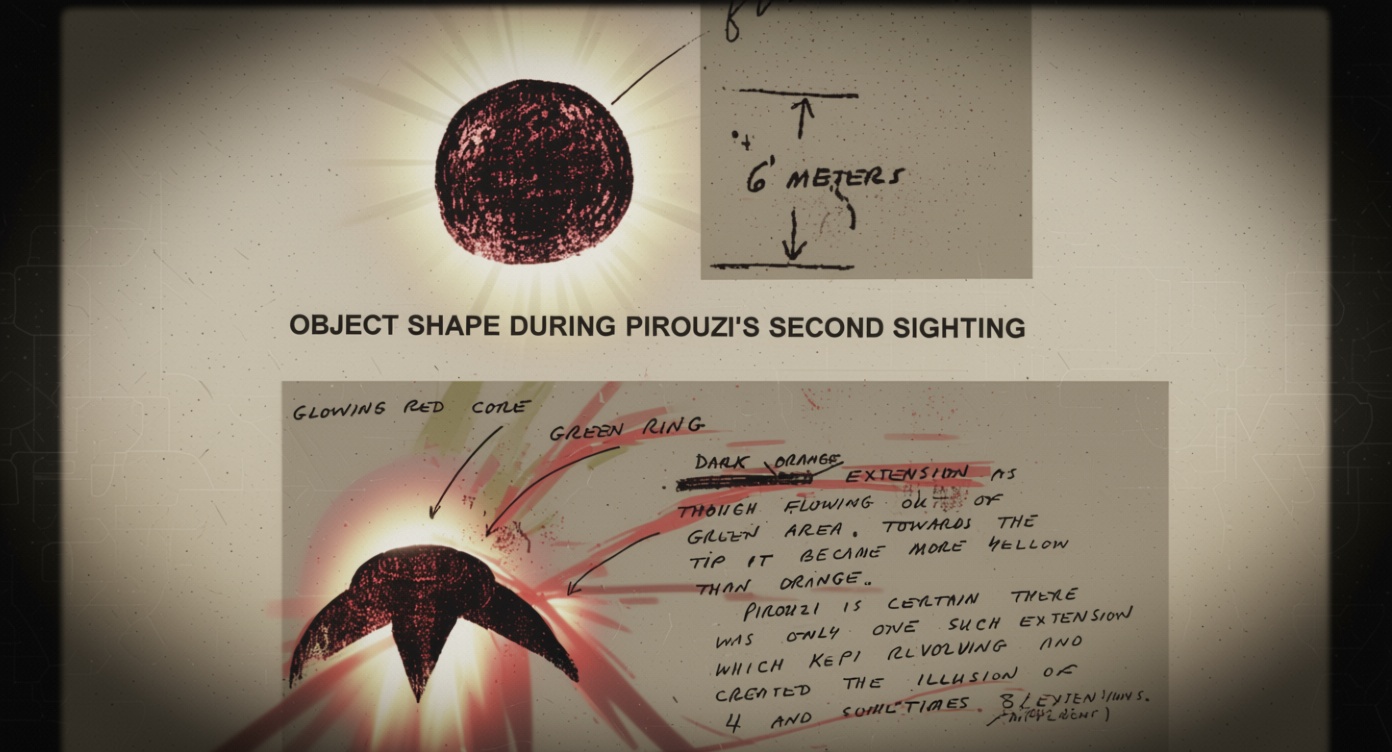
The report also describes a later phase in which the aircrews attempted to respond to the object’s movements. Public accounts of the incident have long associated the case with a smaller luminous object that appeared to separate from the main light and move toward the Iranian aircraft. However, the surviving documentation should be read carefully: the DIA teletype records information obtained from Iranian sources and does not itself establish the nature, origin or physical properties of the object.
U.S. Evaluation
Attached to the teletype is an evaluation sheet that reportedly rated the information and the reliability of its sources favorably. This is often cited as evidence that U.S. intelligence officials considered the Iranian report credible at the time. A high credibility assessment does not mean the object was identified as extraterrestrial or even that every reported detail was independently verified. Rather, it indicates that analysts judged the source and the information sufficiently reliable to merit serious consideration.
The documents are particularly notable because they were generated in a military and intelligence context, rather than as a later retelling by civilian witnesses. They provide names, locations and operational details, while also preserving the uncertainty typical of intelligence reporting. The case therefore remains significant as a record of an unexplained military encounter—not as definitive proof of a specific explanation.
Continuing Questions
The Tehran incident occurred during the final years of the U.S.-aligned Iranian monarchy, when American personnel maintained close military and intelligence ties with Iran. That relationship helps explain why the encounter was transmitted to U.S. officials and evaluated by the DIA. At the same time, the available material does not resolve whether the event resulted from an astronomical object, electronic interference, equipment malfunction, misidentification or another cause.
The reproduced teletype and evaluation sheet add documentary weight to the historical record, but they do not close the case. The central questions—what the crews actually observed, why the aircraft systems reportedly failed, and whether the effects were connected to the object—remain unresolved.