Overview
A speculative framework known as the Galactic Age-Diversity Hypothesis suggests that, if some reported UFO or UAP incidents ultimately involve non-human intelligence, those phenomena might not originate from a single civilization or a uniform technological culture. Instead, the reports could—at least in theory—reflect contact with multiple systems whose inhabitants or machines developed at very different points in biological, technological and evolutionary history.
The proposal does not claim that extraterrestrial vehicles have been identified, nor does it present evidence that any particular UAP case has a non-human explanation. Its central argument is that assumptions about a single, galaxy-spanning “advanced civilization” may be too narrow. Possible sources could include biological explorers, autonomous probes, artificial intelligences or machine civilizations operating on different timescales.
A Spectrum of Possible Intelligences
Under the hypothesis, one reported object could theoretically represent a comparatively young biological society sending crewed spacecraft, while another might be an autonomous system created by a civilization that disappeared millions or billions of years ago. Other possibilities include self-replicating probes, dormant machines activated by environmental conditions, or artificial intelligences whose original creators no longer exist.
The framework also emphasizes that age and capability are not necessarily equivalent. A very old civilization might have collapsed, stagnated or left behind only limited automated infrastructure. Conversely, a younger society could make rapid technological advances or benefit from inherited systems built by an earlier intelligence. This distinction is important because discussions of extraterrestrial life often treat “older” civilizations as automatically more powerful or sophisticated.
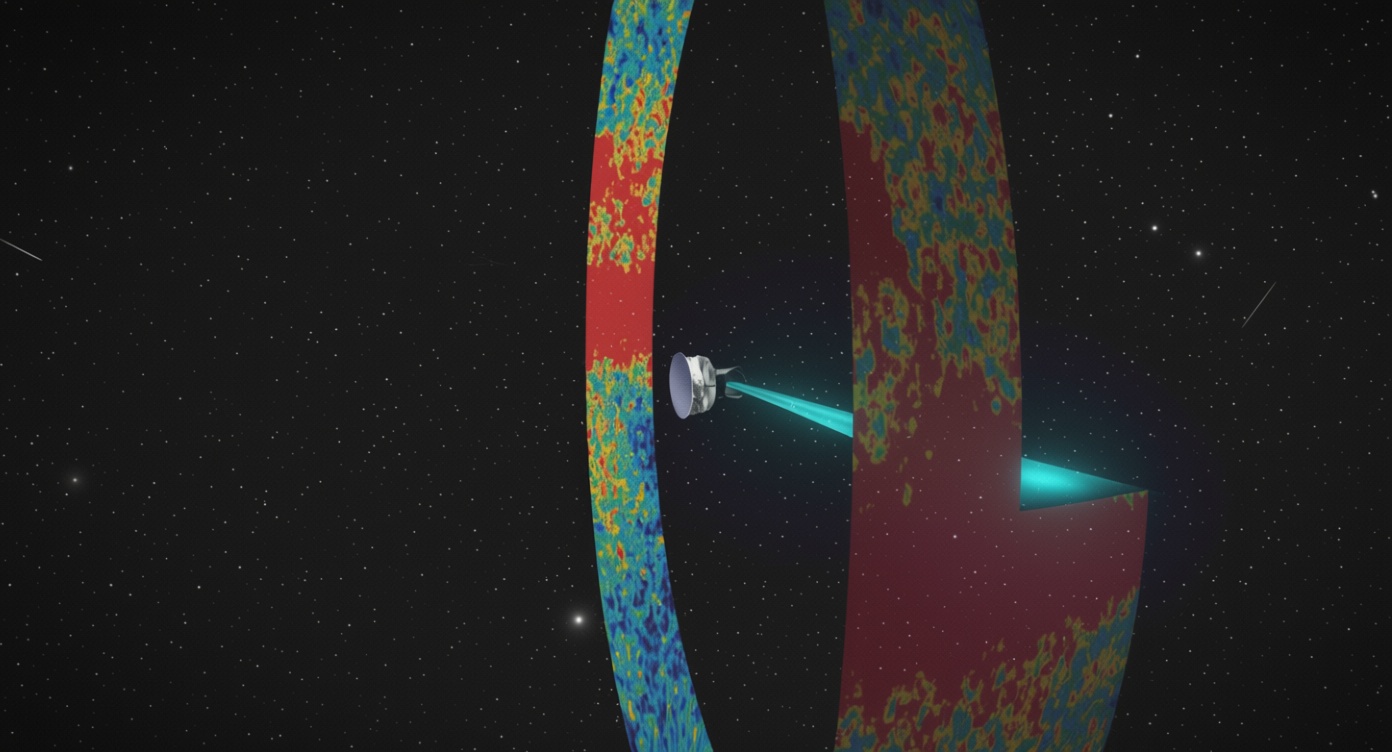
The concept is partly informed by the vast range of cosmic timescales described in modern astronomy. The European Space Agency’s Planck mission, documented in ESA’s “Planck science highlights,” studied the cosmic microwave background—the residual radiation from the early universe—and helped refine scientific understanding of the universe’s origin, composition and evolution. Planck’s results provide cosmological context for thinking about deep time, but the ESA material does not establish a connection between the mission and UFO reports, extraterrestrial visitation or the age-diversity hypothesis.
Evidence and Limitations
There is currently no publicly confirmed evidence demonstrating that UAP observations are vehicles, probes or artifacts of non-human origin. Many reports remain unresolved because of incomplete sensor data, ambiguous imagery, adverse observing conditions, classified information or limited opportunities for independent analysis. An unresolved observation is therefore not, by itself, evidence of an extraterrestrial explanation.
The hypothesis is best understood as a speculative model for organizing possibilities, rather than a scientific conclusion. To move beyond speculation, researchers would need independently verifiable data, including high-quality multi-sensor observations, recoverable physical materials, repeatable measurements or an unambiguous signal showing technological origin. Such evidence would also need to rule out conventional aircraft, atmospheric effects, sensor artifacts, human technology and misidentification.
Why the Idea Matters
Despite those limitations, the proposal raises a useful question about how investigators interpret reports that appear to describe very different behaviors. A single explanation may not account for every observation, particularly when cases vary widely in apparent speed, shape, maneuverability, duration and context. At the same time, differences among reports do not prove that multiple civilizations are involved.
For now, the Galactic Age-Diversity Hypothesis remains an unconfirmed, interdisciplinary thought experiment drawing on astronomy, astrobiology, artificial intelligence and the study of UAP. ESA’s Planck findings help illustrate the immense age and scale of the cosmos, but they do not validate the hypothesis. Any future assessment will depend less on the age assigned to a hypothetical civilization than on the quality, transparency and reproducibility of evidence tied to individual UAP cases.