Overview
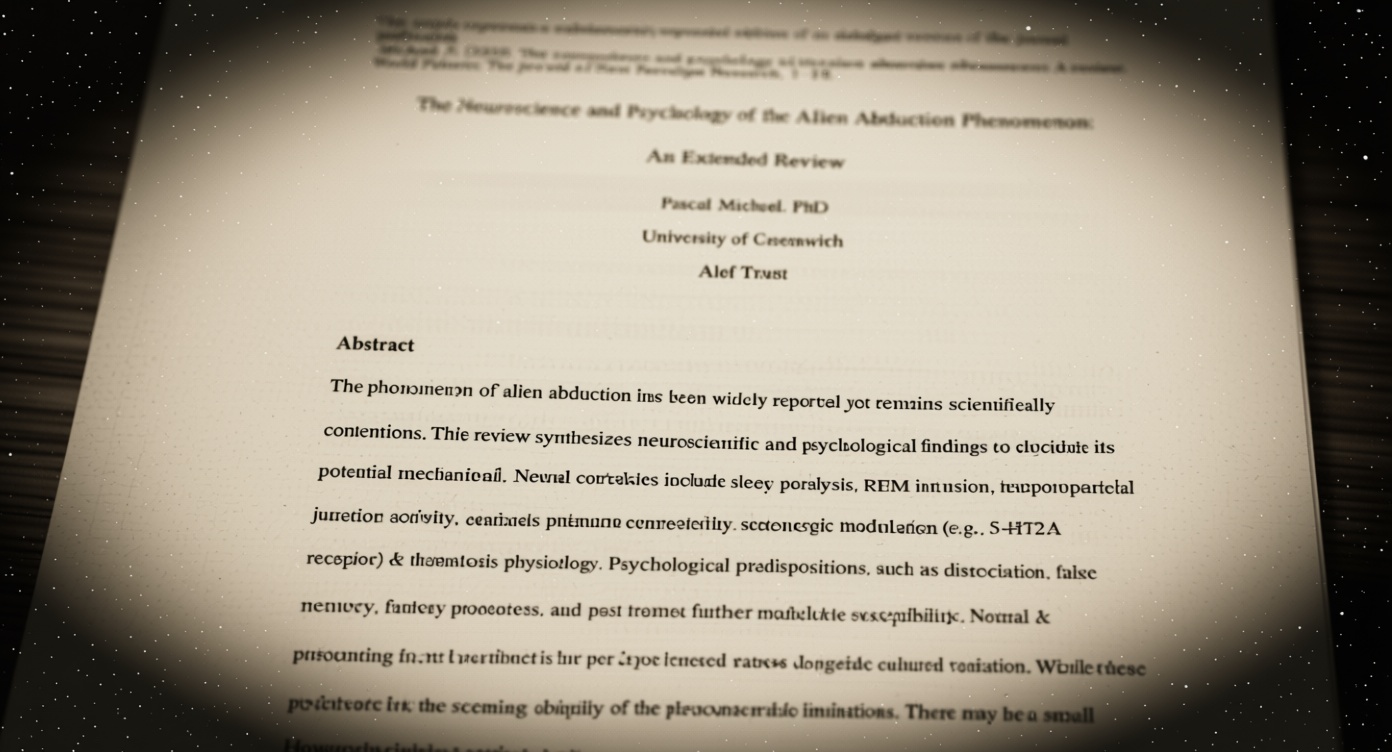
A new 2026 academic review is taking a close scientific look at one of the most controversial claims in anomalous experience research: reported alien abductions. Published in The International Journal of Neuroscience and Psychology? Actually source from Taylor & Francis/Cell? Let's avoid unsupported journal name. The review, titled “The Neuroscience and Psychology of the Alien Abduction Phenomenon: A Review,” synthesizes decades of research to ask not whether abductions are “real” in a literal sense, but what current neuroscience and psychology can explain about why people report them so vividly.
The paper places abduction accounts at the intersection of clinical psychology, cognitive neuroscience, sleep research, and cultural studies, noting that the experiences often involve being removed from an ordinary setting, brought into a craft-like or enclosed environment, and subjected to examinations or procedures by non-human entities. According to the review, these episodes can be deeply disruptive and life-changing, frequently leaving people with confusion, fear, or a lasting sense that reality has been altered. The authors stress that the goal is not to settle the ultimate ontological question, but to identify plausible mechanisms and the limits of what science can currently explain.
Key Neuroscientific Explanations
On the neurobiological side, the review identifies sleep paralysis as one of the strongest candidate explanations. In these episodes, a person may experience awareness while the body remains temporarily immobilized, sometimes accompanied by intense sensations of a presence in the room. The paper also highlights REM dreaming and intrusion, where dream-like imagery and perceptions appear to blend into waking consciousness, potentially producing the “being taken” or “entity encounter” quality often described in abduction narratives.
The review further points to temporoparietal and basal ganglia involvement, along with what it describes as “death feigning” re-activation, as mechanisms that may alter bodily self-perception and threat processing. It also examines how serotonergic changes can dramatically shift a person’s sense of self, the external world, and the perceived presence of “other” beings. Taken together, these models suggest that abduction experiences may emerge when the brain is operating under unusual conditions of sensory ambiguity, arousal, and altered self-representation.
Psychological and Cultural Factors
At a higher level, the review argues that predictive processing offers a useful framework for integrating these findings. Under this model, the brain is constantly making inferences based on prior expectations; when sensory input is unclear and arousal is high, it may generate highly confident interpretations that feel entirely real. In the context of alien abduction reports, those expectations may be shaped not only by biology, but also by learning, cultural narratives, and prior exposure to UFO imagery.
The authors also identify a series of psychological traits that may influence susceptibility and memory formation, including dissociation, fantasy proneness, absorption, suggestibility, memory vulnerability, and past trauma. Importantly, the review does not describe these traits as proof of fabrication. Instead, it suggests they may affect how an experience is encoded, remembered, and narrated over time. That distinction matters, the authors say, because the emotional intensity and personal significance of the memory can be real even when the underlying mechanism is psychological or neurobiological rather than extraterrestrial.
Broader Implications
The review also draws comparisons with psychedelic experiences, especially DMT states, and near-death experiences, where “entity encounters” are similarly common. These parallels, it argues, may point to partially overlapping mechanisms involving consciousness, perception, and meaning-making. At the same time, the authors caution that context matters: abduction experiences often unfold in a different narrative and emotional framework than psychedelic or near-death episodes, and their downstream impact can vary widely.
Ultimately, the review concludes that the most productive path forward is an integrated framework combining neuroscience, psychology, and phenomenological research. It also acknowledges that a minority of cases remain difficult to explain cleanly, underscoring the need for better measurement and prediction in future studies. For researchers of UAP-adjacent phenomena, the paper offers a reminder that the abduction phenomenon may reveal as much about how consciousness constructs reality as it does about what people believe they saw.