Overview
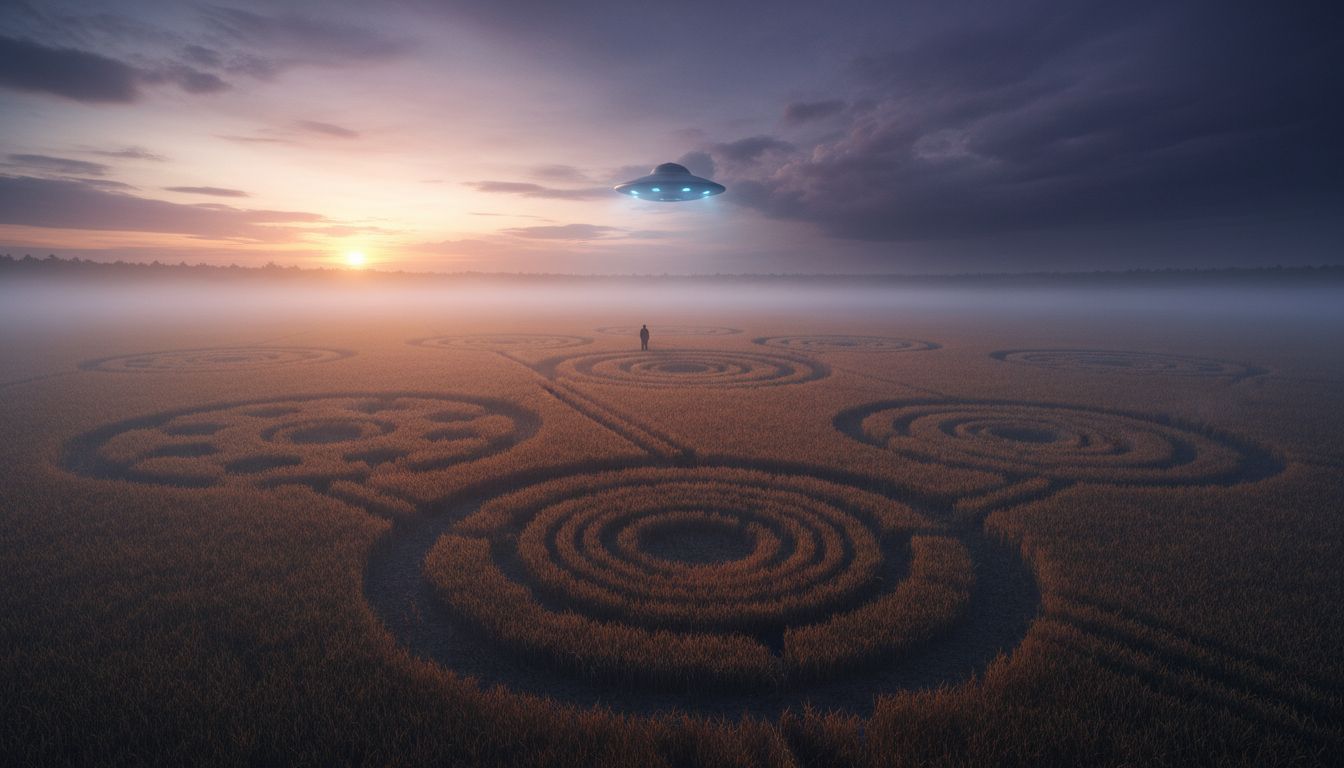
The phenomenon of crop‑circle formations in the British West Country has moved from headline‑making mystery to a largely academic footnote. First reported in the national press in August 1980, the circles—often appearing in wheat, barley and oat fields across Wiltshire and Hampshire—were quickly linked to UFO lore, especially after the British UFO Association (BUFORA) became involved following a spate of sightings near Warminster, a site already infamous for the “Warminster Thing” UFO flap of the 1960s. A 1986 BUFORA report titled Mystery of the Circles, compiled by Paul Fuller and written by noted ufologist Jenny Randles, traced the rise of public fascination and documented the subsequent decline in serious UFO‑community interest.
Early History and the UFO Connection
According to Randles, “persistent local rumors” of strange markings in the West Country date back at least four decades before the 1980 media burst, suggesting a long‑standing folklore of unexplained ground patterns. The 1980s, however, marked a turning point: the appearance of intricate designs during the growing season—from May through August—for six consecutive years captured the imagination of both the press and the UFO‑research community. BUFORA’s involvement was spurred by the proximity of these circles to Warminster, where earlier UFO reports had created a “definite hype” that encouraged the interpretation of the circles as “ground traces left by a landing, or hovering, spacecraft.”
The association of mysterious ground patterns with extraterrestrials was not unique to Britain. In 1966, similar phenomena—dubbed “Tulley nests” or “saucer nests”—were reported in the wetlands near Tully, Queensland, Australia. Although those formations consisted of swirled reeds and swamp grass rather than cultivated crops, contemporary Australian press coverage linked them to flying‑saucer sightings, indicating that the cultural link between circular ground markings and UFOs predates the British craze.
The Rise of Skepticism
The initial wave of enthusiasm began to wane as investigators uncovered evidence of human involvement. By the mid‑1980s, a growing number of researchers demonstrated that many circles could be reproduced with simple tools such as planks, ropes, and garden rollers. The BUFORA report highlighted these findings, noting that the increasingly complex designs often coincided with the emergence of hoax‑making groups who publicised their methods in magazines and later on television.
Jenny Randles herself emphasized that “the credibility of the phenomenon suffered once the community could point to reproducible techniques.” Academic studies of the period also identified natural explanations—such as wind‑blown patterns, fungal growths, and animal activity—that could account for simpler formations. As the scientific and skeptical explanations gained traction, mainstream media coverage declined, and the topic slipped from the agenda of major UFO conferences.
Current Status of Crop‑Circle Activity
Despite the loss of mainstream fascination, crop‑circle formations continue to appear each summer across the United Kingdom. Recent sightings are typically reported on dedicated forums and social‑media groups, where enthusiasts share photographs and coordinate field visits. However, the “mystique” that once surrounded them has largely diminished; most observers now treat new circles as either artistic installations or deliberate hoaxes rather than evidence of extraterrestrial visitation.
A 2024 survey of British ufologists conducted by the International UFO Research Network found that fewer than 5 % of respondents still consider crop‑circle research a priority area, compared with 38 % in the early 1990s. The same poll indicated that the majority now view the phenomenon through the lens of cultural folklore and media influence rather than as a legitimate investigative frontier.
Context and Outlook
The trajectory of the British crop‑circle mystery mirrors broader patterns in UFO research, where initial public excitement often gives way to rigorous scrutiny and, ultimately, a re‑evaluation of significance. While the early 1980s surge illustrated how local folklore can be amplified by contemporary UFO narratives, the subsequent decline underscores the importance of methodological transparency and reproducibility in the field.
As the phenomenon persists in a reduced, largely recreational form, its legacy remains a cautionary tale for researchers: extraordinary claims demand extraordinary evidence, and the allure of the unknown can quickly be tempered by systematic inquiry. For now, the fields of Wiltshire and Hampshire continue to host intricate patterns each harvest, but the conversation has shifted from “what do they mean?” to “who is creating them and why?”