Reported Observation
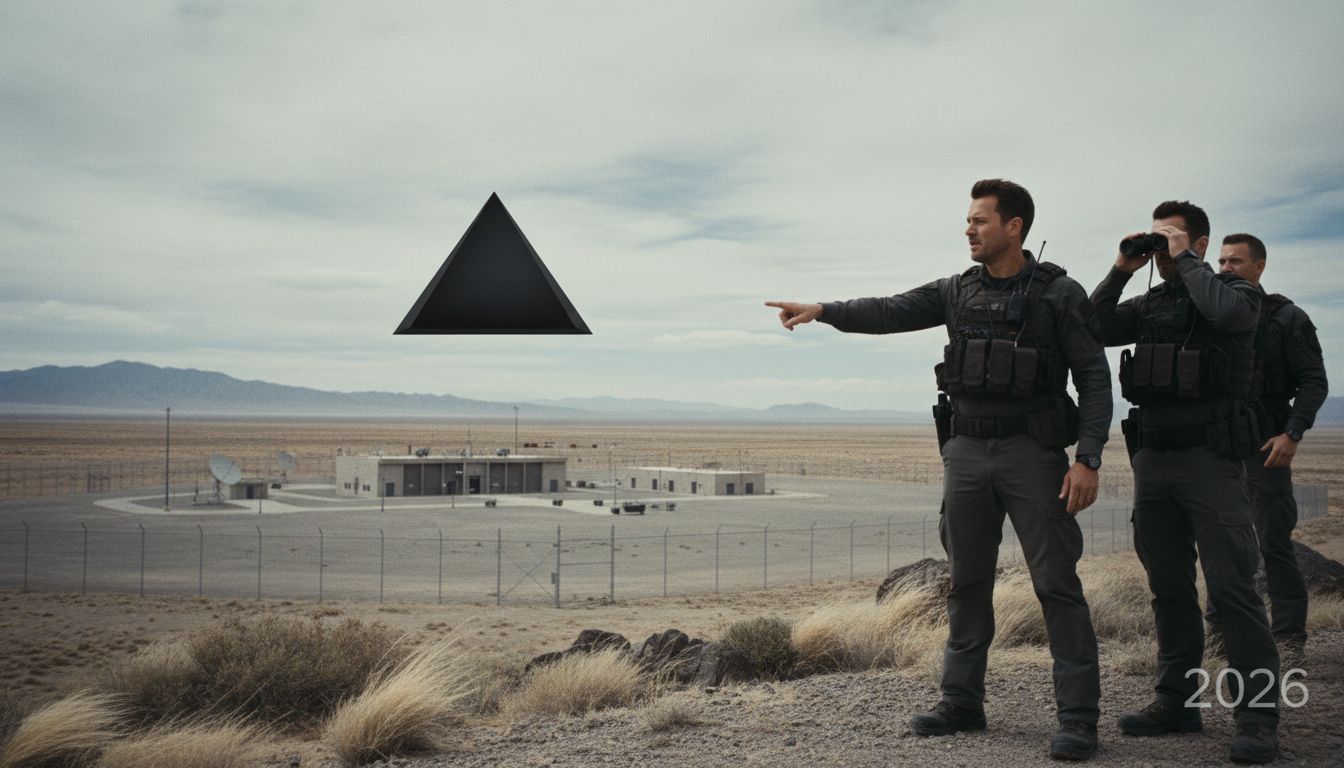
Three federal agents reportedly observed a matte-black, triangular object near a secure U.S. facility in 2026, according to an Axios report dated Oct. 23. The account describes an object estimated to be approximately 15 feet wide that rose about 300 feet above a ridgeline, hovered for roughly 20 seconds, and then traveled an estimated 1.5 miles in three seconds.
The reported movement would correspond to an average speed of about 1,800 miles per hour, assuming the distance and timing estimates were accurate. The object was also described as moving without an audible sound. Those details, if corroborated, would distinguish the incident from a conventional aircraft, drone or other known object—but the available material does not establish what the object was or whether the estimates were based on instruments, visual judgment or later reconstruction.
Thermal-Imaging Detail
A central detail in the account is that one of the agents reportedly used a thermal monocular while observing the object. Thermal monoculars detect infrared radiation rather than visible light, allowing users to identify heat signatures in darkness or reduced-visibility conditions. Their use can provide additional information beyond a naked-eye observation, but thermal imagery is not automatically conclusive.
Infrared devices can record apparent shapes and temperature contrasts influenced by distance, atmospheric conditions, background terrain and the characteristics of the sensor itself. A thermal image may help investigators determine whether an object produced a detectable heat signature, but it does not, by itself, identify an object’s construction, propulsion system or origin. The report, as summarized, does not provide imagery, sensor specifications, calibration data or an analysis by an independent technical expert.
What the Account Does—and Does Not—Show
The reported testimony is notable because it allegedly involved three federal agents observing the same event near a sensitive government location. Multiple witnesses can help investigators compare timelines, viewing angles and descriptions. However, shared observation alone does not resolve questions about distance, size or speed. Those measurements can be difficult to estimate without synchronized video, radar data, known reference points or other records.
The summary does not identify the facility, the agents, the object’s exact altitude or the direction of travel. It also does not state whether the incident was reported through an official government channel, reviewed by a law-enforcement or intelligence body, or matched with air-traffic, radar or satellite data. Such information would be important in assessing the reliability of the account and determining whether the object could have been a drone, aircraft, balloon, optical phenomenon or another known technology.
Broader UAP Context
Reports involving unusual objects near government facilities have attracted heightened attention in recent years, particularly as federal agencies have sought to standardize the collection and review of unidentified anomalous phenomena, or UAP, reports. The term describes observations that remain unidentified after initial review; it does not imply extraterrestrial activity.
At present, the incident should be treated as an unverified report, rather than evidence of a new aircraft or unexplained technology. Axios’ article was the cited source for the account, but the source page was unavailable in the provided material because it displayed a security-verification screen. No direct quotations, supporting documents or independent corroboration were available for review. Further assessment would depend on the release of witness statements, thermal footage, flight-tracking information and other contemporaneous records.