Overview
A black-and-white image circulating in UFO-history circles shows a large, irregular chunk of metal resting on the ground—the kind of stark visual that has long fueled speculation around one of Canada’s more intriguing mid-century aerial mysteries. Shared under the banner of #ufotwitter and #ufohistory, the post recalls a 1960 incident over Quebec in which witnesses reportedly saw a fiery object in the sky that later split into pieces after a sonic boom. The event, often referenced as “Ottawa’s Mystery Metal,” remains part of the broader archive of unsolved aerial reports that continue to attract attention decades later.
What the Historical Account Says
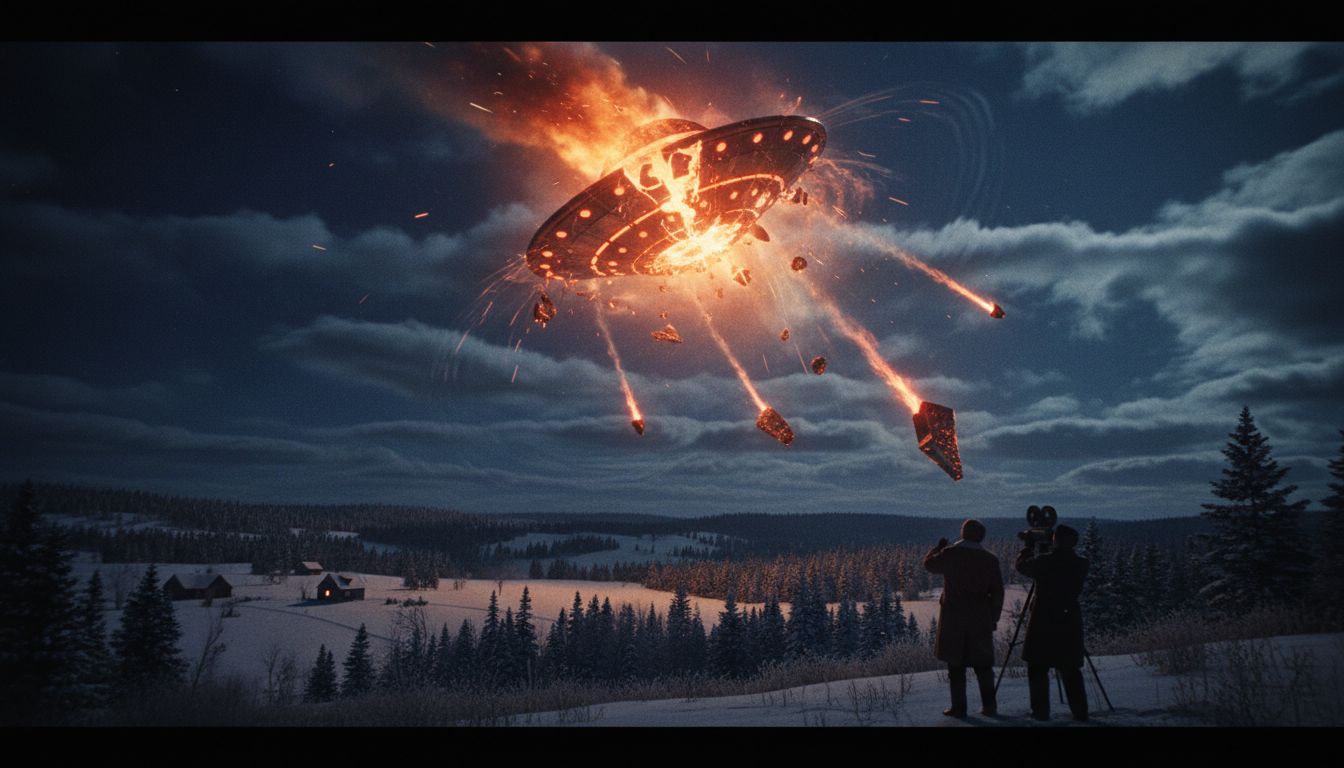
According to the recap attached to the post, the sighting took place in 1960, when observers in the Quebec-Ottawa region reported a luminous object moving overhead before a loud sonic boom shattered the calm. In the aftermath, accounts described the object as breaking apart, with fragments falling to the ground. The metal shown in the photograph is presented as part of that story—an artifact that, if authentic, could have represented debris from the event. But like many early UFO-era cases, the historical record is murky, and the available material does not settle the question of what the object actually was.
The phrase “mystery metal” underscores the central tension in the case: a tangible object exists in the narrative, yet its origin remains unresolved. In UFO research, physical debris often carries outsized significance because it appears to promise something more concrete than eyewitness testimony alone. Still, without a verified chain of custody, laboratory analysis, or contemporaneous official documentation, such finds can be difficult to interpret. The photo itself offers only limited clues—just the metal object and no immediate context for where, when, or by whom it was recovered.
Why the Incident Still Resonates
What keeps incidents like this alive in public memory is not just the possibility of an unexplained craft, but the broader atmosphere of the Cold War era, when skies were filled with aircraft tests, experimental technology, meteor sightings, and rising public concern about objects moving at high speed. A sonic boom could point to a jet or other aircraft, while a fiery descent might suggest a meteor or space debris. Yet for researchers and enthusiasts, the fact that witnesses linked the event to a dramatic breakup in the sky is precisely what makes it compelling.
The post’s framing also reflects how UFO history is now shared online: through archival images, short summaries, and community hashtags that invite collective memory and debate. In that sense, Ottawa’s Mystery Metal is less a closed case than an example of how older sightings continue to circulate in digital spaces, where fragments of evidence are re-examined through a modern lens.
The Larger Context
Even without a definitive answer, the incident fits a familiar pattern in UAP history: a striking aerial event, physical debris, and lingering uncertainty. That combination has kept generations of observers engaged, whether they approach the case as a mystery, a misidentification, or a piece of forgotten aerospace history. For now, the photograph remains a relic of that uncertainty—an object on the ground that invites questions the historical record has yet to resolve.
In the end, the 1960 Quebec account endures because it sits at the intersection of eyewitness drama and material evidence, two elements that make UFO cases especially durable. More than six decades later, Ottawa’s Mystery Metal continues to serve as a reminder that not every anomalous sighting is easily explained, and not every piece of debris yields its story on first inspection.