Overview
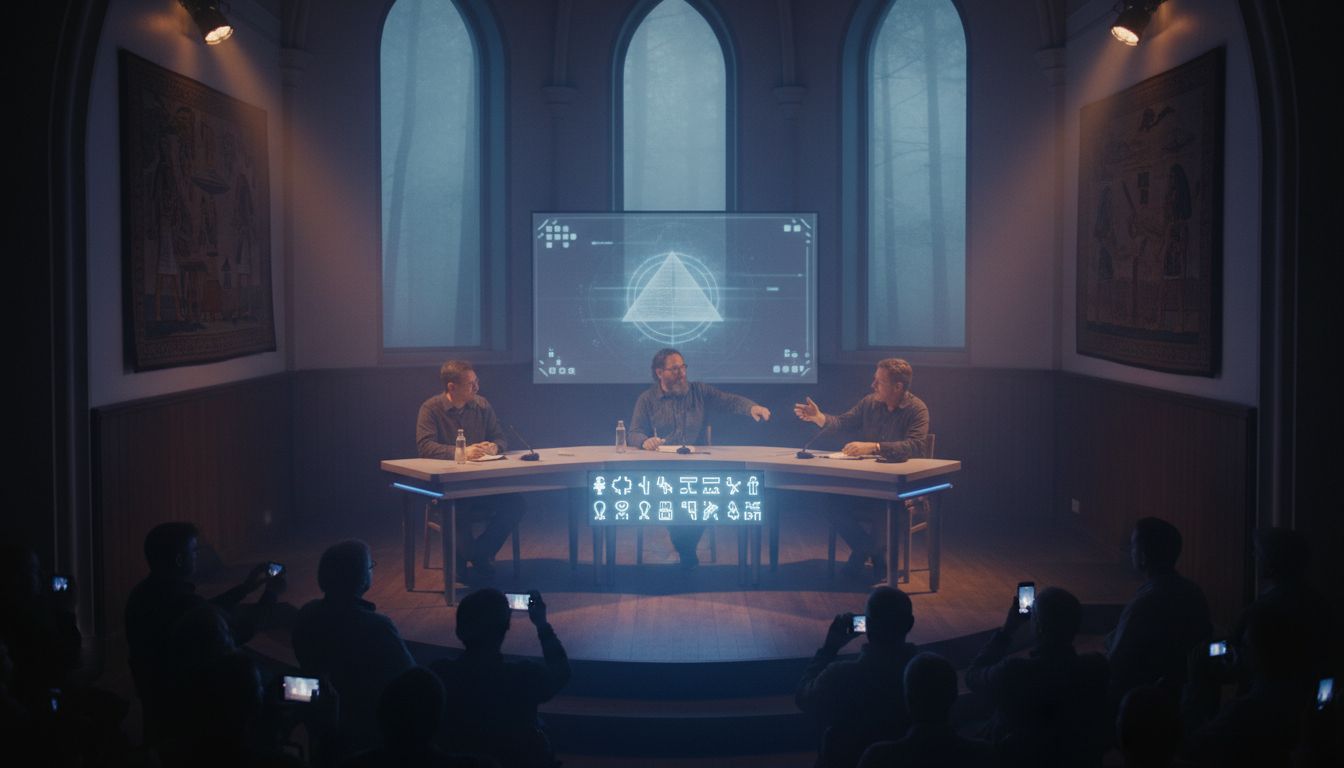
In a recent episode of Connecting the Universe, host Mike Ricksecker and researcher Gary Osborn revisited one of the more unusual intersections in UFO and ancient mystery circles: the 1980 Rendlesham Forest incident and the geometry of Egypt’s Giza Plateau. The discussion centered on Osborn’s presentation, The Giza Coordinates Deciphered from the Rendlesham Binary Code: The Giza Diagonal Part Two, which argues that a message allegedly received during the Rendlesham case contains encoded references to the Great Pyramid complex and its alignment to broader astronomical cycles.
Osborn, author of The Rendlesham Enigma, used the program to advance a set of highly specific mathematical and symbolic claims about what he calls the “Giza Diagonal”—an abstract line linking the subsidiary pyramids G3-a and G1-a. His thesis is that the Giza plateau was deliberately designed with a level of precision and cross-referencing that suggests, in his view, an “advanced intelligence” behind the architecture. The show framed these ideas as part of a broader pattern seen in fringe research communities that connect pyramids, star lore, and UFO-related narratives.
The Giza Alignment Claims
A major part of the presentation focused on geographic alignments at Giza. Osborn cited the work of Egyptologists Mark Lehner and Hans Goerdic, saying their earlier observations about a Heliopolis alignment were close but incomplete. He argued that a line running from the southeast corner of pyramid G2 to the southeast corner of G1 points precisely to the ancient obelisk at Heliopolis. He also highlighted a second claim: that the distance from G3 to G1 measures 930 meters, while the span from G2 to G1 measures 930 royal cubits, which he interpreted as evidence of deliberate dual measurement in both modern and ancient units.
The discussion also presented the Giza layout as a kind of “precessional clock.” Osborn said the movement of Al-Nitak, the first star in Orion’s Belt, maps onto dates such as 10,460 BC and 2,500 AD, which he described as markers for the Age of Leo and the Age of Aquarius. He further claimed that shadows cast by the pyramids on the Winter Solstice align with this diagonal, reinforcing his argument that the site encodes astronomical time rather than serving only as a burial complex.
The Sphinx, Symbolism, and Rendlesham
Another key element of the video involved the Sphinx, which Osborn identified with the lioness goddess Mehit rather than the more familiar interpretive frameworks often used in mainstream Egyptology. He said a line passing through the Sphinx’s right eye, associated in his presentation with the “Eye of Ra,” bisects the Giza Diagonal into two equal sections of 1,080 royal cubits. He also linked that geometry to the Galactic Center and to the 10th Tarot card, The Wheel of Fortune, reflecting the symbolic and esoteric dimensions of his argument.
The Rendlesham portion of the discussion drew from the binary code reportedly associated with Jim Penniston, the former U.S. Air Force staff sergeant at the center of the incident. Osborn connected the alleged 360-yard reference in the code to the 360th day of the year, which he tied to December 25 or 26, the period when the encounter began in 1980. He also said the span between the incident and the completion of his book in June 2019 equals 14,040 days, a number he derives by combining other Giza-related measurements.
Broader Context
As presented in the video, Osborn’s conclusion is that the Giza complex functioned as a warning system or time capsule, built to preserve knowledge about cyclical global catastrophe and precessional change. The claims sit firmly within the speculative end of UFO and ancient-mystery research, where mathematical patterning, sacred geometry, and alleged extraterrestrial contact are often interwoven. While the discussion offered an ambitious synthesis of Egyptian archaeology, astronomy, and the Rendlesham case, the arguments remain interpretive and are not part of mainstream historical or scientific consensus.
Still, the episode illustrates why the Rendlesham incident continues to resonate beyond UFO studies: it remains a cultural touchstone that researchers like Osborn use to explore much older questions about monuments, cosmic cycles, and whether ancient sites may conceal information intended for future generations.