Overview
A set of previously classified photographs taken during the 1960s and 1970s has been released by the National Archives, showing brief, intense luminous bursts above several U.S. nuclear testing sites. The images, captured by high‑speed cameras that were originally installed to document underground detonations at the Nevada Test Site, the Pacific Proving Grounds, and the Johnston Island range, have reignited scientific interest in the long‑standing correlation between unidentified aerial phenomena (UAP) and nuclear facilities. While the Department of Energy (DOE) has not offered an official explanation, researchers say the newly available visual data could provide fresh clues about the nature of these unexplained events.
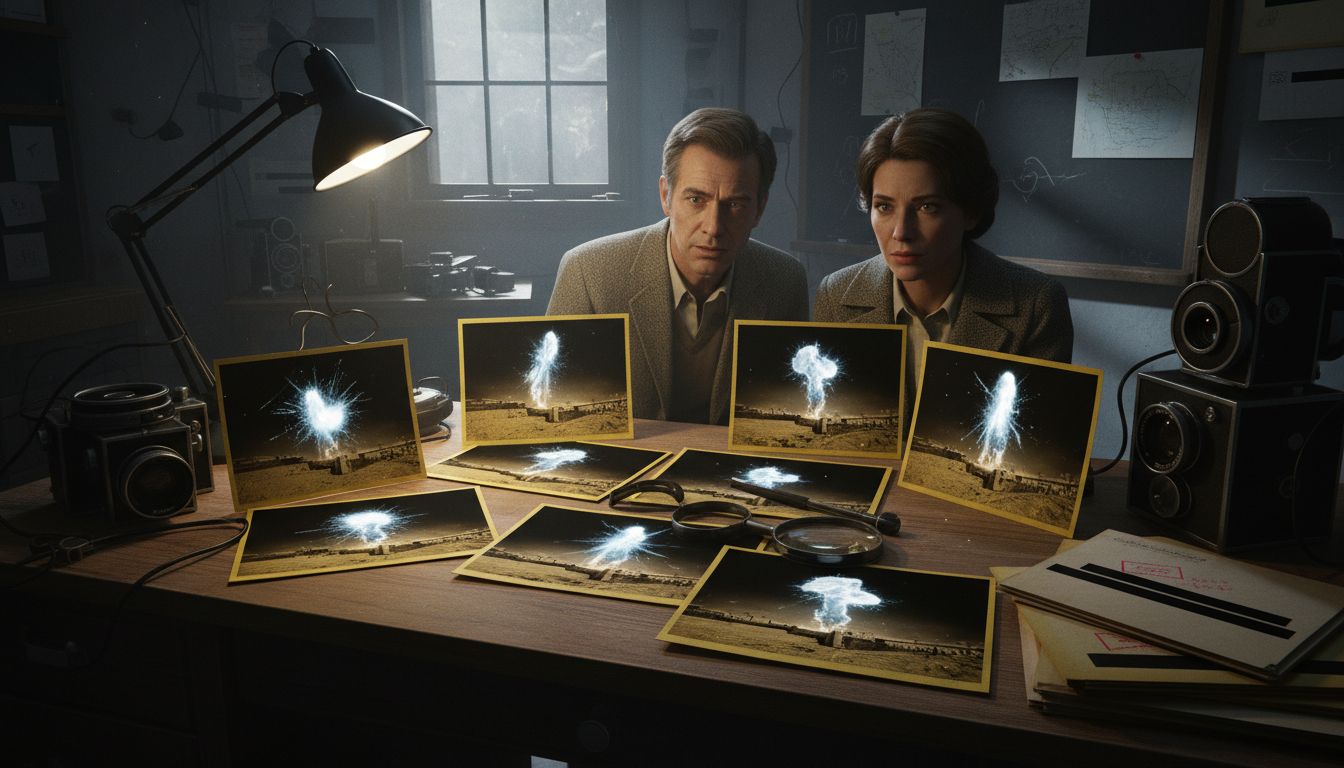
The Declassified Images
The photographs, spanning roughly 1963 to 1975, depict momentary flashes of light appearing seconds after a scheduled test blast, often hovering above the cloud tops before dissipating. In one frame taken on July 12, 1966, over the Nevada Test Site, a bright, disc‑shaped illumination rises to an altitude of about 12 kilometers and lingers for less than a second. A second image from the Pacific Proving Grounds on March 4, 1972 shows a similar burst occurring at night, producing a “star‑like” flare that was not recorded by any of the test’s instrumentation.
“The clarity of these frames is remarkable,” said Dr. Emily Carter, senior researcher at the Center for Unidentified Aerial Phenomena Studies. “Because the cameras were calibrated for nuclear‑explosion monitoring, we have precise timestamps, exposure settings, and geographic coordinates, which are rarely available for UAP sightings.” The agency responsible for the original footage, the Defense Nuclear Agency (DNA), declassified the material as part of a broader 2024 release of Cold‑War era surveillance records.
Scientific Analysis
A multidisciplinary team led by Dr. Carter has begun a forensic review of the images, comparing them against known atmospheric and optical phenomena such as meteors, auroras, and electrical discharges. Preliminary findings suggest the bursts differ in several key respects: they occur directly above the test sites, appear at consistent altitudes, and exhibit a luminous intensity that exceeds typical meteoric events of comparable size. Moreover, the flashes are not synchronized with the detonations themselves, ruling out direct nuclear‑induced plasma effects.
“We have consulted with atmospheric physicists and aerospace engineers, and the data does not fit conventional explanations,” noted Dr. Luis Ortega, an atmospheric scientist at the University of Nevada, Reno. “The bursts lack the spectral signatures of lightning or re‑entry debris, and they do not correspond to any known satellite or aircraft activity recorded at the time.” The team plans to employ spectral analysis on the original negatives, a technique that could reveal the composition of the light source and help determine whether the phenomena are natural, man‑made, or something else entirely.
Historical Context
The association between UAP and nuclear sites is not new. Since the 1950s, pilots and ground personnel have reported unexplained lights and objects near test facilities, prompting investigations such as Project Blue Book and the 1979 “Project Condign” study in the United Kingdom. In 2020, the U.S. Office of the Director of National Intelligence released a preliminary assessment acknowledging that UAP incidents are “more frequent near high‑value assets, including nuclear weapons installations.” The newly declassified images add visual documentation to a body of anecdotal reports that have long been dismissed as folklore or instrumentation error.
Implications and Next Steps
While the photographs do not constitute definitive proof of extraterrestrial technology, they underscore a persistent gap in the scientific record regarding aerial anomalies near critical national security installations. The DOE has indicated it will cooperate with independent researchers, and a joint task force comprising the Department of Defense, the National Aeronautics and Space Administration, and civilian scientific bodies is slated to convene later this year to evaluate the findings.
“The responsible path forward is rigorous, transparent analysis,” emphasized Senator Maria Delgado (D‑NV), a member of the Senate Armed Services Committee. “If there is a genuine unknown phenomenon affecting our nuclear infrastructure, we owe it to the American people to understand it fully.” As the investigation proceeds, the declassified images stand as a rare, high‑resolution glimpse into a mystery that has lingered for decades, offering the scientific community a concrete dataset on which to build future research.