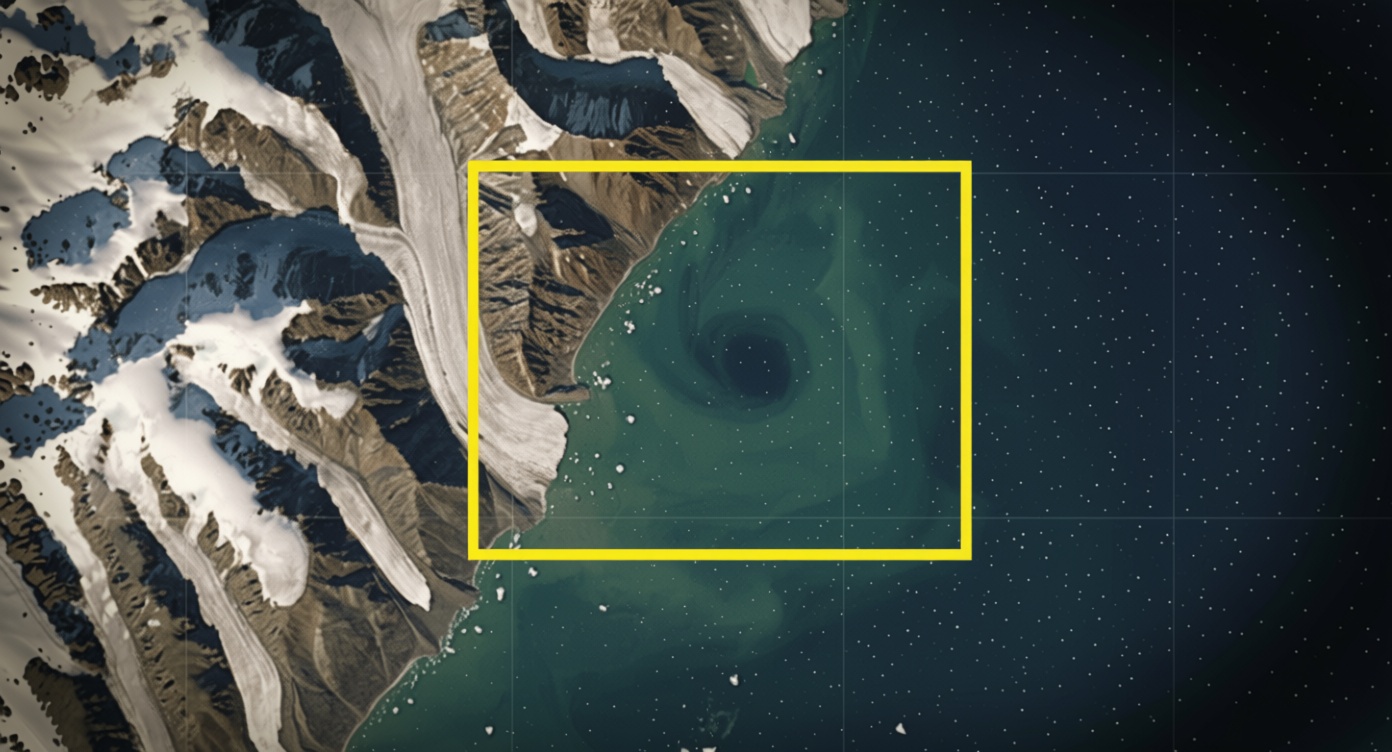
Reported Discovery
A UFO researcher has drawn attention to an alleged one-kilometer-long tunnel or structure in the Canadian Arctic, suggesting that it could be connected to a concealed underground extraterrestrial base. The claim was circulated in a Reddit post and discussed in material published by the website World Gone Mad on October 28, 2026. The report identifies UFO researcher Scott Waring as the source of the interpretation, but provides no independent confirmation of the formation’s location, dimensions or origin.
Waring’s video, titled “1KM Tunnel Entrance To Underground Alien Base Found In Canada,” presents the feature as an unusual formation in a remote, frozen environment. According to the report, the apparent structure may represent an entrance or passage extending beneath the Arctic surface. Waring has speculated that it could have been constructed by an unknown intelligence and might lead to a much larger underground facility. However, the available material does not establish that the feature is artificial, much less extraterrestrial.
Evidence and Unanswered Questions
The Canadian Arctic’s extensive ice fields, rugged islands and isolated terrain make on-site investigation difficult. Satellite imagery and video can reveal apparently regular shapes or shadows, but they may not provide enough information to determine whether a feature is a tunnel, a natural geological formation, an ice crevasse or an artifact of image processing. No coordinates, survey data, geological analysis or independent expert assessment were included in the source material.
The report also does not identify a Canadian government agency, scientific institution or Arctic researcher that has examined the alleged site. Nor does it present evidence of an entrance, interior passage or technological activity. As a result, the proposed connection to an alien base remains speculation rather than a verified finding. Establishing the structure’s nature would require precise location data, high-resolution imagery and an assessment by specialists familiar with Arctic geology and remote sensing.
Online Reactions
The footage prompted mixed responses from viewers. One commenter requested GPS coordinates so the location could be checked independently and shown to others. Another described the feature as a remarkable discovery, while a viewer identifying as Canadian thanked Waring for sharing it. Other reactions were more skeptical, with at least one commenter suggesting that the video might be satire.
Those differing responses reflect the broader challenge of evaluating extraordinary claims online. Images of remote landscapes can generate compelling narratives, particularly when the terrain is difficult for the public to access. But visual interest is not evidence of extraterrestrial activity, and the absence of verifiable information makes it impossible to draw firm conclusions from the report alone.
What Investigation Would Require
The source proposes deploying a robotic exploration vehicle capable of operating in severe Arctic conditions. Such a mission could potentially use cameras, mapping instruments and geological sensors to determine whether the feature continues underground and whether it has natural or artificial characteristics. Before any expedition, researchers would need to establish the site’s exact coordinates, secure appropriate permissions and assess environmental and logistical risks.
For now, the reported Arctic tunnel is best characterized as an unverified anomalous formation. Further investigation could clarify its scale, composition and origin, but the material currently available does not demonstrate that it is an entrance to an underground complex or evidence of extraterrestrial presence. Claims about hidden bases should therefore be treated cautiously until supported by independently reproducible observations.