Overview
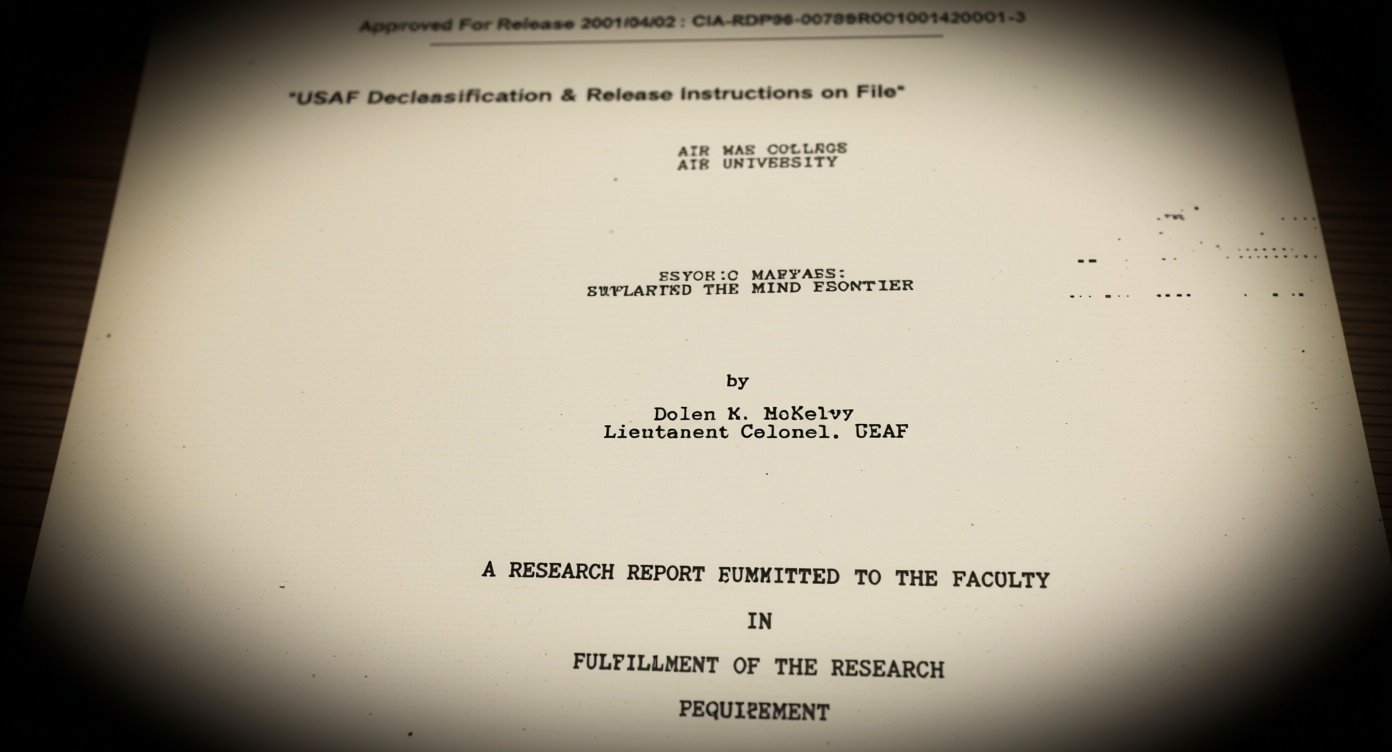
A declassified 1988 Air War College report titled Psychic Warfare: A Military Frontier has resurfaced in online discussions, drawing renewed attention to a little-known corner of Cold War-era defense thinking: whether extrasensory perception (ESP), remote viewing, and psychokinesis could have practical military value. The document, now circulating widely in #ufotwitter and fringe-science communities, is being shared less as proof of paranormal capability than as a reminder that portions of the U.S. national security establishment once seriously entertained the possibility of using such phenomena for intelligence and operational advantage.
What the Report Discussed
According to the summary associated with the declassified paper, the Air War College explored whether psychic phenomena could be applied in military contexts such as intelligence gathering, target acquisition, communications, and even weapons-related research. The report’s framing is notable: it did not treat these topics as mere science fiction, but as questions worth examining in the context of strategic competition. That mindset reflected a broader Cold War environment in which U.S. defense planners were often willing to investigate unconventional technologies and methods if they appeared to offer an edge over adversaries.
The report’s language places it squarely within a period when the Pentagon and intelligence agencies were also monitoring Soviet interest in parapsychology. For historians of intelligence, that context matters. The document does not establish that psychic abilities are real or deployable; rather, it shows that military institutions sometimes studied even highly speculative ideas when they believed foreign rivals might be doing the same.
Why It Matters Now
The renewed attention to the report is being fueled by online communities that track UAP, government secrecy, and fringe scientific claims. In those spaces, the document has taken on symbolic significance as evidence that the U.S. government has periodically explored subjects far outside conventional defense science. That has made the Air War College paper a talking point in larger debates about how much of the national security apparatus has historically engaged with topics once considered taboo or unserious.
Still, it is important to separate documented government curiosity from verified capability. A declassified report showing that officials studied remote viewing or psychokinesis does not mean those programs produced reliable results. The historical record of U.S. parapsychology-related research is mixed at best, and many such efforts were later criticized for weak methodology, inconsistent outcomes, and limited practical value.
Historical Context
The 1988 report emerged near the end of the Cold War, when the U.S. military was still heavily focused on asymmetric threats and technological surprise. In that atmosphere, exploratory work on subjects like psychic warfare was not entirely out of step with broader defense experimentation. Intelligence agencies had long shown interest in unconventional methods, including behavioral science, deception detection, and human performance enhancement. Psychic research, though far more controversial, was part of that same culture of inquiry at the margins.
What makes the report compelling today is not that it proves anything paranormal, but that it offers a declassified glimpse into how seriously some defense thinkers were willing to ask unusual questions. For researchers of UAP and government secrecy, that makes it another data point in a larger pattern: official interest in the strange has often been wider than the public assumes. The challenge, as always, is distinguishing between institutional curiosity, operational experimentation, and claims that can actually withstand scrutiny.