Overview
Unidentified submerged objects (USOs) are drawing renewed attention through Sky HISTORY’s series Bradley Walsh: Out of This World, which examines reports of unexplained phenomena beneath the ocean or emerging from it. The subject expands the familiar UFO discussion beyond the atmosphere, focusing instead on a largely inaccessible environment that covers more than 70% of Earth’s surface.
The network’s accompanying article, written by Craig Lenaghan, presents USOs as part of the wider history of unexplained sightings, while acknowledging that the available material does not establish that any reported object is extraterrestrial. Its central question is whether some mysteries traditionally associated with the skies might be better understood by looking toward the sea.
What is a USO?
The acronym USO stands for “unidentified submerged object.” In the article’s description, the term refers to an unexplained phenomenon detected underwater, in the sea, or apparently emerging from it. It is therefore used as an aquatic counterpart to UFO, or unidentified flying object.
That label does not, by itself, identify the nature or origin of an observation. As with UFO reports, an unexplained sighting may ultimately have a conventional explanation. The article notes that apparent USOs could include marine life such as fish, sharks or whales, particularly when observations are made at a distance, under poor conditions or with limited instrumentation. In other cases, objects may be connected to vessels, underwater equipment, atmospheric effects or misinterpretations of natural events.
Why the ocean remains mysterious
The ocean’s scale and relative inaccessibility provide a compelling backdrop for USO claims. The source material states that less than a third of the global seafloor had been mapped as of 2026, leaving extensive areas that are difficult to observe directly. That lack of visibility can create uncertainty, but it also limits the ability of investigators to verify extraordinary reports.
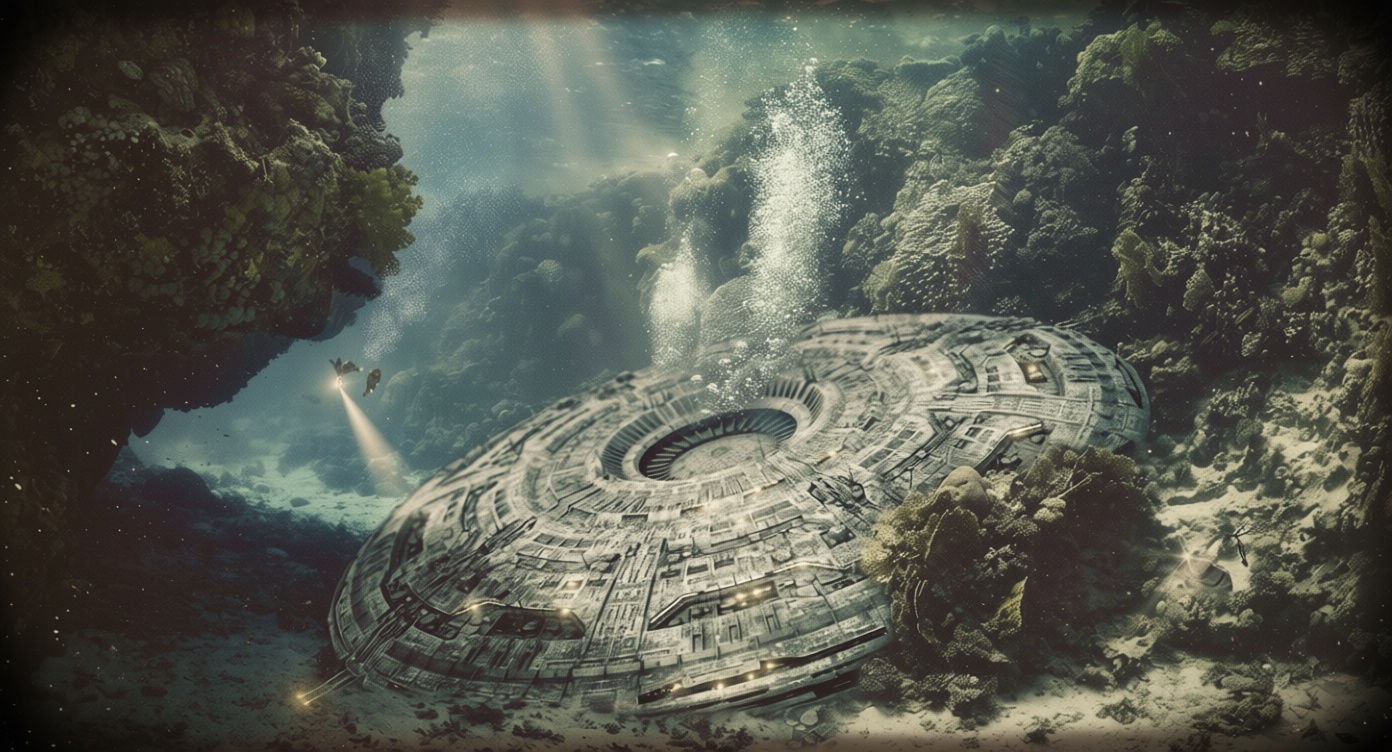
Some speculation goes further, suggesting that unknown marine species—or even extraterrestrial visitors—could be concealed beneath the waves. The article refers to the possibility of permanent underwater alien bases as a particularly dramatic theory. However, these ideas remain conjectural in the supplied material, and no supporting evidence is presented.
Historical reports and modern cases
The article frames USOs within a long history of unexplained maritime observations, referencing Christopher Columbus’s reported mystery light as well as the modern “Tic Tac” incident. The latter is commonly associated with U.S. Navy personnel who reported observing an unusual object during training exercises off the coast of California in 2004. Although the event is often discussed in UFO and UAP debates, the material provided here offers no additional case details or verified explanation.
It also mentions a roughly three-mile-wide formation on the seabed near California’s Malibu coast that attracted speculation because of its apparently artificial appearance. The supplied text ends before explaining the formation or presenting evidence about it, making it impossible to assess the claim from the available source alone.
Evidence versus speculation
Sky HISTORY’s presentation places USOs within popular culture and the continuing investigation of unexplained phenomena, but an unidentified observation is not proof of extraterrestrial activity. Establishing what lies beneath the water requires reliable sensor data, precise locations, independent witnesses and repeatable analysis—standards that can be difficult to meet in the marine environment.
For now, USOs remain a category for unresolved reports rather than a confirmed class of object. Out of This World is likely to bring public attention to those accounts, while the broader question—whether they represent misunderstood natural events, human technology or something genuinely unknown—remains open.