Overview
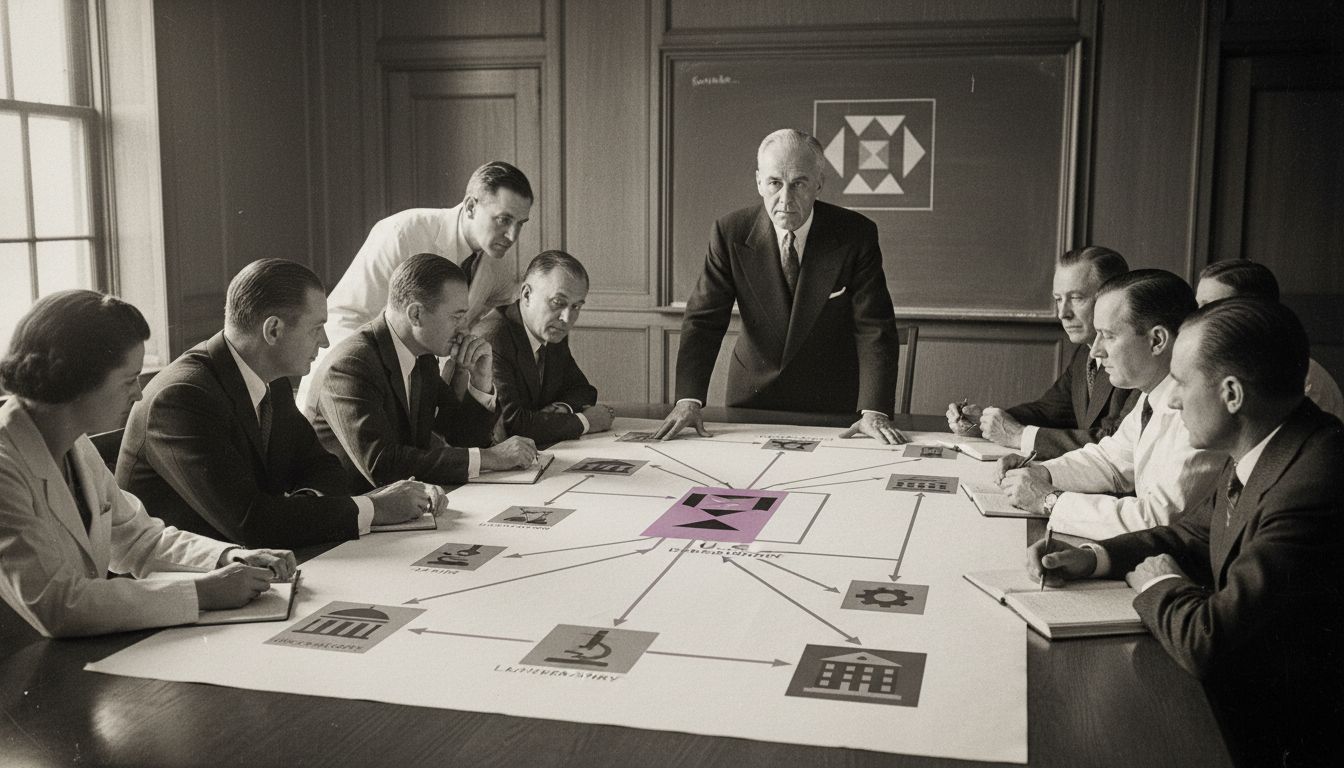
Vannevar Bush’s importance to the history of American science rests less on laboratory discoveries than on his ability to organize complex research at national scale. As the National Park Service explains, Bush headed the Office of Scientific Research and Development (OSRD) during World War II, administering scientific work connected to the U.S. war effort. His role placed him at the center of a system that linked federal agencies, universities, government laboratories and private industry.
That organizational model is central to the 1933 Magenta narrative, a UFO-related account that has been discussed in connection with claims of an alleged early retrieval of an unusual aircraft. The narrative itself remains contested, and the available evidence does not establish that the event occurred as described. Its relevance to Bush comes from a later claim that the scientist was positioned to oversee highly sensitive research because of his wartime responsibilities and extensive connections across the U.S. scientific establishment.
Bush’s Wartime Architecture
The official National Park Service profile presents Bush as a senior administrator who coordinated scientific work rather than as an isolated technical specialist. Through OSRD, research programs could be distributed among academic institutions, military facilities and commercial contractors while remaining connected to federal decision-makers. That structure became one of the defining features of the wartime research system and helped support projects involving radar, weapons development and other strategically important technologies.
Bush’s prominence also explains why his name appears in later accounts of alleged secret saucer investigations. A person with authority over multiple research networks could, in theory, have served as a coordinator or gatekeeper for classified technical work. That institutional plausibility, however, is not evidence that he directed research into extraterrestrial craft. It only establishes why later writers and witnesses may have considered him a credible figure in such a story.
The 1950 Canadian Memo
A key document cited in the discussion is a 1950 Canadian memorandum associated with Wilbert Smith, a Canadian government engineer who investigated reports of unidentified aerial phenomena. According to the account summarized in the post, the memo identified Bush as the head of a U.S. group conducting “saucer” research. The claim has attracted attention because it predates many later public narratives and appears to connect a named senior American official with a classified investigation.
The chain of transmission is crucial. Smith reportedly received the information through intermediaries rather than directly from Bush or from a publicly identified U.S. program. That makes the memo evidence of what Smith was told, not independent confirmation that such a group existed or that Bush led it. The distinction is particularly important when a document contains claims about compartmentalized or classified activities that cannot be checked against ordinary records.
Evidence and Limitations
Later testimony has sometimes been cited in support of the Bush connection, but the available account does not independently verify the central allegation. No corroborating official record is identified here showing that Bush headed a saucer-research organization, and the National Park Service material documents his role in wartime scientific administration—not UFO investigations.
The strongest defensible conclusion is therefore limited: Bush had the stature, access and organizational reach that would have made him a plausible name in reports of secret research, but plausibility is not proof. The 1950 memo remains a historical lead requiring corroboration, while the 1933 Magenta narrative should be treated as an unresolved claim rather than an established episode. This distinction preserves both the significance of Bush’s documented career and the evidentiary standards necessary when assessing allegations of hidden UAP programs.