Overview
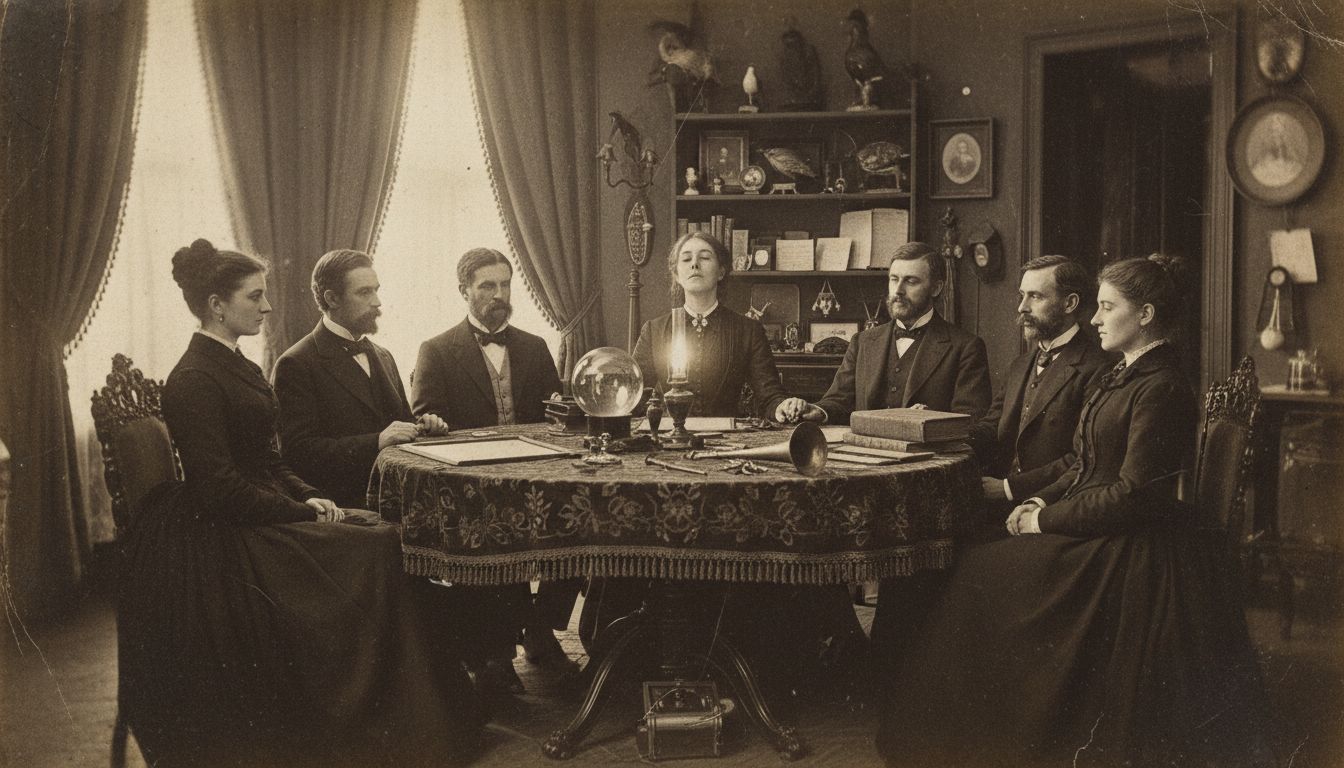
Long before artificial intelligence offered “deathbots” that can reproduce a deceased person’s voice, Victorian Britain developed its own commercial responses to the desire to communicate with the dead. Spiritualism, which expanded rapidly during the 19th century, transformed séances, mediums, spirit photography and supernatural entertainment into marketable services. A recent study of the movement’s business history argues that Victorian spiritualism was not simply a rejection of modernity, but an industry shaped by the same technologies, consumer culture and commercial networks that defined the period.
The movement appealed to a society deeply preoccupied with mortality. High death rates, infectious disease and the dangers of industrial life made bereavement a familiar experience, while religious uncertainty and scientific change encouraged questions about what might exist beyond the material world. Spiritualism promised, for a fee, the possibility of continued contact with lost relatives and friends. The emotional power of grief therefore became connected to a growing marketplace of séances, performances and spiritual services.
Technology and the Supernatural
Victorian Britain is often associated with industrial progress, engineering and scientific discovery. It was also an age of department stores, arcades, luxury brands and increasingly sophisticated forms of mass entertainment. Those developments created conditions in which supernatural experiences could be staged, reproduced and sold to large audiences.
Advances in large-scale plate-glass production, illumination and optical physics helped performers create phantasmagorical effects, including the illusion known as Pepper’s Ghost. Photography introduced another apparently authoritative way to represent spirits: so-called spirit photographs appeared to capture ghostly figures alongside living subjects. Although such images could be manipulated, photography’s association with science and evidence gave them a powerful cultural appeal.
At the same time, Gothic fiction and inexpensive “penny dreadfuls” circulated stories of ghosts, crime and the macabre among a mass readership. The supernatural was therefore not confined to isolated religious communities or rural folklore. It became part of a commercial ecosystem that included theatre, publishing, photography and paid spiritual consultation.
Credibility, Performance and Profit
The expansion of spiritualism also created a persistent problem: how could mediums persuade audiences that their claims were genuine? The movement negotiated questions of authenticity and fraud at a time when public demonstrations increasingly depended on technical skill, theatrical presentation and consumer trust. Séances could be framed as religious experiences, scientific investigations or entertainment, depending on the audience and the practitioner.
This ambiguity enabled spiritualism to reach different sections of Victorian society, but it also exposed the movement to criticism. Skeptics questioned whether mediums were exploiting bereaved people, while supporters argued that unusual phenomena deserved serious investigation. The boundary between spiritual practice and commercial performance was often difficult to establish, particularly when grief made customers more willing to believe—or more vulnerable to deception.
A Modern “Underside”
The researchers place Victorian spiritualism within the contradictions of industrial modernity. The period’s commitment to rational progress did not eliminate supernatural belief; instead, modern commerce and technology gave those beliefs new forms. Philosopher Slavoj Žižek’s idea of society’s “underside” offers one way to understand this relationship: practices that appear to contradict official values can provide outlets for desires those values do not fully accommodate.
That interpretation helps explain why spiritualism flourished alongside laboratories, factories and expanding consumer markets. The supernatural was not merely surviving despite modernity; it was being reorganized by modernity and made profitable through it. The Victorian experience also offers a historical parallel for today’s grief technology, in which digital systems recreate voices, personalities or conversations associated with the dead. As then, the commercial question is inseparable from an ethical one: whether, and to what extent, the desire to overcome death should become a product.