Testimony Before Congress
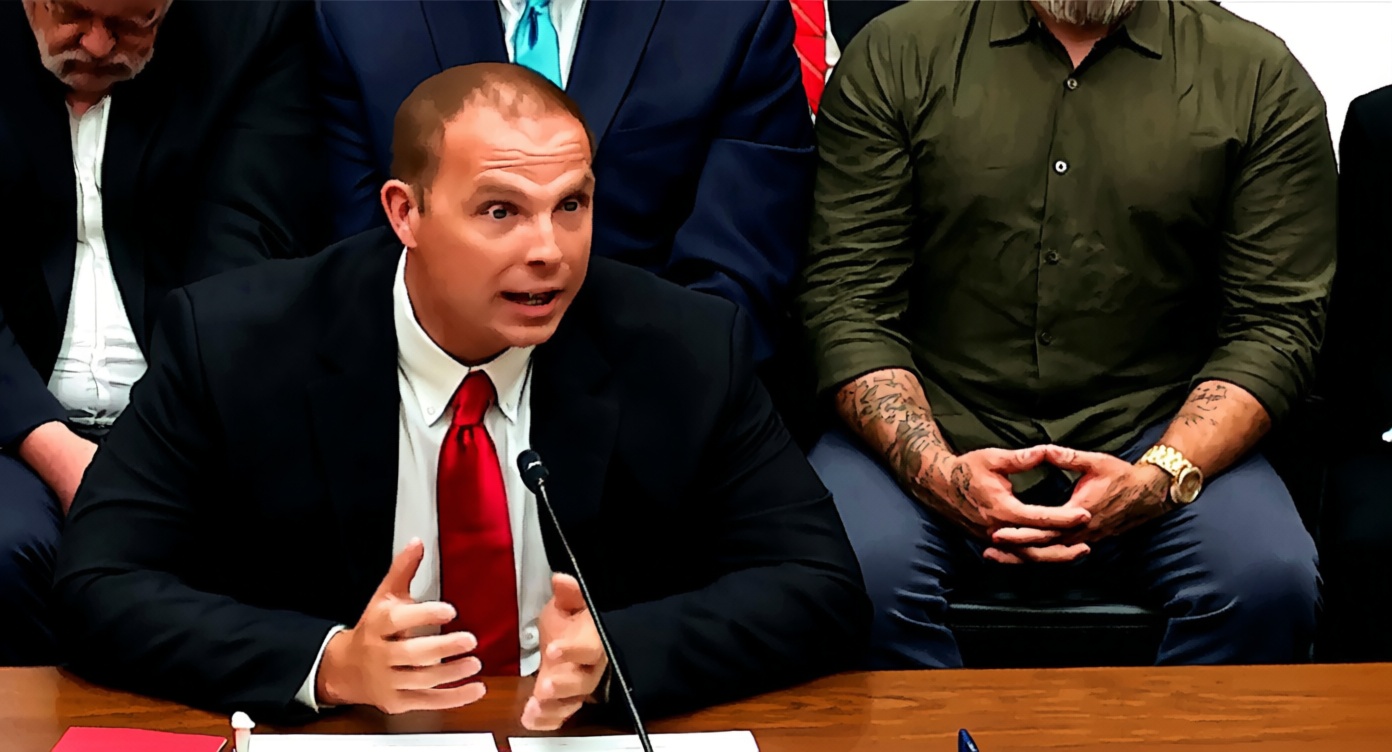
A former U.S. Air Force intelligence officer told Congress that the government has concealed a “multi-decade” program to retrieve and reverse-engineer unidentified aerial phenomena (UAP). Retired Major David Grusch made the allegation during a closely watched hearing before a House Oversight subcommittee, reviving congressional scrutiny of unexplained sightings reported by military personnel.
UAP is the official term used by the U.S. government in place of “UFO.” While the subject is often associated with speculation about extraterrestrial visitors, lawmakers from both parties have increasingly framed it as a national-security and aviation-safety issue. They have cited concerns that some unidentified objects could be surveillance platforms or aircraft linked to U.S. adversaries.
Allegations of a Classified Program
Grusch said he learned about the alleged program in 2019, when he was assigned to the National Reconnaissance Office, the agency responsible for operating U.S. spy satellites. According to his testimony, he was asked by the head of a government UAP task force to identify highly classified programs related to the group’s mission.
“I was informed in the course of my official duties of a multi-decade UAP crash retrieval and reverse engineering programme to which I was denied access,” Grusch told lawmakers. He did not provide publicly available documentation or physical evidence during the hearing, and several of the details he referenced remain classified.
When asked whether the government possessed information about extraterrestrial life, Grusch said the United States was likely aware of “non-human” activity dating back to the 1930s. His statement was among the most significant claims made during the hearing, but it was not independently verified in the testimony.
Pentagon Rejects the Claims
The Department of Defense has denied that it has operated a program involving recovered extraterrestrial craft or materials. Sue Gough, a Pentagon spokeswoman, said investigators had found “no verifiable information to substantiate claims that any programmes regarding the possession or reverse-engineering of extraterrestrial materials have existed in the past or exist currently.”
The department’s statement addressed allegations involving suspected extraterrestrial materials, but did not rule out the existence of unidentified objects whose origin remains unknown or whose nature has not been established. The distinction is central to the broader debate: an unexplained observation is not necessarily evidence of alien technology.
The Pentagon has previously acknowledged receiving hundreds of new UAP reports as part of a renewed effort to investigate incidents involving military personnel. Officials have said publicly that they have not confirmed extraterrestrial origins for those cases. In an earlier hearing, Pentagon officials showed lawmakers video recorded from an F-18 fighter jet depicting a balloon-like object.
Whistleblower Protections and Congressional Response
Grusch said he became a whistleblower after learning about the alleged programs and claimed he faced professional and personal retaliation. He declined to describe the alleged tactics in detail, citing an ongoing investigation, but told lawmakers they were “very brutal and very unfortunate.”
The hearing drew bipartisan interest and a more measured tone than some recent congressional sessions involving national-security whistleblowers. Lawmakers questioned Grusch about the sources of his information, the consequences of his disclosures and how Congress could obtain greater access to UAP-related records.
Representative Jamie Raskin, a Maryland Democrat, summarized one central concern by asking whether the United States needed “real transparency and reporting systems” to establish what was happening. Other members criticized the Pentagon for providing limited information in classified briefings and urged officials to release imagery that could be safely shown to the public. The hearing produced no definitive evidence of recovered alien craft, but it underscored a continuing dispute over government transparency, classified programs and unexplained aerial incidents.