The Event Described
At sunrise on April 14, 1561, residents of Nuremberg, in the Holy Roman Empire, reportedly observed a striking display in the sky. The episode is now frequently discussed in UFO and UAP literature because the reported objects were described as spheres, crosses, rods, cylinders and a large black, arrow- or spear-shaped form. According to the account, the phenomena appeared to move around the sun, engage in an apparent “battle,” and eventually descend toward the ground beyond the city.
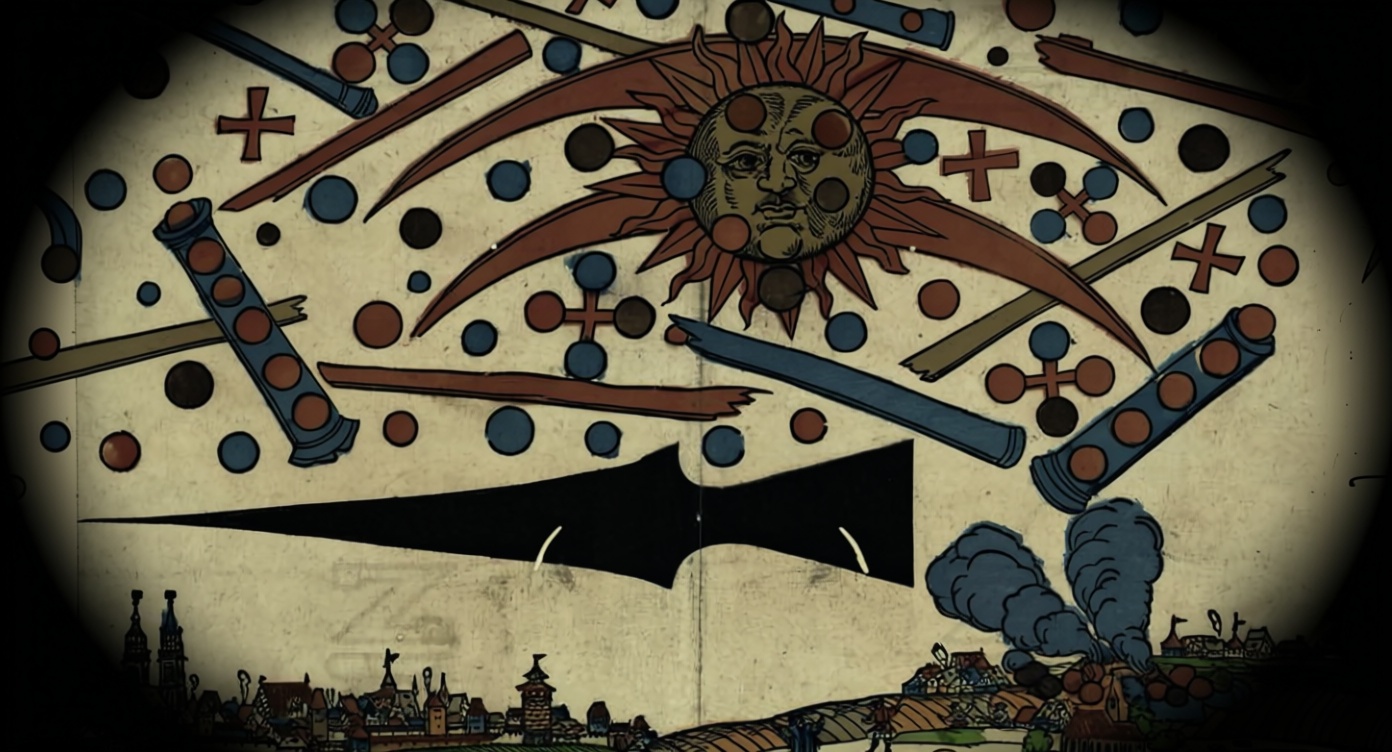
The principal surviving record is a broadsheet created later that month by Hans Glaser, a Nuremberg letter-painter and artist. His woodcut depicts an elaborate scene over the city, with numerous geometric forms arranged around the sun. The accompanying text claims that the spectacle began between 4 and 5 a.m. and lasted for more than an hour. However, the broadsheet is not a modern-style eyewitness investigation. It is a sixteenth-century printed account shaped by the religious, cultural and artistic conventions of its time.
What the Broadsheet Says
Glaser wrote that observers saw “two blood-red semi-circular arcs” in the sun, along with a dark or iron-colored sphere. Other red spheres appeared in groups, while crosses and elongated rods occupied the surrounding sky. These objects supposedly moved toward and away from the sun, “fought vehemently with each other,” and then fell toward the earth “as if they all burned,” producing what the text describes as immense smoke.
The account concludes with the appearance of “something like a black spear, very long and thick,” whose shaft pointed east and point faced west. Rather than presenting the event as evidence of visitors from another world, Glaser interpreted it through a theological framework. He described the phenomena as signs sent by God to encourage repentance, warning that those who mocked them risked divine punishment. That conclusion is important context: the original document treats the spectacle as a religious omen, not as a technological encounter.
Why It Became a UFO Case
Nuremberg 1561 attracts continuing attention because the woodcut can appear, to modern viewers, like a depiction of an aerial conflict involving multiple craft. The image’s forms have been compared by UFO proponents to flying saucers, cylindrical vehicles, crosses and a large triangular object. Its apparent description of objects maneuvering, colliding and crashing has encouraged claims that it represents an early report of extraterrestrial activity.
Yet the case rests primarily on one surviving broadsheet, rather than a body of independently preserved testimonies, official reports or physical evidence. The distinction matters because Glaser’s illustration may not reproduce the scene literally. Sixteenth-century artists commonly used symbolic compositions, conventional forms and religious imagery to communicate meaning. The woodcut therefore requires interpretation within its historical setting, rather than being read automatically as a technical diagram of aircraft.
Natural Explanations and Historical Limits
A commonly proposed explanation is an atmospheric optical display involving parhelia, or sundogs—bright patches produced when sunlight passes through ice crystals in high, thin clouds. Sundogs can appear on either side of the sun and may be accompanied by halos, arcs and luminous pillars. Viewed under unusual conditions, such phenomena could plausibly account for some of the reported rings, crosses, colored lights and apparent movement, especially when combined with changing atmospheric conditions and the effects of direct observation near sunrise.
That possibility does not prove precisely what occurred over Nuremberg. The account’s language is vivid but ambiguous, and the broadsheet provides limited information about weather, viewing angles or the number and independence of witnesses. The reported “crash” also lacks a documented location or recovered material. Consequently, the event cannot be established as an extraterrestrial encounter—or explained with certainty as one specific meteorological phenomenon.
A Case That Reflects Its Era
The enduring interest of Nuremberg 1561 lies in the intersection of eyewitness perception, print culture, religion and modern UFO interpretation. Glaser’s broadsheet preserves a remarkable description of an unusual sky display, but it also shows how sixteenth-century observers made sense of extraordinary events. For its original audience, the central lesson was moral and theological. Centuries later, the same imagery has been recast as possible evidence of alien spacecraft.
The most cautious assessment is that the broadsheet is a valuable historical source whose details may reflect an atmospheric event, artistic conventions, or both. It is intriguing precisely because it leaves room for questions—but the available evidence does not establish that Nuremberg witnessed an extraterrestrial battle.