Overview
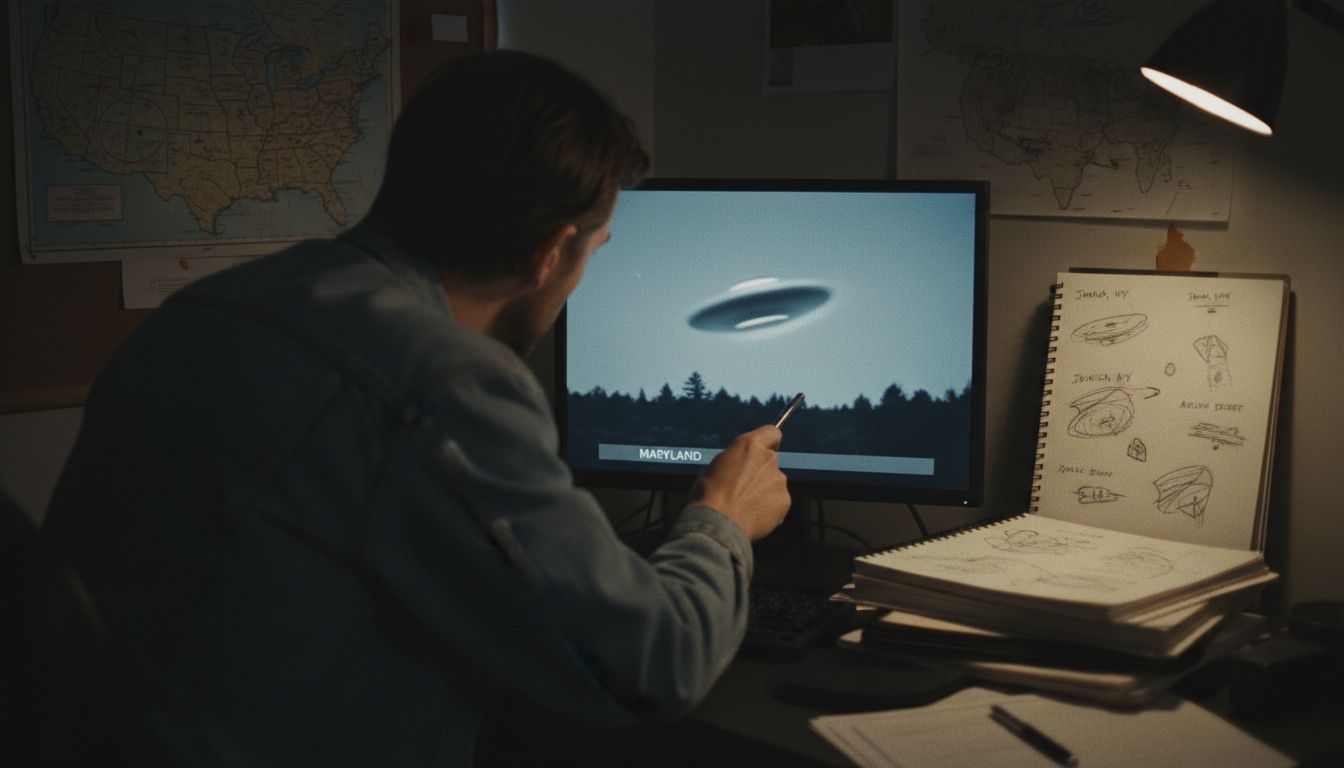
Reports of unidentified flying objects that appear to vanish suddenly remain among the most difficult claims to assess in UFO and UAP research. Witnesses sometimes describe an object moving across the sky before disappearing in an instant, while others say a craft seemed to fade from view, accelerate beyond sight, or become impossible to track. The central scientific problem is not proving that an unusual event occurred, but determining what the event actually was.
The available source material does not identify a particular incident, witness, location, or sensor record. It instead highlights a broader question: why do some accounts continue to resist straightforward explanation? In most cases, investigators must work with incomplete observations, often made under conditions that are poor for judging distance, speed, size, and motion. Without independent recordings or physical evidence, a report may remain unresolved rather than confirming an extraordinary explanation.
Why Objects May Seem to Vanish
Several ordinary factors can make an object appear to disappear. Atmospheric haze, clouds, glare, changes in illumination, and the limits of human vision can obscure an object within seconds. A distant aircraft or balloon may be lost against the sky, while a nearby object can be hidden by terrain, buildings, or a change in viewing angle. An apparent disappearance is therefore not necessarily a physical disappearance.
Human perception also plays a significant role. Observers tend to estimate motion relative to nearby landmarks, but an object’s true distance can be difficult to judge when there are few visual reference points. This can make a stationary or slowly moving object seem to accelerate, or cause a conventional aircraft to appear to make an abrupt maneuver. Memory may further alter details when an event is recalled after a significant period, particularly if the account is retold through media coverage or online discussion.
The Evidence Problem
Scientists generally seek evidence that can be independently checked, such as synchronized video, radar data, infrared imagery, or recovered material. A single photograph or brief video may establish that something was captured, but it often cannot establish the object’s identity, distance, or behavior. Camera artifacts, autofocus problems, lens flares, digital compression, and sensor limitations can also create misleading impressions.
This is why a report may be classified as unidentified without being considered extraterrestrial. “Unidentified” describes the current state of the evidence, not the origin of the object. If there is no reliable data showing a vehicle physically vanished, researchers cannot determine whether the event involved unusual technology, a natural phenomenon, an observational error, or an incomplete record.
Why Some Cases Remain Unresolved
Cases can remain open for practical reasons as well as scientific ones. Witnesses may not know which direction they were facing, how long the event lasted, or how far away the object was. Radar and military records may be unavailable, classified, or never collected. Even when multiple people report the same event, they may have shared the same viewpoint and the same limitations, rather than providing independent confirmation.
The persistence of these accounts reflects a gap between what witnesses experience and what investigators can measure. Scientists can propose plausible explanations, but they cannot reliably select among them when critical data are missing. Until future cases are documented with high-quality, multi-sensor evidence, alleged UFO disappearances will continue to occupy an uncertain space: intriguing and potentially important to investigate, but not sufficient on their own to demonstrate technology beyond known human or natural phenomena.