Overview
The Phoenix Lights remain one of Arizona’s most enduring UFO stories, decades after thousands of people reported seeing unusual lights across the state. A new video feature from azcentral.com and The Arizona Republic, published Oct. 6, 2026, revisits why the incident continues to attract public attention and why it remains one of the region’s most captivating unexplained sightings.
Presented by journalist Tiffany Acosta, the feature examines the event’s lasting cultural impact rather than suggesting a definitive explanation. The story appears in the publication’s entertainment video section, reflecting how the Phoenix Lights have become part of Arizona’s identity as well as a recurring subject of UFO and UAP discussion.
What witnesses reported
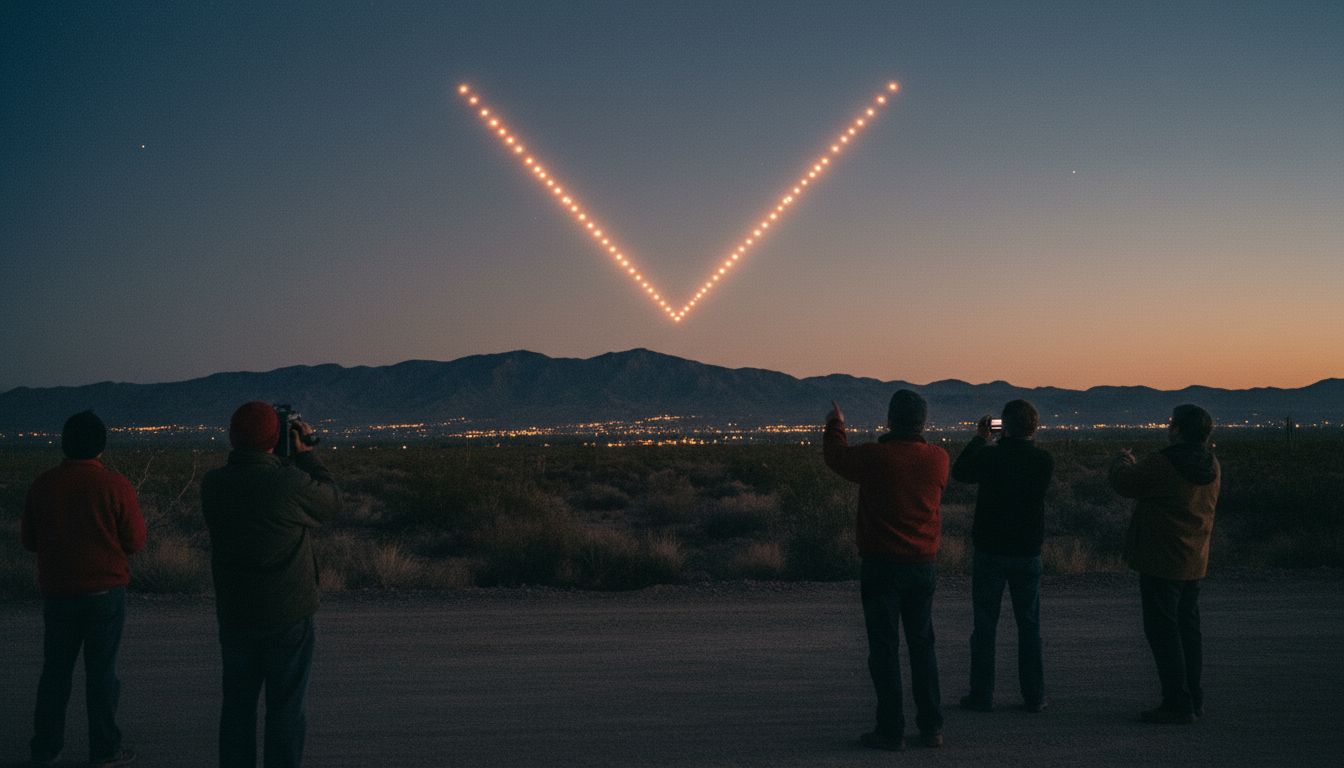
The incident is generally associated with the night of March 13, 1997, when residents across Arizona described seeing lights moving through the night sky. Reports came from the Phoenix metropolitan area and other communities, with witnesses describing formations that appeared to travel in a coordinated pattern.
Some observers said the lights formed a large V-shaped or triangular arrangement, while others focused on a series of bright points that appeared to move slowly overhead. The range of observations has contributed to the mystery: accounts varied depending on location, viewing conditions and which part of the event witnesses saw.
The term “Phoenix Lights” is often used to describe more than one observation that night. Researchers and officials have distinguished between lights seen moving across the state and a later display of stationary lights over the Phoenix area. That distinction has fueled debate over whether witnesses observed a single phenomenon or several unrelated events.
Competing explanations
The sighting generated widespread media coverage and public discussion, but no explanation has resolved every witness account. One widely cited explanation is that some of the lights were military flares released during training exercises near the Barry M. Goldwater Range. Flares can appear unusually bright and seem to hover or drift when viewed from a distance, particularly at night.
That explanation, however, has not satisfied everyone who reported seeing a large object or formation moving silently across the sky before the stationary lights appeared. Other possibilities raised over the years have included aircraft, atmospheric effects and misidentified conventional objects.
The available accounts do not establish that the lights were extraterrestrial spacecraft. At the same time, the absence of a universally accepted explanation has allowed the story to endure. The incident illustrates the central challenge in investigating historical UAP reports: eyewitness testimony can be compelling, but it is difficult to verify decades later without complete radar data, synchronized recordings and consistent observations from multiple locations.
Why the story endures
The Phoenix Lights continue to resonate because the event involved numerous witnesses, unfolded over a populated area and became part of Arizona’s modern folklore. The sighting also arrived during a period when public interest in UFOs was already strong, giving the reports a national profile.
The azcentral feature presents the Phoenix Lights as a mystery that remains culturally significant, not as proof of alien visitation. Its continued appeal lies in the tension between credible-seeming observations and ordinary explanations that account for some—but not necessarily all—of what people reported. That unresolved tension has made the Phoenix Lights Arizona’s most recognizable UFO sighting and a lasting subject of public curiosity.