Overview
A new editorial on Techno‑Science.net argues that the study of unidentified aerial phenomena (UAP) must shed the “mystery‑show” veneer that has long dominated public discourse and adopt rigorous, peer‑reviewed scientific practices. Published on 26 April 2026, the piece follows a series of high‑profile government releases—including the U.S. Department of Defense’s 2023 UAP report—and calls for a systematic, transparent approach that can move the field from speculation to credible research.
Scientific Shortcomings
The article points out that most existing UAP investigations rely on anecdotal testimony, limited sensor data, and ad‑hoc analyses that rarely survive academic scrutiny. “Without standardized data collection and open‑access archives, we are left with fragmented case files that cannot be independently verified,” the author writes. Critics have long warned that sensational headlines and conspiracy‑laden narratives erode public trust, making it harder for legitimate scientists to secure funding or institutional support for serious inquiry.
Call for Rigorous Methodology
To counter these flaws, the editorial proposes a transparent data‑sharing framework modeled on open‑science initiatives in astronomy and climate research. It urges agencies that collect radar, infrared, and visual recordings—such as the U.S. Air Force’s Advanced Aerospace Threat Identification Program (AATIP) and European Space Agency sensor networks—to publish raw datasets in searchable repositories, accompanied by metadata on sensor calibration, observation conditions, and classification criteria. The piece also stresses the need for peer‑reviewed publications in recognized journals, arguing that “only through reproducible analysis can we differentiate genuine anomalies from instrument artefacts or human error.”
Interdisciplinary Collaboration
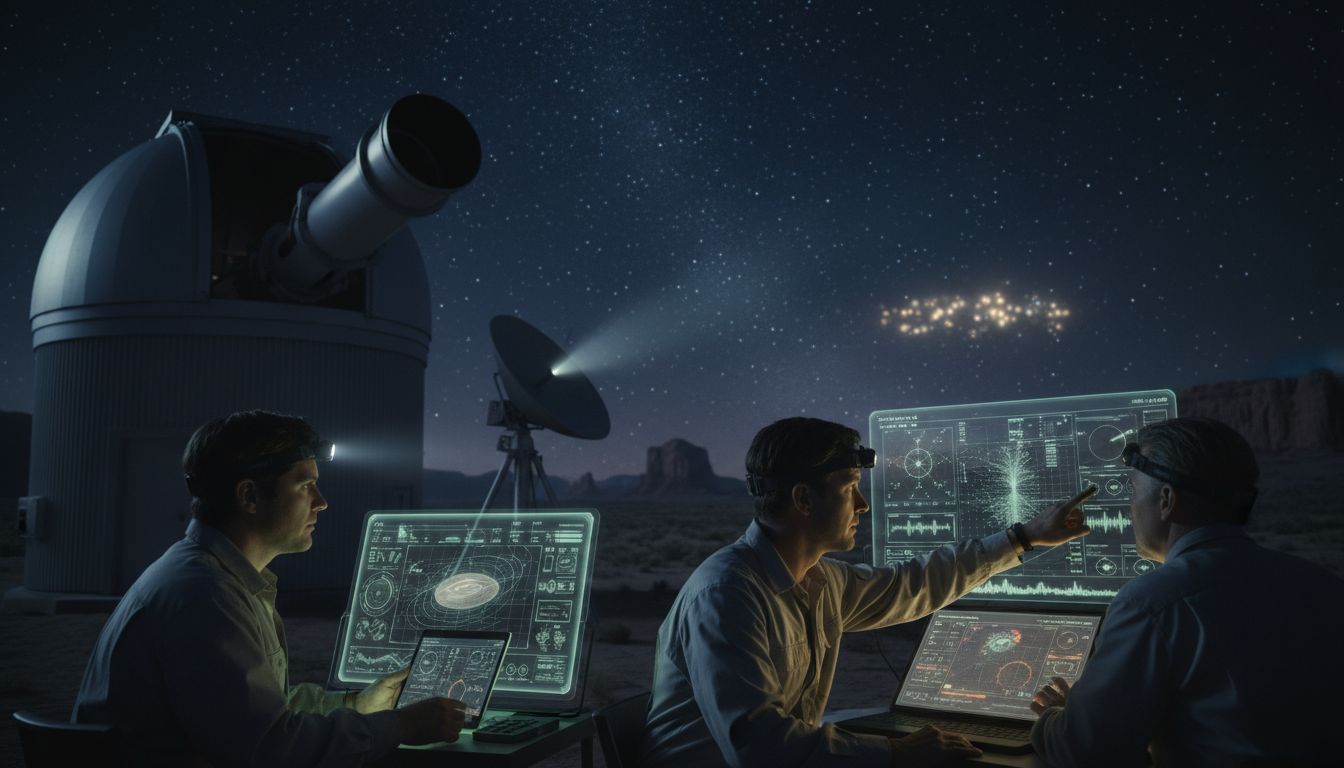
Recognizing that UAP phenomena intersect multiple domains, the article calls for interdisciplinary teams that bring together aerospace engineers, atmospheric physicists, data scientists, and psychologists. It cites successful models such as the International Astronomical Union’s working groups on transient events, suggesting a similar consortium could evaluate UAP sightings with a common taxonomy. “A collaborative platform would allow, for example, a radar specialist to work alongside a meteorologist to rule out known atmospheric phenomena before labeling an observation as truly unidentified,” the author notes.
Path Forward
The editorial concludes with a concrete roadmap: establish an international UAP data hub, secure funding through neutral scientific bodies (e.g., the National Science Foundation or the European Research Council), and launch a series of open‑call research grants that require pre‑registration of hypotheses and post‑study data release. By aligning UAP research with the standards that govern other frontier sciences, the author believes the community can finally produce credible, testable knowledge—whether that leads to new physics, advanced aerospace technology, or a better understanding of atmospheric processes. The piece ends on a hopeful note, urging policymakers and scholars alike to treat unidentified phenomena not as a fringe curiosity but as a legitimate scientific frontier worthy of systematic exploration.