Overview
The interstellar comet 3I/ATLAS, discovered on July 1 2025, is only the third object of its kind ever recorded passing through the Solar System, following 1I/‘Oumuamua (2017) and 2I/Borisov (2019). Its highly eccentric trajectory and faint, dusty tail have drawn attention from professional astronomers and amateur sky‑watchers alike. While NASA and other agencies have released orbital data and low‑resolution images, the comet’s faintness has left many visual details to be captured by ground‑based telescopes and citizen‑science observatories.
The Viral Clip
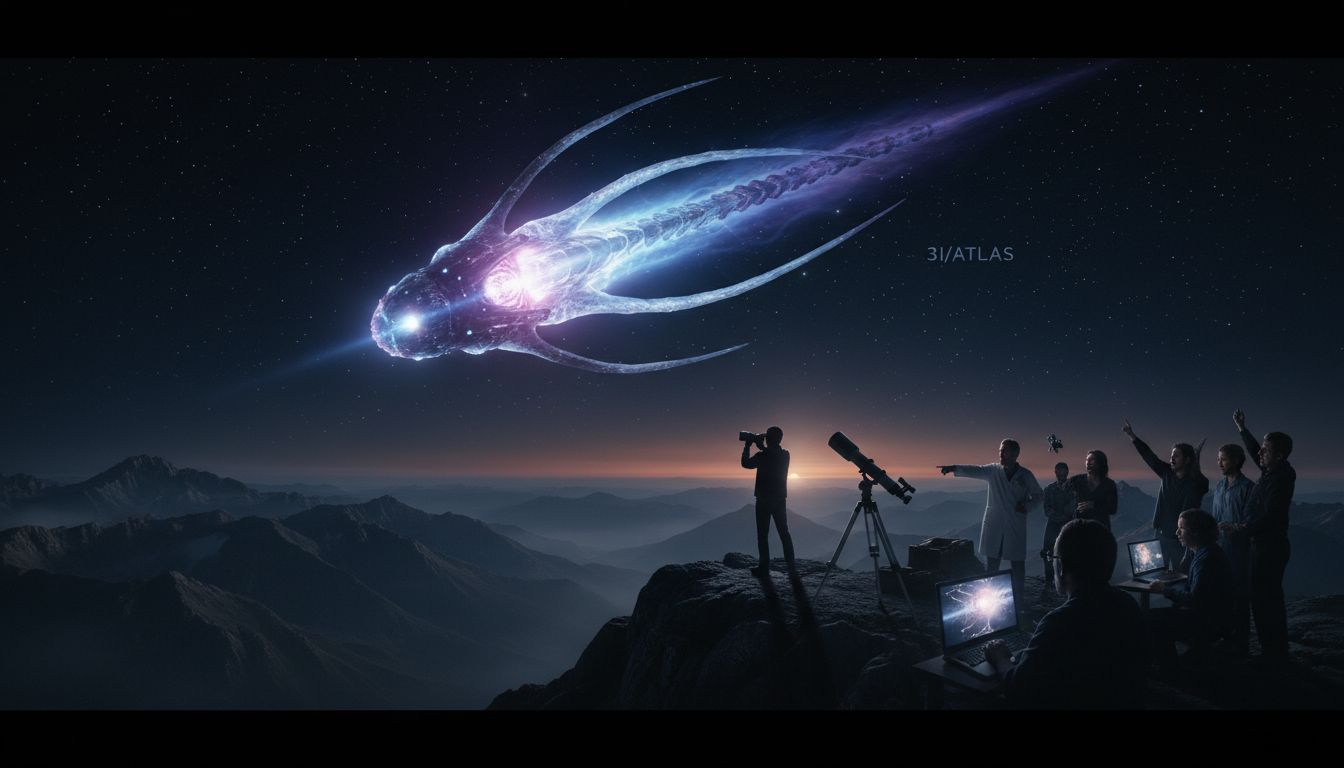
Late last week a short video circulated on platforms such as X, TikTok and Reddit, purporting to show 3I/ATLAS “glowing on the edges like an alien spaceship,” with multiple green‑tinged streaks radiating from the nucleus. The clip, set to dramatic music, quickly amassed millions of views and sparked a wave of speculation, with some users captioning it “Proof of extraterrestrial tech?” and others warning it was a hoax. The video’s description claimed the footage was taken from a backyard telescope, but no metadata or source attribution accompanied the post.
Scientific Assessment
A team of astronomers from the International Astronomical Union (IAU) and a fact‑checking group at AFP Fact‑Check examined the footage frame by frame. Lead analyst Dr. Maya Patel noted that the “greenish halo and linear flares are characteristic of sensor blooming and diffraction spikes that appear when a bright point source exceeds a camera’s dynamic range, especially in low‑light, high‑gain settings.” She added that “the pattern matches what we see in laboratory images of microscopic organisms under phase‑contrast microscopy, not in astronomical imaging.” NASA’s Near‑Earth Object Program Office confirmed that no high‑resolution, space‑based observations of 3I/ATLAS have been released, making the claim of a “spaceship‑like glow” scientifically implausible.
AI‑Generated or Manipulated?
Given the rapid rise of generative‑AI tools capable of producing photorealistic space imagery, experts weighed the possibility that the clip was artificially created. “The color grading, the smooth motion blur, and the exaggerated luminosity are hallmarks of AI‑enhanced composites,” said Dr. Luis Ortega, a digital media forensics specialist at the University of Cambridge. He ran the video through a forensic algorithm that flagged inconsistencies in pixel noise and compression artifacts, suggesting post‑production manipulation. However, Ortega cautioned that “without original raw files, we cannot definitively label it as AI‑generated; it could also be a heavily edited real observation.”
Implications and Caution
The episode underscores the challenges faced by the scientific community in an era where viral visual content can outpace verification. While public enthusiasm for interstellar visitors is welcome, analysts stress the need for transparent data sharing. “When extraordinary claims arise, they must be matched with equally extraordinary evidence,” reminded Dr. Avi Loeb, Harvard astrophysicist, in a comment to the article. He urged hobbyist observers to upload raw FITS files to public repositories, allowing peer review and reducing the spread of misleading media. As the debate over the 3I/ATLAS video continues, the consensus remains clear: extraordinary visual claims require rigorous, peer‑reviewed validation before being accepted as fact.


