Overview
A team of linguists and archaeologists has identified a possible 40,000‑year‑old symbolic system on Paleolithic artifacts from Germany, suggesting the Swabian Aurignacian culture may have used a non‑spoken communication method that resembles proto‑cuneiform. The findings, published in Proceedings of the National Academy of Sciences, are based on a statistical analysis of more than 3,000 individual signs carved into 260 objects ranging from ivory figurines to stone tools. If the interpretation holds, it would push back the earliest known use of writing‑like symbols by tens of thousands of years, predating the Mesopotamian tablets dated to around 3000 BCE.
The Swabian Aurignacian Markings
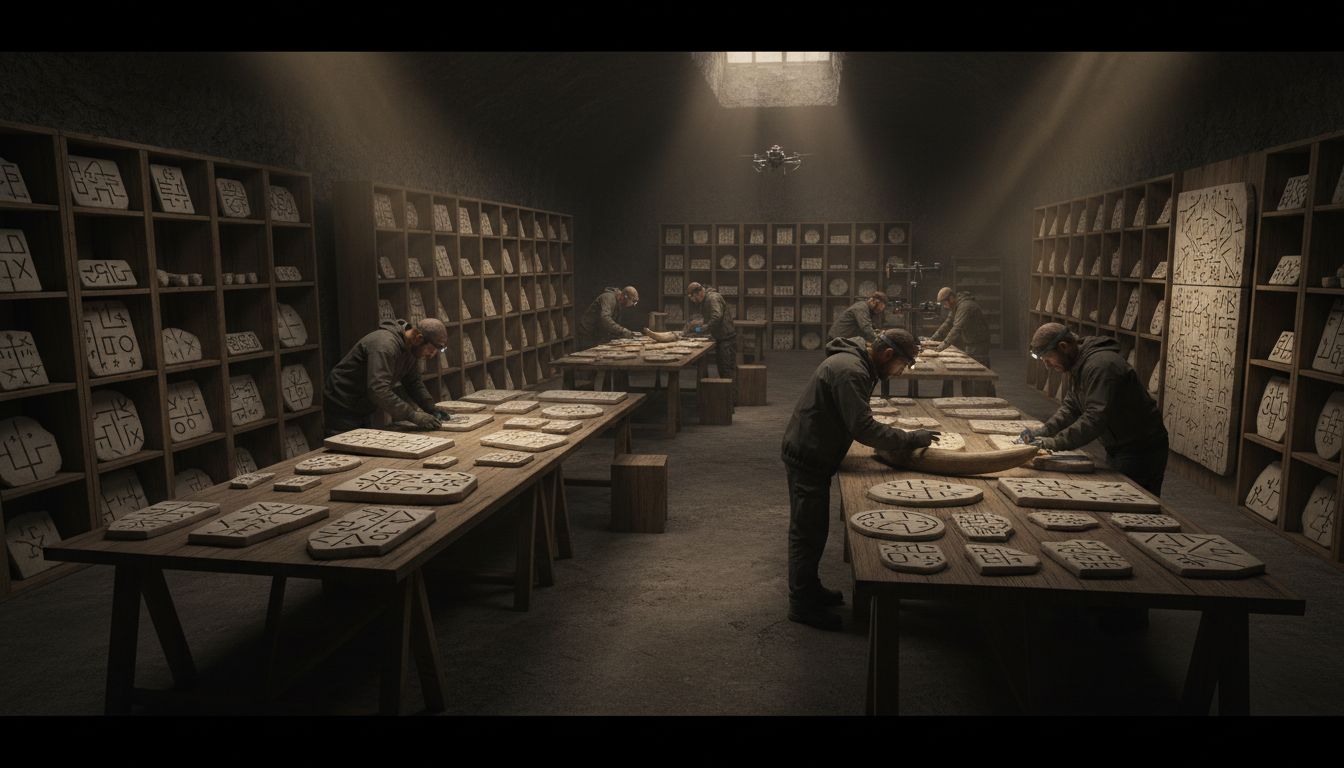
The artifacts, recovered from four closely situated caves—Hohle Fels, Geißenklösterle, Vogelherd and Hohlenstein‑Stadel—in the Swabian Jura of southern Germany, display rows of lines, notches, dots and crosses. Notable examples include a mammoth‑ivory figurine covered in cross‑dot sequences and an ivory plaque depicting an anthropomorphic lion marked with parallel notches along the arm. “The four main excavation sites are within hiking distance from one another, so the artifacts with sign sequences are a well‑circumscribed, regional phenomenon tied to this particular archaeological culture,” said Prof. Christian Bentz of Saarland University. Archaeologist Ewa Dutkiewicz added that the objects are hand‑sized and portable, “another way in which the objects are similar to proto‑cuneiform tablets,” underscoring their potential role as a portable record‑keeping medium.
Statistical Fingerprint and Implications
Dutkiewicz and her colleagues applied computational pattern‑recognition techniques to isolate a statistical fingerprint unique to the Swabian signs. “We’ve only just scratched the surface,” she noted, emphasizing that many more marked objects likely remain undiscovered in museum collections across Europe. The analysis revealed recurring clusters and ordered sequences that differ from random decorative marks, suggesting intentional encoding of information. While the researchers stop short of declaring a fully fledged writing system—citing the hunter‑gatherer lifestyle that may not have required complex record‑keeping—they argue the system “served a function similar to writing, helping record information and communicate ideas” within the community.
Parallel Breakthroughs in Archaeology
The study arrives amid a wave of high‑profile discoveries reshaping our view of ancient societies. A recent lidar survey in Spain uncovered the 10th‑century “Lost City of Almanzor,” a sprawling urban complex hidden beneath dense forest, confirming medieval chroniclers’ accounts of a once‑thriving settlement. In North Africa, a 2,200‑year‑old bone fragment bearing wear patterns consistent with harness fittings has been linked to the war elephants employed by Hannibal during his campaigns against Rome, offering tangible evidence of the logistical networks that supported his famed crossing of the Alps. Meanwhile, a multidisciplinary soil‑analysis project on Easter Island has identified distinct phosphate layers around the moai statues, supporting the hypothesis that the statues were erected as part of a resource‑allocation system rather than purely ceremonial monuments. Together, these findings illustrate how advanced analytical tools are revealing layers of complexity in cultures once thought to be primitive.
Expert Commentary and Future Directions
Scholars caution that interpreting prehistoric symbols as “writing” remains speculative. Dr. Laura Martínez, a specialist in prehistoric cognition at the University of Barcelona, remarks, “The statistical regularities are intriguing, but without a decipherable lexicon we must treat them as a proto‑symbolic system rather than a language.” Nevertheless, the research opens new avenues for interdisciplinary collaboration, combining archaeology, linguistics, and computer science to explore the origins of symbolic communication. The team plans to expand the survey to sites in France and Italy, where similar Aurignacian artifacts have been reported but not yet examined for sign sequences. As the field gathers more data, the possibility that human societies were experimenting with written expression far earlier than previously believed becomes an increasingly plausible chapter in the story of human intellectual evolution.


