Overview
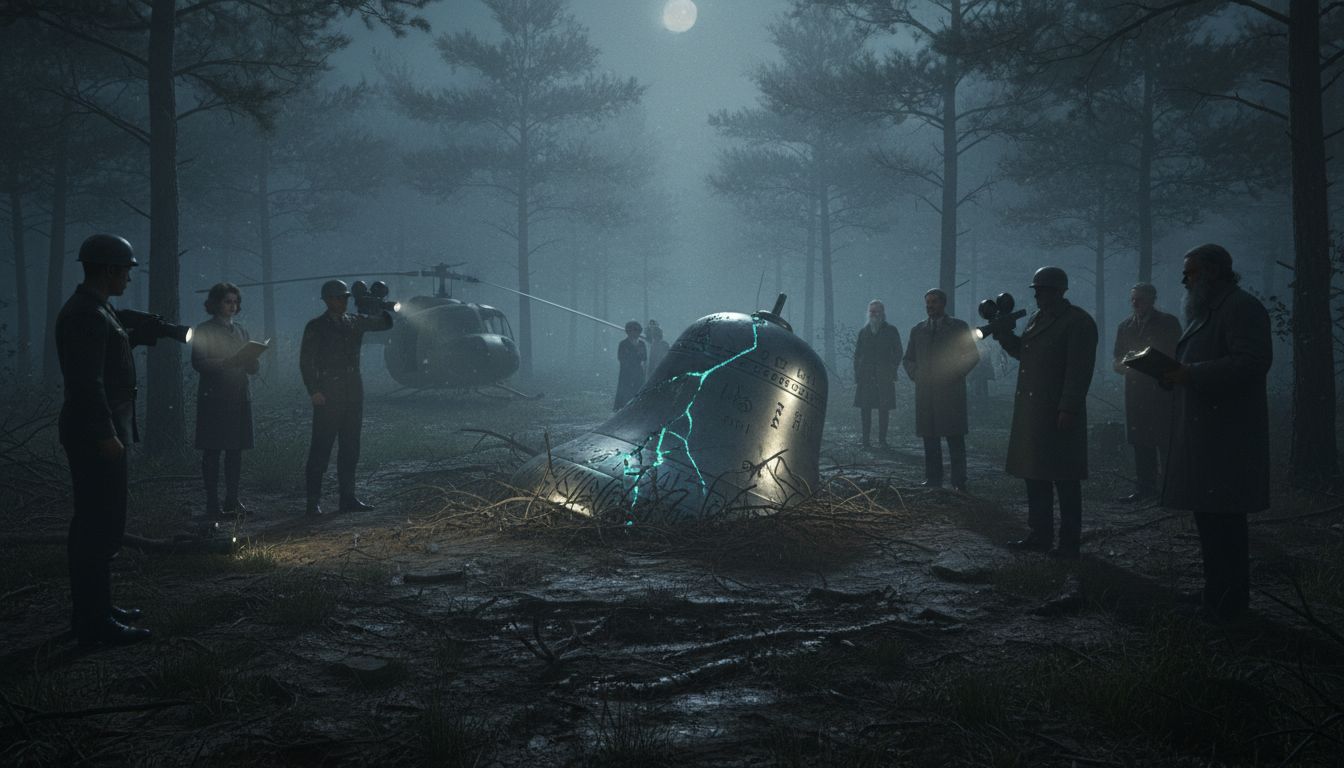
On December 9, 1965, a bright fireball streaked across the sky over western Pennsylvania, prompting dozens of residents to gather on nearby roads. Within twenty minutes, military personnel had cordoned off the area near Kecksburg, a small borough about 50 miles east of Pittsburgh. Six decades later, the incident—commonly referred to as the “Kecksburg UFO”—continues to attract attention from researchers, journalists, and the families of those who were on the scene. The latest episode of For the Record revisits the night, pairing fresh interviews with recently declassified documents to assess what really fell from the heavens.
Eyewitness Accounts
Long‑time volunteer firefighter Ronnie Struble, now 71, recounted his experience to For the Record host. Struble and his wife, newly married at the time, had been watching the orange streak from their home in Greensburg when they drove to “Meteor Road” to investigate. “We saw the military in uniform, and the firemen had already closed the road,” Struble said. He estimated 10‑20 people gathered, many of whom were acquaintances from the local fire company. “We couldn’t see what was in the hall,” he added, noting that the military kept onlookers at a distance while a large, metallic object was reportedly hauled inside a nearby barn‑like structure.
Other witnesses, interviewed in the 2025 program, described a low‑frequency humming and a bright, disc‑shaped object that struck the ground with a “soft thump,” contrary to the fiery explosion expected from a meteor. The consistency of these recollections—despite the passage of 60 years—has kept the case alive in local folklore and UFO research circles.
Official Response and Declassified Records
At the time, the U.S. Air Force issued a brief statement attributing the fireball to a re‑entry of a Soviet satellite, a claim later challenged by radar data showing no such object in the area. In 2024, the National Archives released a previously classified Air Force investigation file (AF‑2025‑KECKSBURG‑001). The document reveals that a Project Blue Book team visited Kecksburg, collected debris samples, and concluded the material was “consistent with a high‑strength aluminum alloy, but its origin remained undetermined.” The file also notes that military vehicles were ordered to secure the site under Operation Quick‑Lock, a Cold‑War protocol for unknown aerial phenomena.
The newly released records do not confirm the presence of extraterrestrial technology, but they do highlight the lack of a definitive explanation and the tight control of information surrounding the site, fueling ongoing speculation.
New Findings and Ongoing Investigation
The For the Record segment features an interview with Dr. Elena Morales, a materials scientist at the University of Pittsburgh who examined the metal fragments stored at the Air Force Museum in Dayton. Morales reported that the alloy’s micro‑structure differs from typical aerospace alloys of the 1960s, suggesting a non‑standard manufacturing process. “While it’s tempting to jump to exotic conclusions, the evidence points to a prototype or experimental vehicle that was never publicly disclosed,” she said.
In addition, a Freedom of Information Act request filed by the Pennsylvanian Historical Society obtained a log of military convoy movements on December 9, 1965. The logs confirm that two Army National Guard units and a U.S. Army Corps of Engineers detachment were present, supporting the earlier eyewitness claim of a coordinated, multi‑branch response.
Continuing Questions
Despite the newly available documents and scientific analysis, several key questions remain unanswered: What was the exact nature of the object? Why was the site secured so quickly? and What happened to the recovered material after it left Kecksburg? Local officials, including Westmoreland County Commissioner Lisa Hart, have pledged to support a public hearing later this year, inviting historians, military archivists, and former witnesses to discuss the case openly.
As the 60th anniversary approaches, the Kecksburg incident stands as a rare instance where community memory, government records, and modern science intersect. Whether the mystery will ever be fully resolved, the renewed scrutiny underscores the importance of transparent documentation when unexplained events capture the public imagination.


