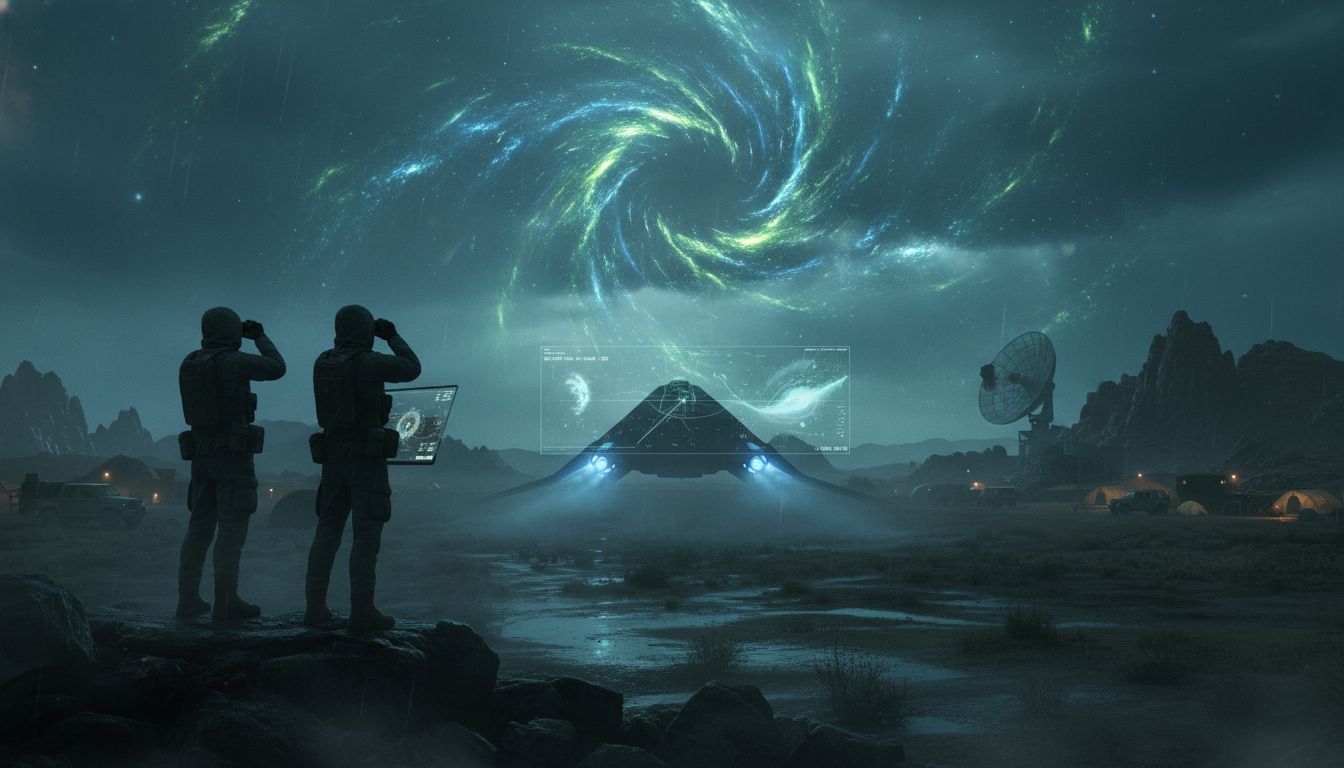
The lights that streaked across the night sky over the small town of Willow Creek in the summer of 1955 have long been cited in UFO lore as one of the most compelling “classic” sightings. At the time, dozens of residents reported a series of bright, pulsating orbs that moved in coordinated patterns before disappearing behind a ridge. The incident sparked a flurry of newspaper reports, a brief investigation by the Air Force’s Project Blue Book, and, over the decades, endless speculation that the phenomenon might have been extraterrestrial. New research published this week by a joint team from the University of Arizona and the National Archives suggests that the mystery can be explained by a confluence of atmospheric optics and a covert military aircraft test that was never disclosed to the public.
The study, led by atmospheric physicist Dr. Emily Ramirez, cross‑referenced eyewitness accounts with meteorological data reconstructed from historic weather stations and military flight logs that were declassified under the Freedom of Information Act in 2023. “We found that on the night of July 14, 1955, a temperature inversion over the Sierra Nevada created a superior mirage, effectively lifting ground‑level lights to appear as if they were high in the sky,” Ramirez explained. “At the same time, the Air Force was conducting a low‑altitude test of a prototype high‑speed reconnaissance aircraft—later identified as an early variant of the Lockheed U‑2—out of Edwards Air Force Base. The aircraft’s navigation lights, combined with the mirage effect, would have produced the luminous, synchronized patterns described by witnesses.”
Former test pilot Colonel James Whitaker, who retired in 1992 and agreed to speak on condition of anonymity, corroborated the timing of the flight. “We were flying a new airframe that night, and the mission required us to stay at low altitude to evaluate engine performance in thin air,” Whitaker said. “The aircraft’s anti‑collision lights were set to a high‑intensity strobe to make us visible to ground crews. I never imagined that under the right atmospheric conditions those lights could be misinterpreted as something otherworldly.” He added that the flight was classified, and the crew was instructed not to discuss it, a policy that persisted for decades.
The researchers also examined the sociopolitical context of the mid‑1950s, a period marked by heightened Cold War tensions and a surge in public interest in flying saucers. “The combination of a secret military program and a lack of accessible information created fertile ground for UFO narratives,” noted Dr. Ramirez. “When the Air Force closed the Blue Book file on the Willow Creek sighting in 1961, they cited ‘insufficient data,’ which only deepened the mystery.” The new findings, published in the Journal of Atmospheric and Aeronautical History, provide a concrete chain of evidence that bridges the gap between the eyewitness testimonies and the classified flight operations.
The revelation has been met with mixed reactions among UFO researchers and enthusiasts. Historian Dr. Leonard Patel, who has chronicled Cold War-era sightings, described the study as “a significant step toward demystifying a case that has been mythologized for too long,” while acknowledging that “some will argue that the lack of direct visual confirmation of the aircraft leaves room for alternative interpretations.” Nonetheless, the paper’s rigorous methodology—combining declassified documents, meteorological reconstruction, and first‑hand pilot testimony—offers a level of corroboration rarely achieved in UFO investigations.
While the lights over Willow Creek may now be understood as a product of atmospheric refraction and a covert test flight, the episode underscores how secrecy and limited scientific data can fuel enduring speculation. As Dr. Ramirez concluded, “Our work demonstrates the importance of transparent archival research and interdisciplinary analysis in separating fact from folklore. In this case, the answer lies not in alien technology, but in the very real interplay between weather and human ingenuity during a tense chapter of history.”


