Overview
The latest episode of Podcast UFO, released on January 30, 2026, blends three distinct narratives to explore the human side of unidentified aerial phenomena (UAP). Host Albert Wain revisits a 2015 encounter with a retired Air Force officer whose service record links him to the historic Roswell investigations, recounts a recent Canadian sighting in which three witnesses were illuminated by an unexplained “beam” of light, and pays tribute to the late veteran researcher Fran Ridge, a pioneer of instrumented UFO documentation. The episode, titled “A Conversation Worth Remembering — Hint: Roswell,” aims to move beyond sensational headlines and focus on the lived experiences of those who have observed the unknown.
A Roswell‑Linked Airmen Story
During a routine furniture‑damage inspection in Buffalo, New York, Wain met an octogenarian retired Air Force officer who had flown combat missions in Korea and Vietnam. While reviewing photographs of aircraft in the veteran’s “room of memories,” Wain asked whether the former pilot had ever witnessed anything he could not explain. The veteran paused, then replied, “Nope. Not that I recall. Some of the other pilots and I would see these things called contrails and couldn’t figure out where they came from, but no UFOs.”
Wain notes that the officer’s response, while modest, is significant because many former service members who participated in early Cold‑War air‑space monitoring have remained tight‑lipped about anomalous sightings. “His silence reflects a broader pattern,” the host observes, “wherein disciplined aviators often dismiss or conceal what they cannot readily categorize, especially when official channels offer little support.” The conversation underscores how personal loss— the veteran’s recent battle with bone cancer and the death of his wife—can shape an individual’s willingness to discuss extraordinary experiences.
The Canadian Beam Incident
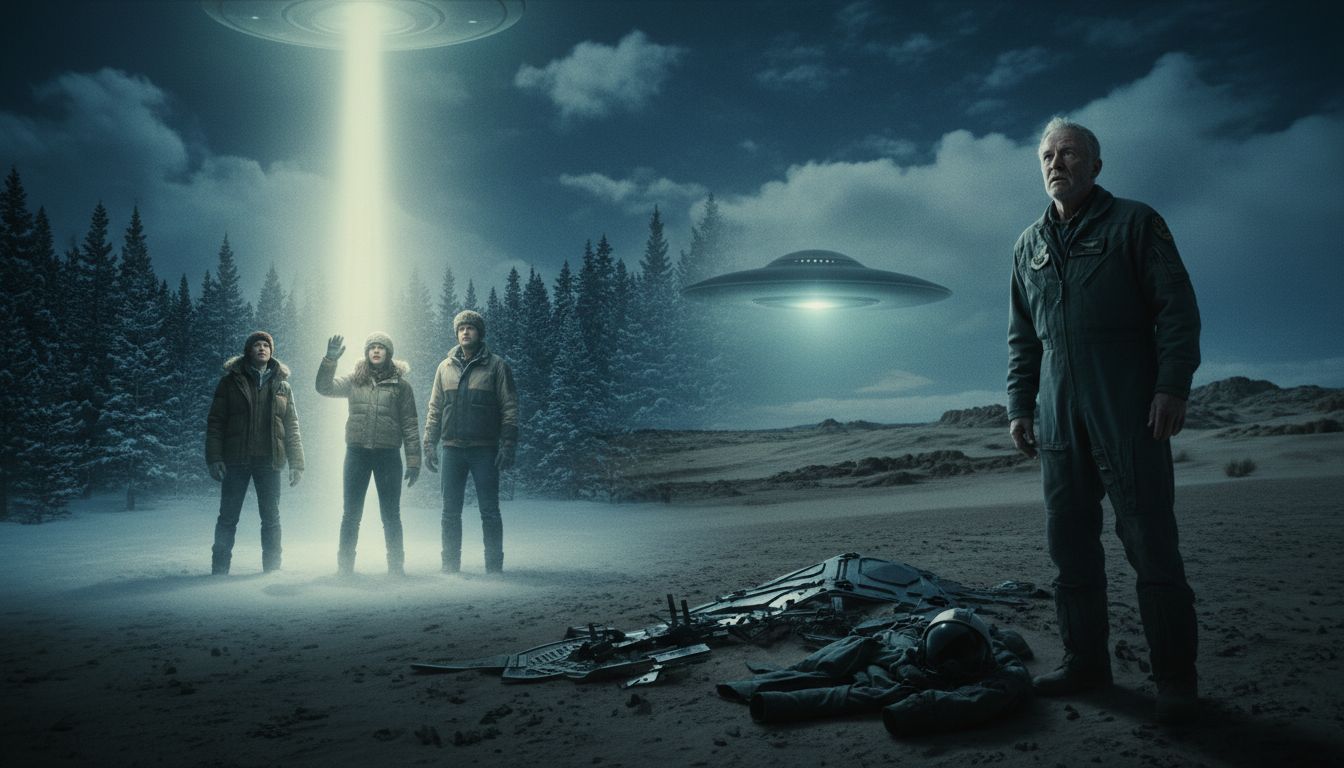
The episode shifts to a 2025 report from three civilians in rural Ontario who described being “bathed in a mysterious beam” while stargazing. According to the witnesses, a column of light descended silently, enveloped them for approximately two minutes, and then vanished without a trace. The trio recorded the event on a smartphone, capturing a faint, pulsating glow that researchers later analyzed for photometric consistency.
Dr. Megan Larsen, a UAP analyst consulted for the podcast, emphasized that the incident “shares several hallmarks with other documented instrumented sightings: a clear visual signature, multiple independent observers, and contemporaneous video evidence.” While no radar data were available, the case was logged with the Canadian Centre for UFO Studies (CCUFO), which classifies it as a “high‑confidence visual sighting.” The segment illustrates how ordinary citizens, unlike the retired officer, may feel more compelled to report anomalous events when modern technology provides tangible documentation.
Honoring Fran Ridge
The most poignant portion of the episode commemorates Fran Ridge, who passed away earlier this year. Ridge, a former Air Force meteorologist turned UFO researcher, was instrumental in developing the first systematic “instrumented sighting” protocols in the 1990s, integrating high‑resolution cameras, spectrometers, and GPS timestamps into field investigations. Colleagues recalled her dedication: “Fran insisted that every claim be backed by hard data, not just anecdote,” said former collaborator Dr. Luis Mendoza.
Ridge’s legacy lives on through the “Ridge Method,” now employed by several civilian UAP research groups worldwide. The podcast includes excerpts from her unpublished field notes, which describe a 2003 encounter over the Nevada desert where a triangular craft emitted a low‑frequency hum measurable on a portable seismometer. By highlighting Ridge’s contributions, the episode reinforces the importance of rigorous, scientific approaches to a subject often plagued by speculation.
Context and Implications
While the Roswell‑linked airmen story, the Canadian beam sighting, and Fran Ridge’s memorial each stand alone, together they illustrate a broader trend: the growing willingness of both military veterans and civilians to share personal UFO experiences when supported by credible documentation. Researchers point to the 2023 release of the U.S. Office of the Director of National Intelligence’s UAP report as a catalyst for this openness, noting that official acknowledgment has reduced stigma and encouraged more systematic data collection.
The episode’s balanced tone—neither dismissive nor sensational—offers a template for future reporting on UAPs. By foregrounding human narratives and emphasizing methodological rigor, Podcast UFO contributes to a more nuanced public discourse, reminding listeners that behind every sighting is a person seeking answers.
Looking Ahead
As the podcast concludes, Wain invites listeners to submit their own observations, stressing that “every credible account adds a piece to the puzzle.” The episode serves both as a memorial to a pioneering researcher and as a call to action for a community increasingly eager to document the unknown with the same precision once reserved for conventional aviation incidents. In doing so, it underscores that the quest to understand UAPs is as much about human curiosity and resilience as it is about the mysteries that hover above.


