Overview
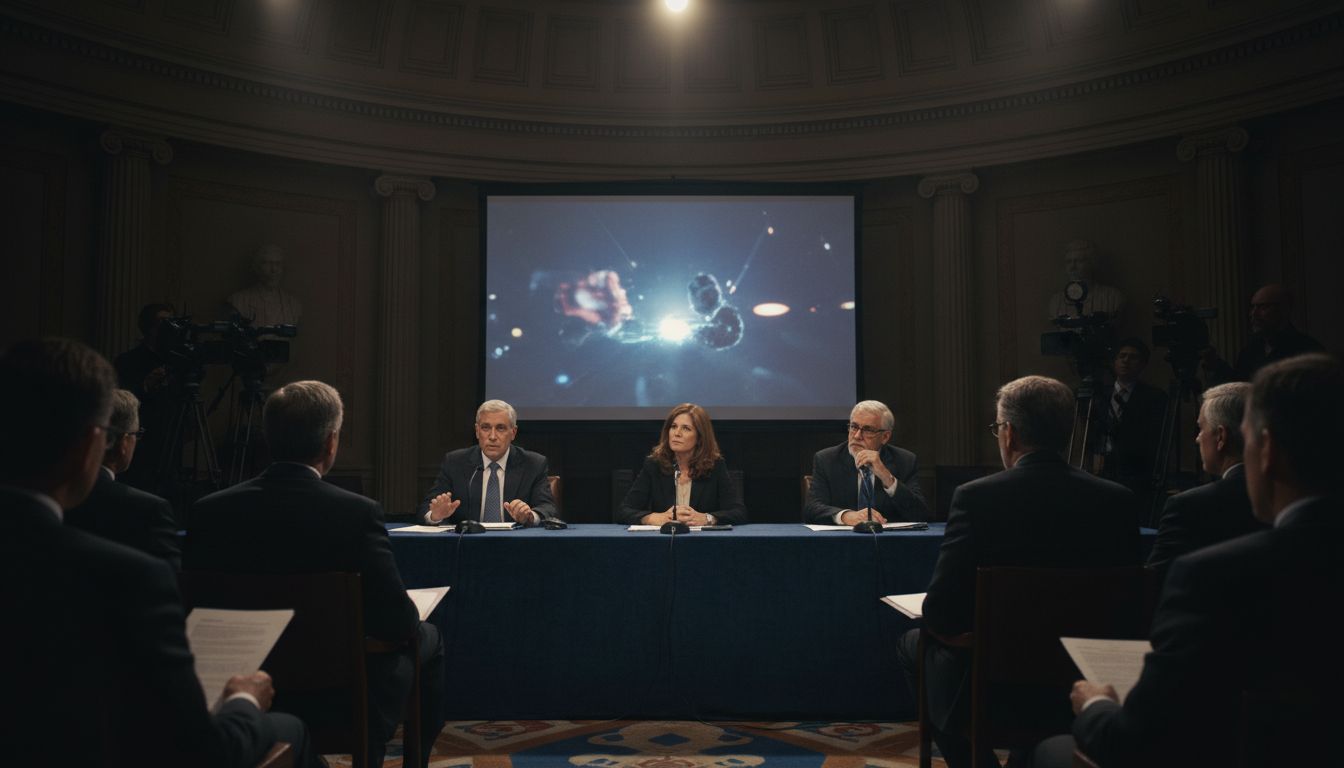
On November 20, 2025, the documentary “The Age of Disclosure” was shown to a bipartisan group of members of Congress in a private screening organized by the House Committee on Oversight and Reform. The film, which traces the evolution of U.S. government investigations into unidentified aerial phenomena (UAP) and argues for greater transparency, has become a focal point in the ongoing debate over how much the public should know about alleged extraterrestrial encounters. Journalists Ralph Blumenthal and Leslie Kean, both long‑time investigators of the subject, joined a panel of scientists, former intelligence officials, and legal scholars to discuss the documentary’s multidisciplinary approach and its potential impact on policy.
Congressional Screening
The screening took place in the Capitol’s historic Rayburn House Office Building, with attendees representing both parties and ranging from senior committee chairs to freshman legislators newly interested in the issue. Organizers emphasized that the event was “non‑partisan and fact‑based,” aiming to provide lawmakers with a consolidated view of the evidence and arguments that have emerged over the past two decades. After the film, a moderated Q&A allowed members to query the panel about specific incidents featured in the documentary, such as the 2004 “Nimitz” encounter and the 2023 Pentagon‑released UAP report. Several representatives, including Rep. James Miller (R‑CA) and Rep. Aisha Patel (D‑NY), expressed that the film “adds a human dimension” to the often technical briefings they receive.
Expert Commentary
Ralph Blumenthal, co‑author of the 2021 New York Times series on UAPs, highlighted the documentary’s effort to “bridge the gap between classified data and public understanding.” He noted that the film’s use of de‑classified footage, interviews with former pilots, and scientific analysis “creates a narrative that is both compelling and accountable.” Leslie Kean, whose 2021 book UFOs: Generals, Pilots, and Government Officials Go on the Record remains a cornerstone of modern UAP research, praised the film’s “multidisciplinary commentary,” stressing that it brings together aerospace engineers, legal experts, and ethicists to examine the ramifications of disclosure.
Other panelists, such as Dr. Mira Sanchez, an astrophysicist at the University of Arizona, warned that “while the documentary raises legitimate questions about data accessibility, it must also guard against conflating anecdotal testimony with rigorous scientific proof.” Former Navy pilot Cmdr. Thomas Reyes, who testified before Congress in 2024, said the film “captures the frustration of service members who have seen unexplained phenomena and are denied a clear explanation.”
Critical Reception
Film critics have offered a mixed appraisal. The Washington Post described the documentary as “a meticulously researched piece that nonetheless leans on scripted reenactments to maintain narrative momentum.” Reviewers acknowledge that the blend of genuine archival material with dramatized sequences can blur the line between documentary and entertainment, potentially influencing viewers’ perception of credibility. Nonetheless, many agree that the film succeeds in “re‑energizing a public conversation that has been muted for years,” especially after the 2023 congressional mandate that required the Department of Defense to release its UAP assessments.
Implications for Policy
The congressional audience for “The Age of Disclosure” reflects a broader shift in legislative appetite for openness on UAP matters. Earlier this year, the Senate Intelligence Committee approved a bipartisan amendment to fund a permanent UAP research office, a move that some analysts attribute to growing public pressure amplified by recent media projects. While the documentary itself does not propose specific legislation, its emphasis on “transparent data pipelines” and “civilian oversight” echoes language found in several pending bills.
As the screening concluded, Rep. Patel remarked, “If we are to maintain public trust, we must move from secrecy to a framework where scientific inquiry and national security coexist.” Whether the film will translate into concrete policy changes remains to be seen, but its presence on the congressional floor signals that the era of official silence on unidentified phenomena may finally be drawing to a close.


