Overview
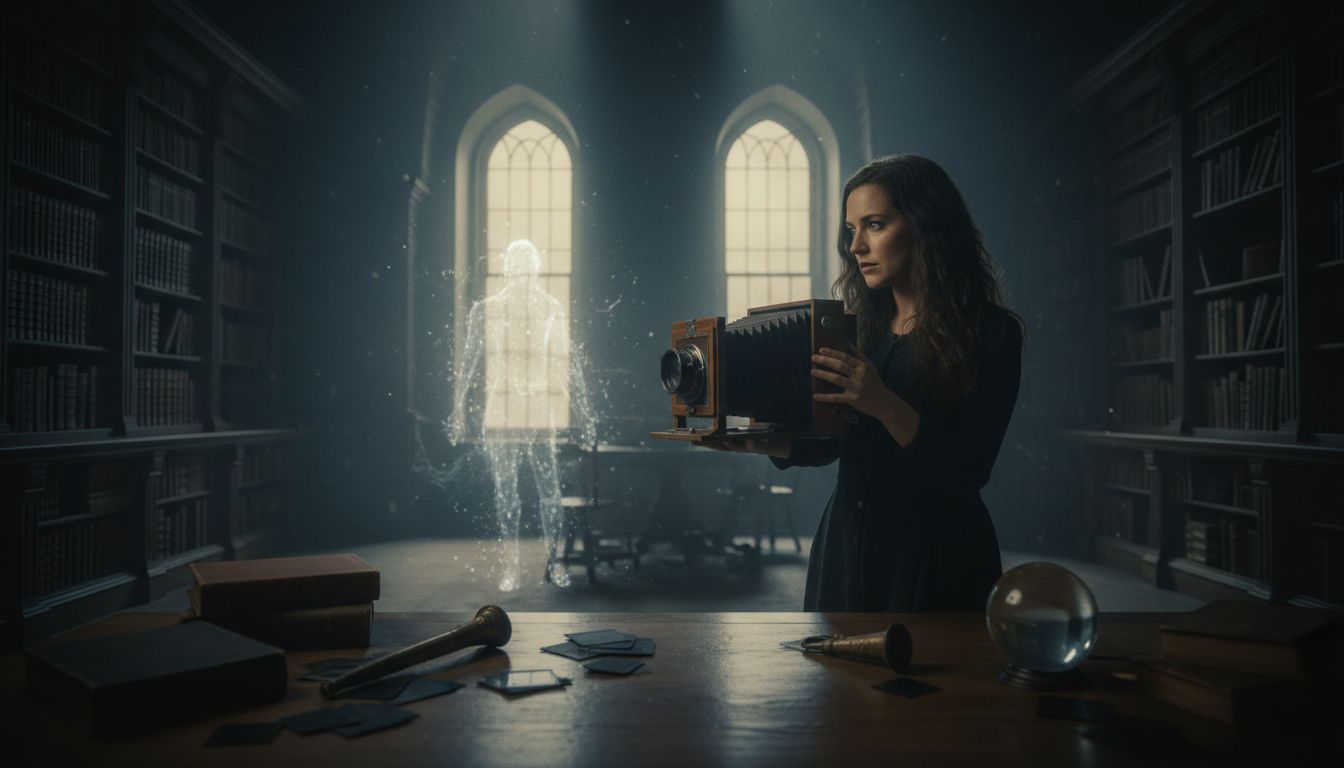
Photographer Shannon Taggart, currently an Artist in Residence at Harvard Divinity School, is turning academic attention toward a neglected chapter of photographic history. Her new book, Séance (Fulgur Press, 2019), documents more than a century of “spirit photography,” tracing its origins to 1860s Boston and arguing that the camera can act as a material conduit for unseen phenomena. In a recent research reflection posted by the Center for the Study of World Religions, Taggart explains that these images “expose how the authority of the camera was forged and remains in tension with ritual, embodiment, and belief,” positioning séance photographs as a unique intersection of science, religion, and visual culture.
Historical Context
The practice of photographing mediums dates back to William Mumler, the 19th‑century Boston photographer whose portraits of the living alongside spectral relatives sparked both fascination and scandal. Taggart links Mumler’s work to the later, more dramatic séances of Mina “Margery” Crandon, whose 1925 investigations at Harvard’s Emerson Hall were attended by scholars from English, mathematics, astronomy, biology and psychology. Photographs from those sessions—showing Margery half‑dressed, surrounded by ectoplasmic “hands” and “faces”—have been described as “some of the most shocking images in the history of photography.” While skeptics dismissed them as staged tricks, believers saw them as visual proof that “the living and the dead remain connected.” Taggart’s research emphasizes that these images functioned as ritual technologies, akin to cave paintings or ceremonial masks, turning photographic emulsion into a threshold where the invisible could be authored.
Séance: Argument and Evidence
In Séance, Taggart assembles a visual archive of over two decades of her own photographs of contemporary mediums, juxtaposing them with historic prints. She contends that the camera’s ability to capture “what was not visibly present” reveals a paradox at the heart of photographic truth: the blurred line between evidence and appearance. Taggart writes, “The camera conjures what was not visibly present, revealing the unstable boundary between evidence and appearance—a paradox at the heart of photographic truth.” By documenting modern séances alongside their 19th‑ and early‑20th‑century predecessors, she demonstrates how the medium continues to challenge scientific rigor while offering a tangible language for spiritual experience.
Review of Jeremy Stolow’s Picturing Aura
Taggart also reviews Jeremy Stolow’s recent volume, Picturing Aura, praising its interdisciplinary approach to a similarly marginalized visual tradition. Stolow’s work, she notes, “brings together art history, anthropology, and the history of science to preserve the marginalised history of aura photography.” Taggart highlights how both books share a commitment to recovering visual practices that sit outside mainstream academic narratives, arguing that such scholarship expands our understanding of how societies construct and contest notions of the unseen. By situating aura photography within the broader field of spirit photography, Taggart underscores a continuity of visual strategies used to negotiate the boundaries between material and immaterial.
Significance for Religious Studies
Taggart’s contributions arrive at a moment when religious studies increasingly examine the material cultures of belief. Her work illustrates how photographic technologies have been employed as ritual objects, shaping and reflecting Spiritualist doctrines that emerged in post‑Civil War America. The Harvard investigations of Margery Crandon, for example, reveal a rare convergence of academic disciplines attempting to verify—or debunk—spiritual claims through empirical means. Taggart’s synthesis of historic and contemporary séance imagery provides scholars with a richer visual lexicon for analyzing how faith communities appropriate scientific tools to legitimize experiential knowledge.
Looking Forward
As an Artist in Residence, Taggart plans to expand her project into a public exhibition at Harvard Divinity School later this year, pairing historic prints with her own contemporary photographs. The exhibition aims to invite viewers to contemplate the persistent allure of the unseen and the camera’s role in mediating that mystery. In the words of Taggart, “When we look at these images, we are not just seeing a trick or a belief; we are witnessing a dialogue between matter and meaning that continues to shape how we understand reality.” Her scholarship, together with Stolow’s interdisciplinary analysis, signals a growing academic willingness to treat spirit photography not as a footnote of curiosity but as a substantive field of inquiry into the visual dimensions of faith.


