Overview
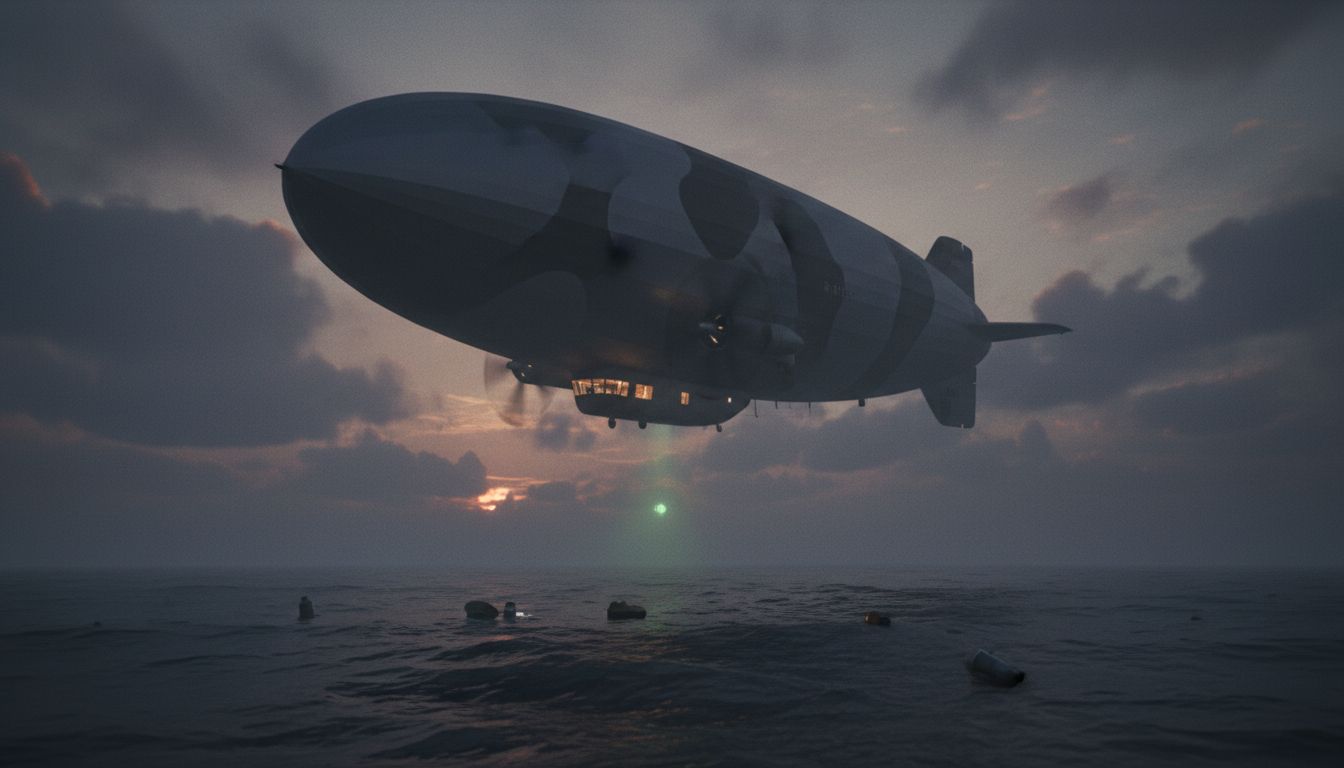
A wartime Navy blimp that vanished over the Pacific in 1942 has long remained one of the most unsettling disappearance cases in U.S. military history. On August 16, 1942, the L-8 lifted off from Treasure Island in San Francisco on a routine antisubmarine patrol with Lieutenant Ernest DeWitt Cody, 27, and Ensign Charles Adams, 35, aboard. Adams was making his first flight as a commissioned officer. Hours later, the airship returned over the city with its engines still running, its radio on, and no one in the gondola.
The Last Contact
According to the account, the crew radioed at 7:38 a.m. that they had spotted an oil slick four miles off the Farallon Islands. A Liberty ship and a fishing boat reportedly watched the blimp descend to about 30 feet above the ocean and circle the slick. That was the last confirmed sighting of the men. Roughly three hours later, the blimp reappeared over Ocean Beach, drifting east with no visible pilot. Two surf fishermen managed to grab the mooring ropes and peek inside the gondola, only to find it empty. They could not hold the craft, and it continued across San Francisco before scraping a cliff, dropping a depth charge, and drifting over the Olympic Club golf course and Mission Street.
Discovery in Daly City
The blimp’s uncontrolled path ended in dramatic fashion in Daly City, where it crashed in front of a house at 419 Bellevue Avenue. By then, a crowd had followed the aircraft on foot, drawn by the strange spectacle of a Navy vessel moving through the city without a crew. When investigators examined the airship, they found that the radio and engines were still on, and all three parachutes were aboard along with the rubber life raft. Significantly, no distress signal had been transmitted. The absence of obvious signs of a struggle or emergency turned the case into a mystery that has endured for decades.
Navy Findings and Aftermath
The Navy later concluded that the L-8 “had not been shot down, burned or made contact with the ocean,” and that Cody and Adams had not engaged in misconduct. Even so, the circumstances never produced a definitive explanation for the men’s disappearance. Both officers were declared legally dead in 1943. The blimp itself did not disappear into history: it was repaired, returned to service after the war, and eventually sold back to Goodyear, where it flew as the advertising blimp America until 1982.
A Broader Pattern of Unresolved Loss
The L-8 story continues to resonate because it sits at the intersection of military history, aviation, and unexplained maritime loss. Cases like this are often cited alongside other baffling disappearances at sea, including a 1955 incident in which a ship was found afloat in the Pacific with all 25 passengers and crew missing. Together, such episodes underscore how, even in heavily monitored military operations and commercial shipping, some vanishings remain stubbornly unresolved. For historians and observers of unexplained cases alike, the L-8 remains a reminder that not every disappearance yields a clear answer.