Overview
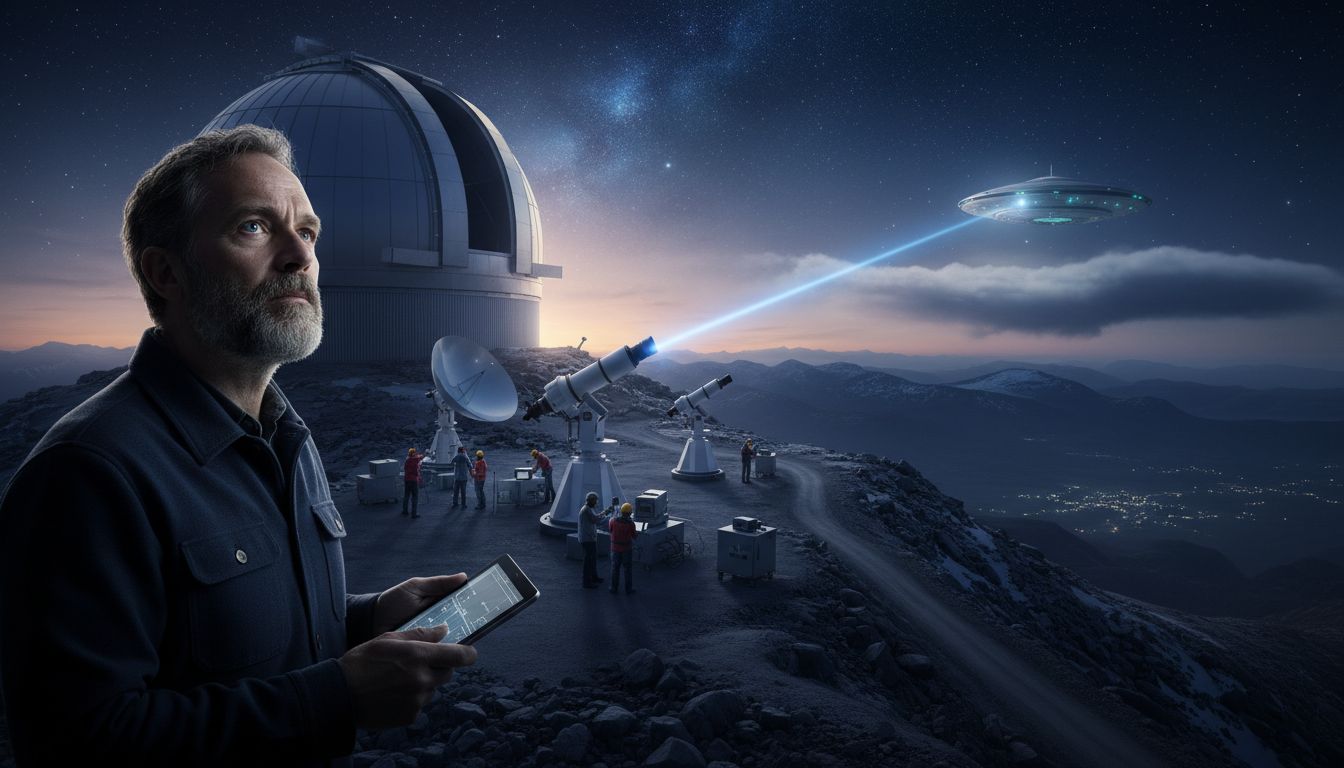
Harvard astrophysicist Avi Loeb announced that the Galileo Project – a privately funded, university‑based effort launched in 2021 – has reached a critical milestone: it now possesses a fully operational, peer‑reviewed framework for the independent detection and analysis of unidentified aerial phenomena (UAP). In a Medium post dated March 2, 2026, Loeb emphasized that the initiative is designed to “bypass traditional government disclosure channels” and provide the scientific community and the public with transparent data that can be evaluated without political or classified constraints. The move comes amid growing congressional interest in UAPs and a wave of declassified military footage, yet the Galileo Project seeks to answer lingering questions through open‑science methods rather than classified briefings.
Methodology
The project combines triangulation‑based optical tracking, high‑resolution spectroscopy, and machine‑learning classification to pinpoint the three‑dimensional trajectories of aerial objects. As Loeb explained, “By deploying synchronized cameras at three geographically separated sites, we can determine a target’s distance to within 10 % of its true range, a precision comparable to that used for commercial aircraft.” In addition to visible‑light sensors, the team has integrated radio‑frequency receivers and lidar arrays to capture a broader spectrum of signatures. All raw data are deposited in an openly accessible repository, and analysis pipelines are submitted to peer‑reviewed journals, ensuring reproducibility and scrutiny by independent experts.
Early Findings
Since the system became fully operational in late 2025, the Galileo team has logged over 2,300 observation windows, during which 47 anomalous events were flagged for further study. Most of these objects displayed conventional flight characteristics—consistent speeds, predictable aerodynamics, and identifiable radar cross‑sections. However, seven instances exhibited non‑Keplerian accelerations and spectral lines that did not match known atmospheric constituents or propulsion exhausts. Loeb cautioned that “these outliers are not evidence of extraterrestrial technology, but they do merit rigorous, unbiased investigation.” The findings have already prompted collaborations with atmospheric physicists and aerospace engineers to rule out experimental drones, meteoritic debris, or sensor artifacts.
Scientific and Policy Implications
By delivering transparent, peer‑reviewed results, the Galileo Project offers a credible alternative to the often‑opaque government reports that have dominated UAP discourse. The approach could reshape policy discussions: legislators seeking reliable evidence now have a non‑classified source to cite, while defense agencies may find value in an independent verification layer for sightings that intersect with national security concerns. Moreover, the project’s open data model aligns with broader calls for scientific integrity in the study of anomalous phenomena, echoing recommendations from the 2023 National Academies report that urged “systematic, reproducible research free from political bias.”
Next Steps
Looking ahead, the Galileo team plans to expand its sensor network to four additional sites across three continents, enhancing global coverage and enabling continuous monitoring of high‑traffic airspace. Funding for the expansion has been secured through a consortium of philanthropic foundations and private donors who share Loeb’s vision of a “science‑first” pathway to understanding UAPs. The next phase will also involve public data releases every quarter, accompanied by detailed methodological appendices, to foster community engagement and interdisciplinary analysis. As Loeb concluded, “If we are to answer the profound question of whether we are alone, the answer must come from data that anyone can examine, not from sealed dossiers.”


