Overview
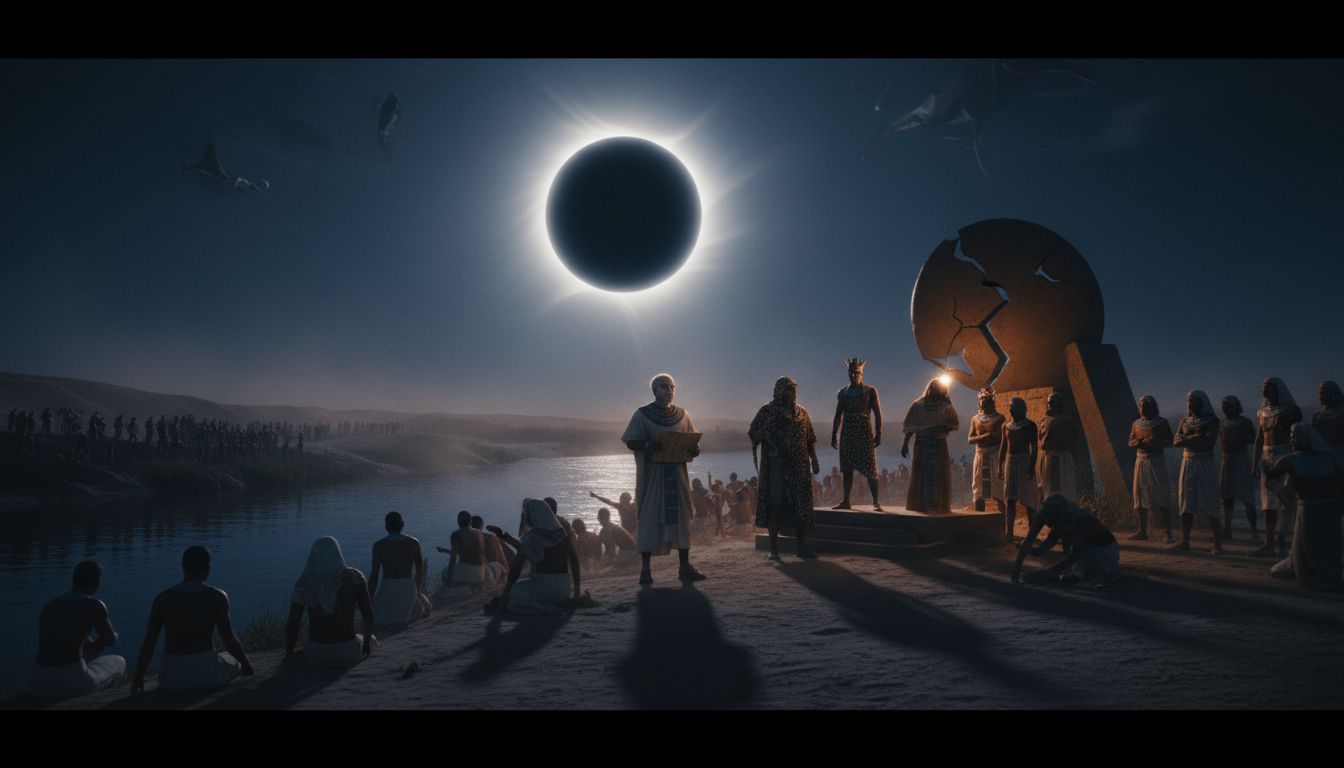
A team of researchers led by Italian archaeo‑astronomer Giulio Magli has proposed that a total solar eclipse on April 1, 2471 B.C.—the first recorded in the Nile Delta—may have been a pivotal catalyst for the abrupt decline of sun worship during Egypt’s Fourth Dynasty. The hypothesis, detailed in a recent paper and reported by GreekReporter.com, links the celestial event to the brief reign of Pharaoh Shepsekaf (also known as Shepseskaf), whose departure from the traditional cult of Ra marked a significant religious shift in ancient Egyptian society.
The Eclipse Event
Using modern eclipse‑prediction software, Magli traced the path of totality for the 2471 B.C. eclipse and found that it passed directly over the fertile lands of the Nile Delta, where the capital city of Menkaure and the surrounding necropolis lay. Contemporary accounts, though scarce, suggest that the sudden darkness would have been dramatic: the sun’s disc vanished for several minutes, stars became visible, and the river’s surface reflected an eerie twilight. Such a phenomenon would have been unprecedented for a civilization whose calendar and mythology were tightly bound to the daily rise and set of the sun.
Archaeological Correlation
The timing of the eclipse coincides with a short, poorly documented reign that followed the death of Khafre. Shepsekaf’s sole monumental project, the Mastaba of Shepseskaf at Saqqara, lacks the sun‑aligned orientation and solar symbolism that characterized the pyramids of his predecessors. Moreover, inscriptions from the period show a reduction in the use of the sun‑disk (Aten) and the falcon‑headed sun god Ra on royal seals and temple reliefs. Some scarab seals even depict a lunar crescent, hinting at a possible re‑orientation toward moon worship or a more neutral pantheon.
Scholarly Interpretation
In an interview, Magli explained, “When a total eclipse occurs, it is not merely an astronomical curiosity; it is a profound psychological shock. For a culture that equated the sun with divine order, witnessing its sudden disappearance could undermine the perceived invincibility of the sun‑god.” He adds that the political instability of the late Fourth Dynasty—evident in the rapid succession of rulers—may have amplified the eclipse’s impact, providing a convenient pretext for Shepsekaf to distance his regime from the entrenched Ra cult. Critics caution that the correlation does not prove causation, but they acknowledge that the alignment of archaeological, textual, and astronomical data is “remarkably compelling.”
Implications and Future Research
If Magli’s theory holds, it would represent one of the earliest documented cases where a natural celestial event directly influenced religious practice and state ideology. The study encourages a re‑examination of other ancient societies that experienced dramatic eclipses, such as the Minoans and Mesopotamians, for similar patterns of cultural transformation. Ongoing excavations at Saqqara aim to uncover more inscriptions from Shepsekaf’s reign, while astronomers are refining eclipse models to verify the exact duration and magnitude of the 2471 B.C. event. As the debate unfolds, the proposal underscores the intricate interplay between sky phenomena and human belief systems, reminding us that even the most ancient civilizations were not immune to the awe‑inspiring power of the cosmos.


