Overview
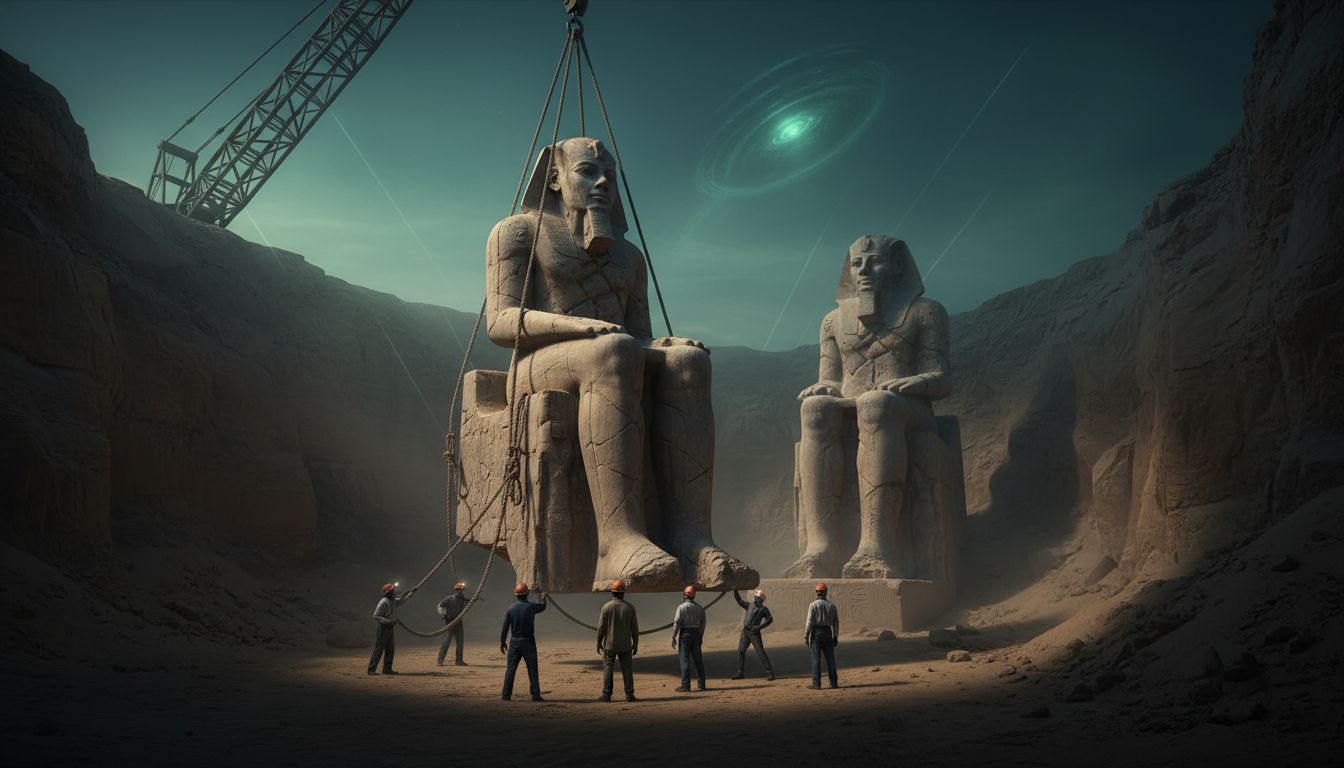
Archaeologists working in El Ashmunein—the modern name for the ancient city of Hermopolis Magna—have uncovered a 12.5‑foot limestone fragment that completes the upper half of a seated statue of Ramesses II. The piece, discovered in early 2024, matches the lower half unearthed by German teams in the 1930s, offering the first chance in nearly a century to reassemble one of the largest known seated representations of the 19th‑Dynasty pharaoh. The find was announced by Egypt’s Ministry of Tourism and Antiquities and confirmed by an international field team that includes Egyptian and U.S. scholars.
The Discovery
The fragment was located during a targeted excavation of a secondary sector at the site, a former provincial capital that remained active through the Greco‑Roman period. Lead Egyptian archaeologist Basem Gehad described the statue’s condition as “unusually well‑preserved” despite centuries of burial in a high‑moisture zone affected by fluctuating groundwater levels after the construction of the Aswan Low Dam. The limestone slab, carved in a ceremonial pose with a headdress and a partially visible royal cobra, aligns precisely with the iconography of Ramesses II’s seated statues known from other New Kingdom contexts.

A section of a limestone statue of Ramesses II unearthed by an Egyptian‑U.S. archaeological mission in El Ashmunein. Credit: Egyptian Ministry of Antiquities/Handout via REUTERS
Pigment Traces and Artistic Insight
Laboratory analysis of the stone surface revealed blue and yellow pigments still adhering to the limestone, a rare survival of New Kingdom coloring techniques. The research team, co‑led by Yvona Trnka‑Amrhein of the University of Colorado Boulder, is conducting compositional tests to identify the mineral sources—likely lapis lazuli or azurite for blue and ochre for yellow. “These pigments can tell us not only how the statue originally looked but also where the raw materials were sourced, shedding light on trade networks during Ramesses II’s reign,” Trnka‑Amrhein said. The findings could refine scholarly understanding of royal coloration, which was traditionally thought to have faded entirely from most stone sculptures.
Historical Context
The lower half of the statue was first documented by a German expedition in the 1930s, when workers uncovered a massive seated figure but were unable to locate its counterpart. At the time, the fragment was catalogued and stored in the Egyptian Museum, yet the missing upper portion remained a mystery for 96 years. Hermopolis, historically a hub of worship for the god Thoth, hosted numerous New Kingdom monuments, making it a focal point for recent archaeological surveys aimed at mapping the region’s architectural evolution. The new fragment confirms that the statue originally stood in a prominent temple precinct, likely serving both a political and religious function.
Next Steps and Conservation
Egyptian authorities have announced plans to reassemble the two halves in a controlled environment, followed by a public exhibition that will allow scholars and visitors to view the statue in its near‑original form. Conservation experts will stabilize the pigments and address moisture‑related deterioration before any display. “Our priority is to preserve the integrity of both the stone and the ancient colors,” said Dr. Laila Hassan, senior conservator at the Ministry of Antiquities. The project, expected to span two to three years, will also involve digital documentation, enabling virtual reconstructions for researchers worldwide. If successful, the restored statue will become a centerpiece for future studies on New Kingdom royal iconography and the logistical capabilities of ancient Egyptian artisans.


