Overview
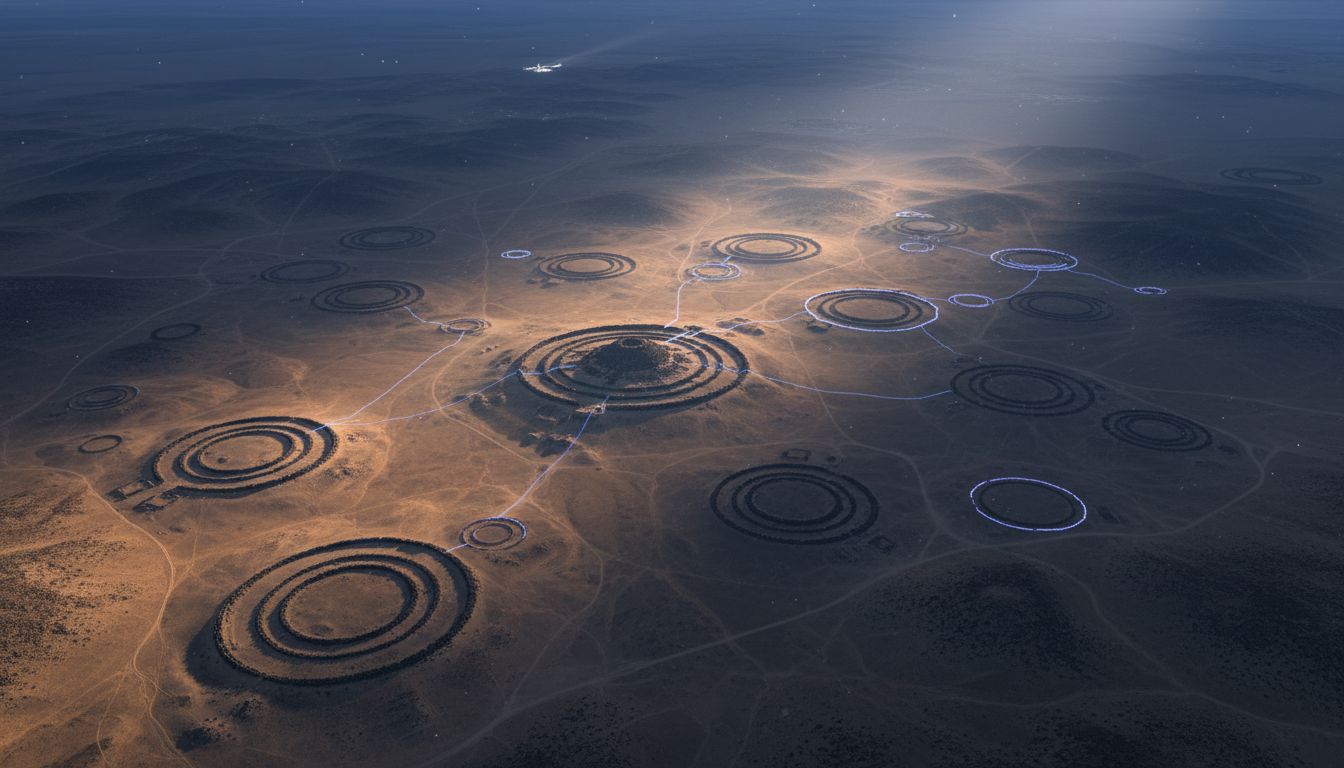
Archaeologists employing artificial‑intelligence (AI) analysis of high‑resolution satellite imagery have identified more than 30 large basalt stone circles scattered across the Golan Heights and adjacent regions of northern Israel. The discovery, detailed in a recent PLOS ONE paper, overturns the long‑standing view that the enigmatic Rujm el‑Hiri—often dubbed the “Wheel of Giants” or “Israeli Stonehenge”—was a solitary monument. Instead, the new data suggest a regional tradition of megalithic construction that dates back between 3,500 and 6,500 years.
Methodology
The research team compiled multi‑temporal satellite datasets from 2004 to 2024, drawing on imagery from several commercial platforms. By training convolutional neural networks to filter out shadows, seasonal vegetation, and surface noise, the AI could highlight subtle circular patterns that conventional aerial surveys missed. The algorithm flagged candidate sites, which were then cross‑checked against existing archaeological records. Of the 32 circles identified within a 25‑kilometre radius of Rujm el‑Hiri, 28 were previously undocumented, underscoring the power of remote‑sensing technologies in uncovering hidden cultural landscapes.
Key Findings
The newly mapped circles share a consistent architectural logic: outer walls of basalt fieldstones arranged in concentric rings, often intersected by radial or orthogonal stone divisions. Their diameters range from roughly 15 m to 76 m (50–250 ft), and many are situated on gently sloping plateaus or near seasonal water sources. While the preservation state varies—some appear heavily eroded—their spatial clustering near dolmens, tumuli, and ancient field‑wall networks points to a broader ritual or territorial function. The most elaborate example remains Rujm el‑Hiri, a complex spanning over 150 m in diameter and containing an estimated 40,000 tons of stone, but it now appears as the flagship of a larger cultural phenomenon rather than an isolated outlier.
Scholarly Context
The findings challenge earlier interpretations that treated the Wheel of Giants as a unique astronomical observatory. In a 2025 study, lead researcher Michal Birkenfeld demonstrated that the site’s structural components shift only 8–15 mm per year, weakening arguments for precise celestial alignment. Birkenfeld now emphasizes that “Gilgal Refaim is, of course, a very well‑known site, and it was always considered to be a very unique site in the area,” but adds, “Most of the sites we discovered were not as elaborate and were of different sizes and levels of preservation, but they still have the same type of logic.” The broader distribution of similar monuments aligns with patterns observed in other Near Eastern megalithic traditions, suggesting shared social or ceremonial practices across the Levant during the Late Chalcolithic to Early Bronze Age.
Future Directions
The researchers plan to conduct ground‑truthing surveys at selected satellite‑identified locations to verify construction techniques, chronology, and possible artifact assemblages. Collaboration with local heritage authorities will be essential to protect these sites, many of which lie in geopolitically sensitive areas of the Golan Heights. Moreover, the success of AI‑driven remote sensing in this project is prompting calls for similar investigations across the broader Eastern Mediterranean, where other “Stonehenge‑style” structures may await discovery. As the archaeological community integrates these new data, the narrative of prehistoric monument building in the region is poised for a significant revision, moving from an isolated marvel to a networked cultural landscape.