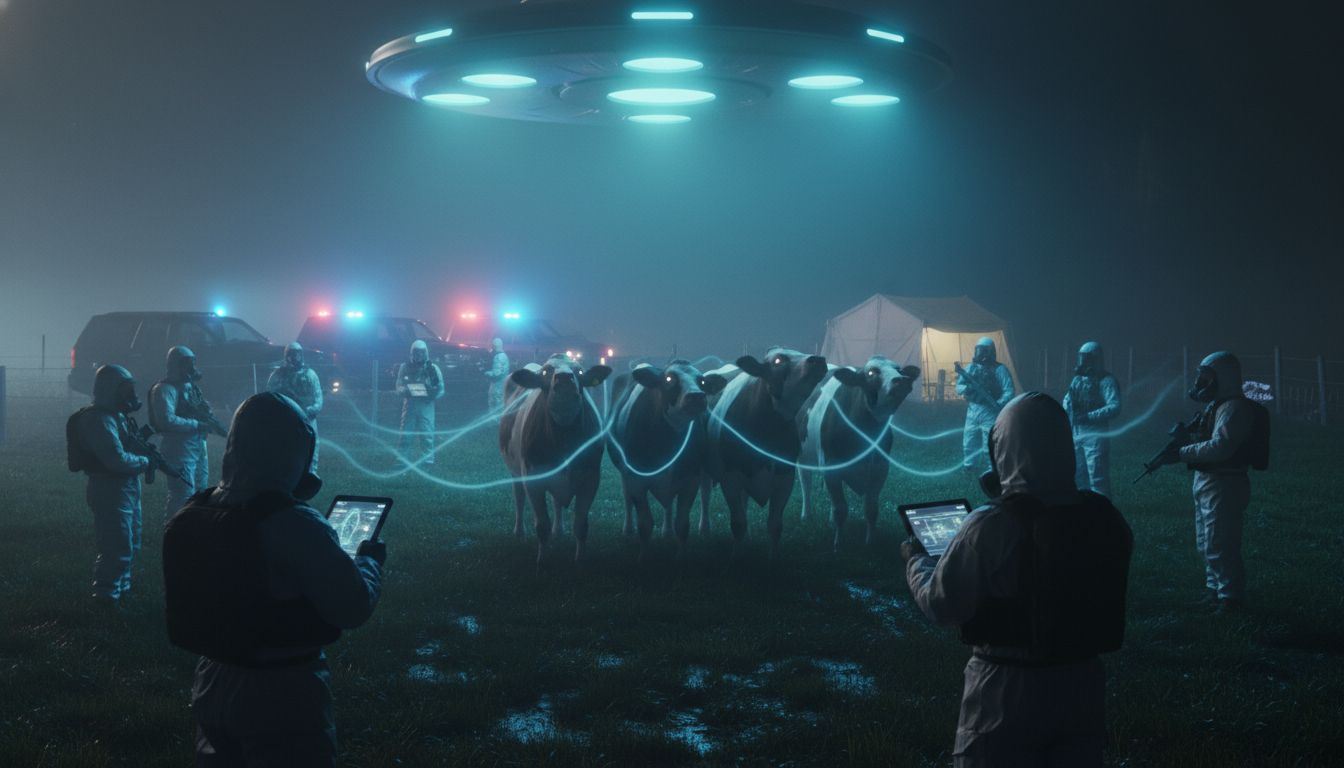
Farmers in the northern district of Himachal Pradesh reported that a group of cattle appeared “entranced” after a sudden display of bright, pulsing lights hovered over their pasture on the night of October 22. Several herders described the animals standing motionless, eyes fixed upward, for an estimated ten to fifteen minutes before resuming normal activity. The incident, which quickly spread through local social‑media groups, prompted the state’s Department of Animal Husbandry to request an investigation from the Ministry of Home Affairs.
Within 48 hours, a joint task force comprising officials from the Ministry of Home Affairs, the Indian Air Force’s technical cell and the National Centre for Scientific Research (NCSR) was dispatched to the site. According to a spokesperson for the task force, “We are collecting visual, acoustic and electromagnetic data to determine the nature of the phenomenon. Our primary concern is the welfare of the livestock and the safety of the local community.” The team set up portable spectrometers, high‑sensitivity cameras and radio‑frequency detectors, but the initial field report was subsequently classified under the Official Secrets Act, with the ministry citing “national security implications.”
The decision to seal the probe has reignited public speculation about unidentified aerial phenomena (UAP), a topic that has gained renewed attention worldwide after the U.S. Department of Defense de‑classified several UAP videos in 2023. India’s own UAP task force, announced in 2022, has been tasked with cataloguing and analyzing anomalous aerial observations, but details of its findings have remained largely undisclosed. Defense analyst Rohan Mehta notes, “When an investigation is moved to a confidential status, it often reflects either a sensitive technology being examined—potentially a foreign surveillance platform—or an effort to protect classified research that could have dual‑use implications.”
Scientific explanations remain plausible. Dr. Ananya Rao, a behavioural ecologist at the University of Delhi, points out that “cattle are highly sensitive to sudden changes in light intensity and frequency. Certain strobe‑like emissions can trigger a ‘freeze’ response, similar to the startle reflex observed in many mammals.” She adds that atmospheric phenomena such as ball lightning or rare meteorological events can produce brief, bright flashes that might affect animal perception. However, Dr. Rao cautions that without access to the field data, “any hypothesis remains speculative.”
Local authorities have also emphasized the need for calm. District Collector Arvind Singh urged residents not to jump to conclusions, stating, “We are following standard protocols. The classification does not imply any imminent threat, but it does indicate that the matter involves information that, if disclosed, could compromise ongoing security measures.” The Ministry of Home Affairs has promised a formal briefing to the state government once the investigation reaches a conclusive stage, though no timeline has been provided.
As the mystery deepens, the episode underscores the growing intersection between rural life, emerging aerial technologies and national security considerations. Whether the lights were a natural atmospheric anomaly, a clandestine test of advanced equipment, or an as‑yet‑unidentified aerial vehicle, the episode has reminded both officials and the public that the skies above India continue to host phenomena that challenge conventional understanding.


