Overview
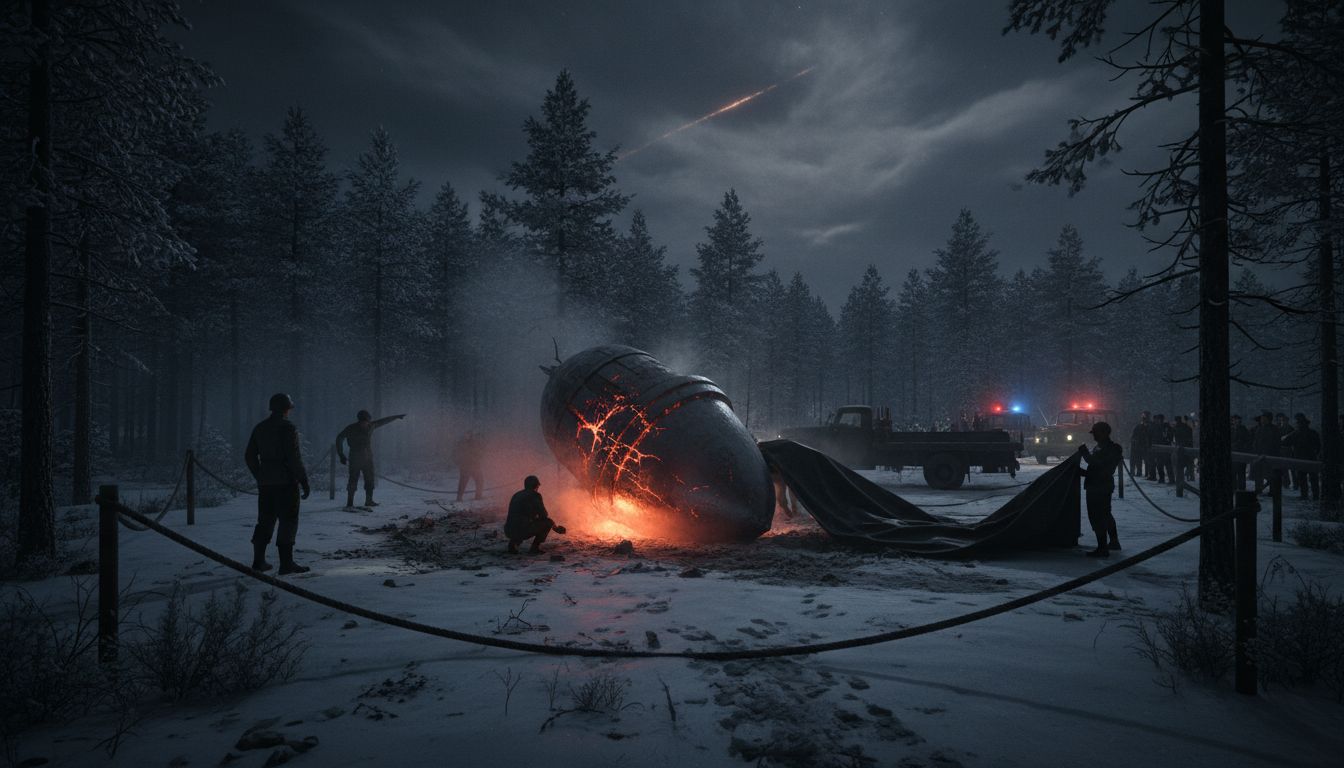
On the evening of December 9, 1965, a brilliant fireball streaked across the skies of the northeastern United States and southern Ontario. The phenomenon was reported by thousands of observers from Michigan to New York, and by residents of the small Pennsylvania town of Kecksburg, located about 30 miles south of Pittsburgh. Within minutes of the flash, witnesses described a “thump” and a brief vibration, after which a metallic, acorn‑shaped object allegedly came to rest in a densely forested area near the town. The incident quickly became known as the “Roswell of Pennsylvania,” and it has remained a focal point for UFO researchers, military historians, and meteorite specialists for six decades.
Eyewitness Accounts
Local resident Bill Bulebush recounted that the object “moved just like it was controlled” before striking the ground. He claimed to have approached the crash site and found a 10‑foot-long, glowing, acorn‑shaped craft that emitted sparks before he fled when other people arrived. Volunteer firefighter James Romansky, who initially thought the event might be a plane crash, reported seeing a metallic object with a smooth, tapered body and a series of rivets along its surface. The Greensburg Tribune‑Review quoted military officials as saying the object “appeared to be an unidentified flying object, possibly the same one seen streaking across seven northeastern states and Canada.” While the accounts vary in detail, they share consistent descriptions of a controlled descent and an unusual, non‑natural shape.
Official Response
Within hours of the sighting, U.S. Army, National Guard, and State Police units established a perimeter around the alleged impact zone. The Greensburg Tribune‑Review noted that the area was “cordoned off on the order of U.S. Army and State Police officials,” and that “no one was allowed near the area,” fueling speculation about possible radioactive or classified material. Military spokespeople told United Press International that no rockets had been launched that night, and the Air Force denied involvement in any test flight. However, the rapid deployment of troops and the removal of the object—reported to have been taken away on a military truck—suggested a level of secrecy that has kept the case alive in public memory.
Competing Theories
Researchers have offered three primary explanations for the Kecksburg event.
Meteorite – Some scientists argue that the fireball was a natural bolide that fragmented and landed in the woods, with the “acorn‑shaped” description arising from a partially melted stone. No recovered meteorite has ever been publicly identified, and the lack of a crater or typical impact evidence challenges this view.
Soviet Satellite – Cold‑War analysts note that the timing coincides with the launch of Kosmos 961, a Soviet reconnaissance satellite that re‑entered Earth’s atmosphere in late 1965. If a fragment survived re‑entry, it could explain the metallic construction and the military’s interest in securing the debris before it fell into Soviet hands.
Classified U.S. Device – A third hypothesis posits that the object was a top‑secret U.S. test vehicle, such as a high‑altitude balloon or a prototype aerospace craft. The swift military response and the removal of the object without public disclosure align with standard procedures for safeguarding classified technology.
Each theory has supporters, but none has been definitively proven. The lack of official documentation—most of which remains classified or has been lost—prevents a conclusive determination.
Legacy and Ongoing Inquiry
The Kecksburg incident continues to attract attention from both scholarly and popular audiences. In recent years, the Pennsylvania Center for the Book has catalogued the event as part of the state’s cultural heritage, while UFO investigative groups have organized annual “Kecksburg Days” gatherings to interview surviving witnesses. A 2024 Freedom of Information Act request yielded a handful of declassified memos indicating that the Air Force’s Project Blue Book examined the case but concluded that “insufficient data exist to determine the nature of the object.”
As the 60th anniversary approaches, historians emphasize the need for rigorous, evidence‑based analysis rather than speculation. Whether the object was a meteor, a Soviet satellite fragment, or a classified American craft, the Kecksburg incident remains a reminder of the challenges inherent in investigating anomalous aerial phenomena—especially when national security concerns intersect with public curiosity.


