Overview
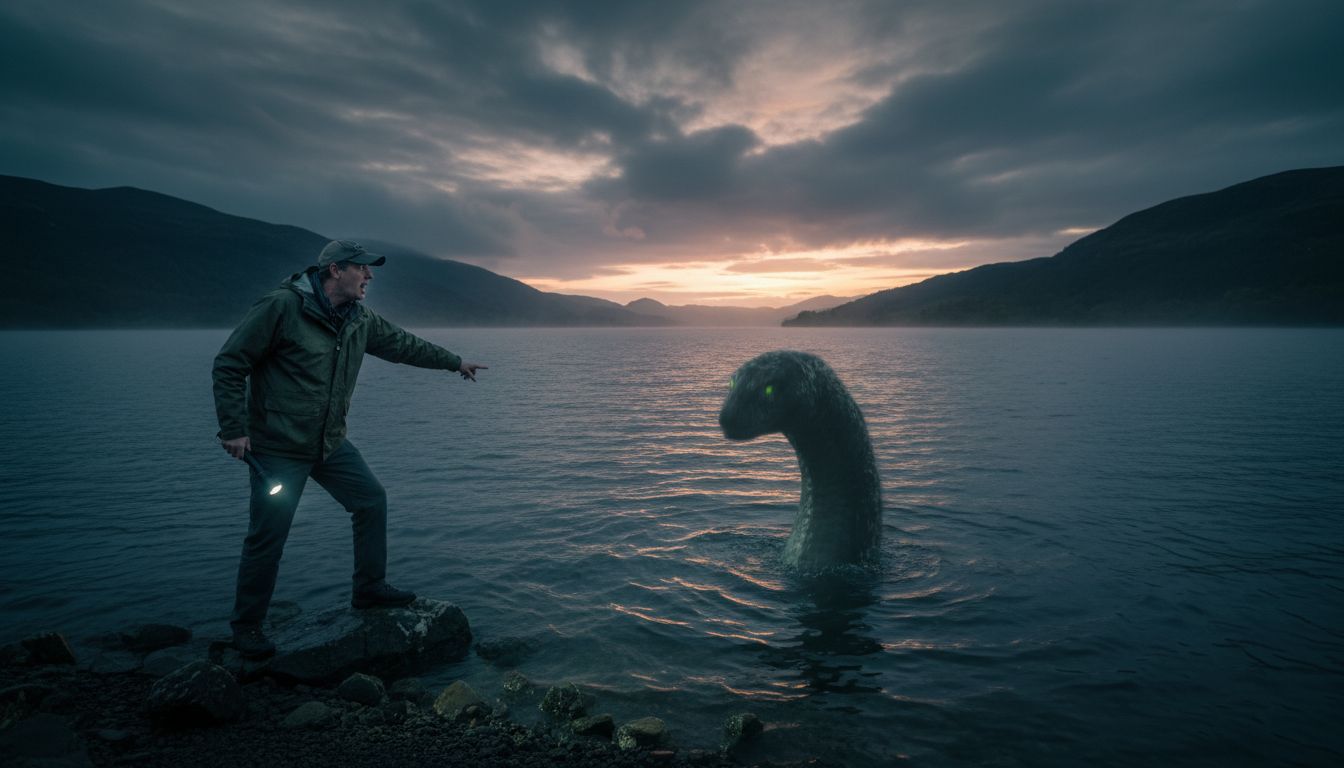
On April 13, 2026, an American tourist became the first person to file an official Loch Ness Monster sighting for the year, according to a report aired on Coast to Coast AM. The brief encounter, lasting roughly five seconds, occurred near the Caledonian Canal, where the witness described a “sizeable anomaly” lifting about two feet out of the loch’s surface before disappearing. The claim has been logged with the Scottish Association for Marine Science (SAMS), which maintains a formal registry of reported cryptid observations in the region.
The 2026 Sighting
The tourist, who asked to remain anonymous for safety reasons, was kayaking along the western shore of Loch Ness when the anomaly appeared. “It was a dark, elongated shape, moving silently and then rising just enough for me to see a hint of something… like a large neck and a small head,” the witness told Coast to Coast AM host George Noory. The sighting was captured on a handheld video that, while grainy, shows a brief disturbance on the water’s surface consistent with the description. SAMS officials noted that the observation met their criteria for an “official” report: a clear time‑stamp, location data, and a first‑hand account.
Historical Context
Loch Ness has hosted a steady stream of alleged monster sightings since the infamous “Surgeon’s Photograph” of 1934, later debunked as a hoax. The most comprehensive early investigation was conducted by Rupert T. Gould in 1933, whose findings were compiled in the 1934 classic The Loch Ness Monster and Others. Gould’s work laid the groundwork for modern cryptozoological research, emphasizing photographic analysis and eyewitness testimony. Despite decades of sonar sweeps, underwater photography, and scientific expeditions, no conclusive evidence of a large unknown aquatic creature has emerged, making each new credible report a point of interest for both scientists and the public.
New Publication Release
In a related development, journalist Roland Watson highlighted the release of a digitized PDF of Gould’s 1934 volume, now freely accessible through the University of Edinburgh’s digital archive. Watson remarked, “Making Gould’s original field notes and photographs available online provides scholars a rare glimpse into the early methodology that shaped Loch Ness research.” The PDF includes Gould’s original sketches, correspondence with contemporaries, and a detailed account of his 1933 fieldwork, offering a valuable reference for anyone evaluating modern sightings against historical data.
Reactions and Next Steps
Local authorities and marine biologists have responded cautiously. Dr. Fiona MacLeod of the Scottish Marine Institute said, “While the video is inconclusive, the sighting meets our reporting standards and will be added to the longitudinal database for pattern analysis.” The Scottish government’s tourism board, meanwhile, noted a modest uptick in visitor interest, stressing that “responsible tourism and respect for the environment remain paramount.” As the video undergoes further expert review, the 2026 sighting adds another layer to the enduring mystery of Loch Ness, reminding both skeptics and believers that the legend continues to evolve.