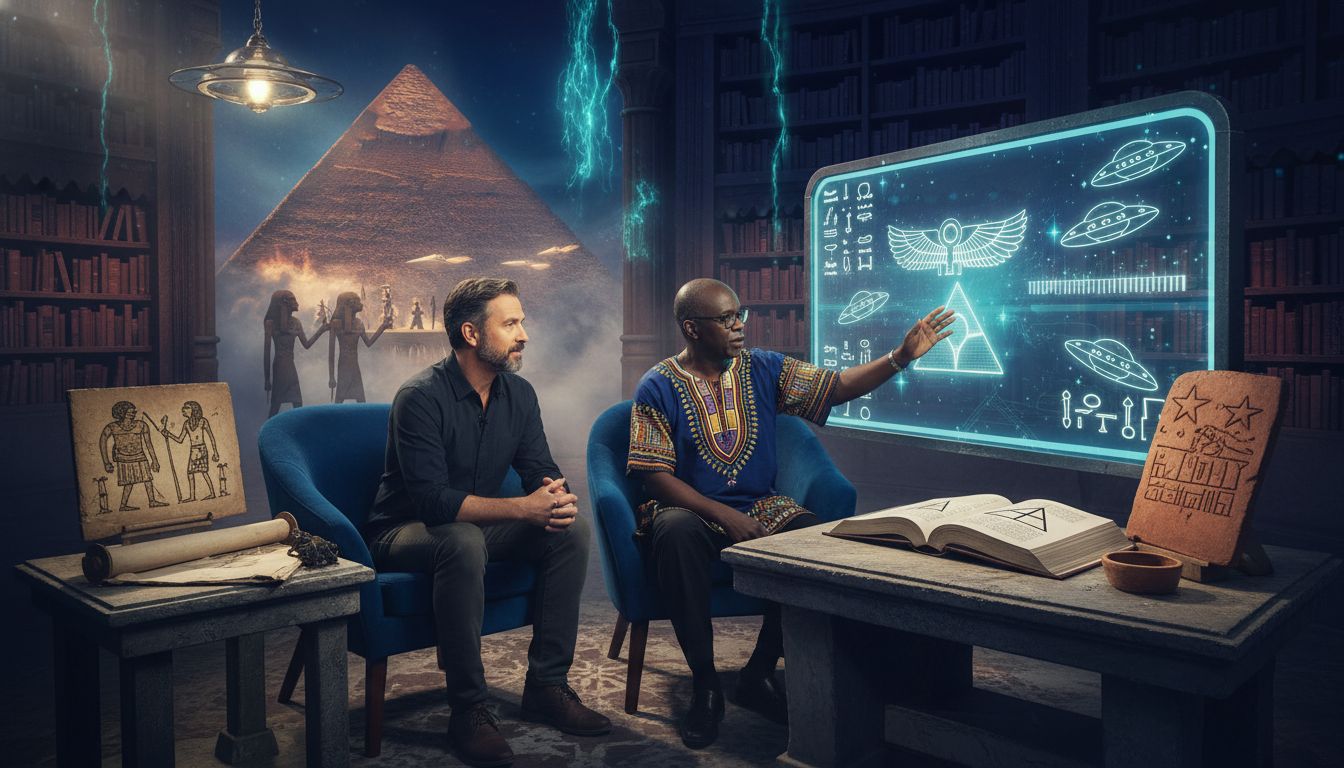
The Dreamland podcast, part of Whitley Strieber’s “Unknown Country” network, aired a new episode on November 7, 2025 in which host James Faulk sat down with Professor Tim Murithi, a cultural anthropologist at the University of Nairobi, to examine the long‑standing UFO and unidentified aerial phenomenon (UAP) narratives that have emerged from Africa. Murithi framed the discussion around three historical strands: the visual motifs found on ancient Egyptian artifacts, the astronomical traditions of the Dogon people of Mali, and a contemporary literary work, Thiaoouba Prophecy, which he likened to the apocryphal Book of Enoch in its claim of extraterrestrial contact. “What we see in the Egyptian tomb paintings are often stylized representations of the sun‑disk and the celestial barque,” Murithi explained, “and while they are striking, they fit comfortably within the symbolic language of the time rather than evidence of advanced technology.”
The conversation moved quickly to the Great Pyramid of Giza, a structure that continues to attract speculative theories about alien engineering. Murithi highlighted recent scholarship that attributes the pyramid’s precise orientation to sophisticated, but terrestrial, astronomical observations. “The alignment with true north is within a fraction of a degree, a feat achievable with the shadow‑tracking methods known to Old Kingdom architects,” he said, citing a 2023 paper by Egyptologists at the University of Cambridge. He contrasted this with the more sensational claims that the pyramid’s internal chambers were designed to house “spacecraft,” noting that no material evidence supports such an assertion.
Turning to West Africa, Murithi discussed the Dogon’s famed knowledge of Sirius B, a white dwarf star invisible to the naked eye. While early 20th‑century anthropologists such as Marcel Griaule reported that the Dogon possessed detailed astronomical information, more recent fieldwork suggests that this knowledge likely entered the community through contact with French missionaries and scholars. “Oral traditions are fluid,” Murichi observed, “and the Dogon’s cosmology reflects a synthesis of indigenous belief and external influence, not a direct transmission from an extraterrestrial source.”
The episode also introduced Thiaoouba Prophecy, a 1994 French‑language memoir that claims the author was abducted to a distant planet called Thiaoouba, where he received spiritual teachings. Murithi positioned the book alongside the Book of Enoch, noting that both texts serve as “cultural mirrors” projecting contemporary hopes and anxieties onto imagined otherworldly realms. He cautioned listeners against equating such narratives with empirical evidence, emphasizing that the allure of alien contact often fills gaps left by incomplete historical records.
In a broader context, the podcast referenced two recent articles from the same platform: one examining disputed claims that Roman shipbuilders possessed “anti‑gravity” technology, and another exploring mysterious “holes” discovered in a Peruvian archaeological site. Both pieces, according to Murithi, underscore a pattern of sensational headlines that outpace the archaeological record. “The responsible approach is to let the data speak,” he concluded, “and to recognize that human ingenuity, not extraterrestrial intervention, explains the remarkable achievements we see across cultures.” The episode thus reaffirmed a growing consensus among scholars: while UFO lore remains a compelling facet of popular imagination, grounded archaeological methodology continues to provide the most reliable explanations for Africa’s ancient wonders.


