Overview
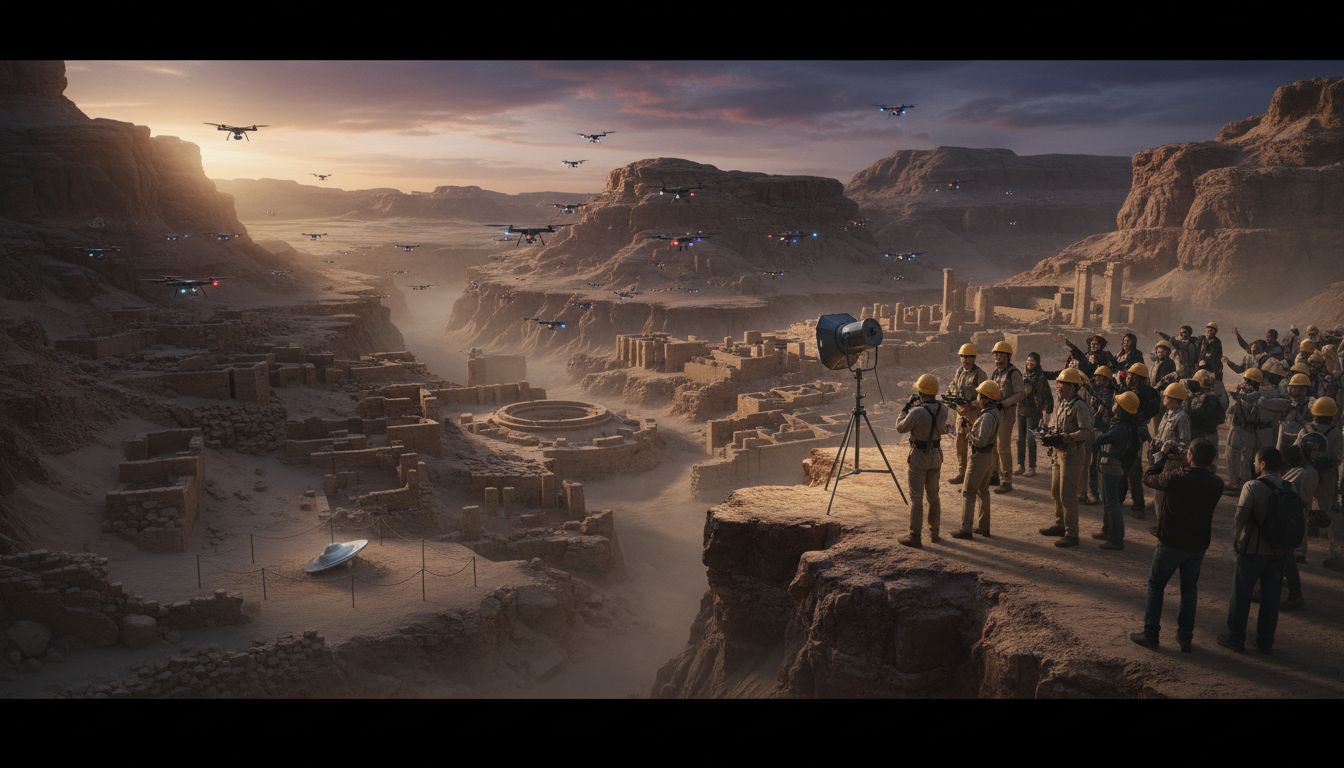
Archaeologists from Italy’s National Institute of Archaeology announced on February 26, 2026 that a previously unknown ancient city has been identified using high‑resolution drone imaging along the historic Appian Way (Via Appia) near the town of Ariccia. The discovery, made during a routine aerial survey of the 2,300‑year‑old Roman road, has been described by officials as “a source of great pride” for the nation and a potential catalyst for cultural tourism in the region. The site, which appears to date to the late Republican or early Imperial period, was first flagged by anomalous terrain patterns captured by LiDAR‑equipped drones and later confirmed through limited ground‑penetration radar and surface artefact collection.
Discovery Details
The research team, led by Dr. Luca Moretti, deployed a fleet of autonomous quad‑copters equipped with multispectral cameras and LiDAR sensors to map the densely vegetated corridor adjacent to the Appian Way. “The drones revealed a grid‑like layout of streets, plazas, and building foundations that were invisible to the naked eye,” Moretti explained in a press briefing. Subsequent on‑site verification uncovered fragments of Roman pottery, a fragmentary marble column, and a series of paving stones consistent with the tabular road construction typical of the era. Preliminary dating, based on ceramic typology and stratigraphic analysis, points to occupation between 100 BCE and 50 CE.
Historical Significance
If further excavation confirms the preliminary dating, the settlement could represent a satellite community that serviced travelers and merchants moving between Rome and southern Italy. Historians have long debated the extent of ancillary towns that flourished alongside the Appian Way, a route that facilitated military movements, trade, and cultural exchange throughout the Republic and Empire. “Finding a city of this scale in such proximity to the Appian Way challenges our assumptions about the density of urban development in the Roman countryside,” noted Professor Maria Rossi, a specialist in Roman urbanism at the University of Rome La Sapienza. The layout—featuring a central forum, residential blocks, and a possible water management system—suggests a degree of planning comparable to other known Roman municipia.
Cultural & Economic Impact
Local and national officials quickly highlighted the discovery’s potential to boost cultural tourism. Ariccia’s mayor, Giuseppe Bianchi, said, “This find is a source of great pride for our community and offers an unprecedented opportunity to attract visitors interested in authentic Roman heritage.” The Italian Ministry of Culture has already earmarked €12 million for site preservation, visitor‑center construction, and the development of guided drone‑flight tours that will allow the public to view the ruins from the air without causing damage. Tourism analysts project that the site could increase regional visitor numbers by up to 15 percent over the next five years, providing economic stimulus to local hotels, restaurants, and artisan shops.
Next Steps
While the initial survey has confirmed the city’s existence, archaeologists stress that systematic excavation will be required to fully understand its layout, chronology, and social role. The team plans to conduct a phased dig beginning in the summer of 2026, prioritizing areas that appear to contain public buildings and possible burial sites. Collaboration with international partners, including the European Research Council and the U.S. National Geographic Society, will bring additional expertise in remote sensing and conservation. As Dr. Moretti concluded, “We are at the beginning of a remarkable journey that will not only rewrite a chapter of Roman history but also demonstrate how modern technology can uncover the hidden layers of our past.”


