Overview
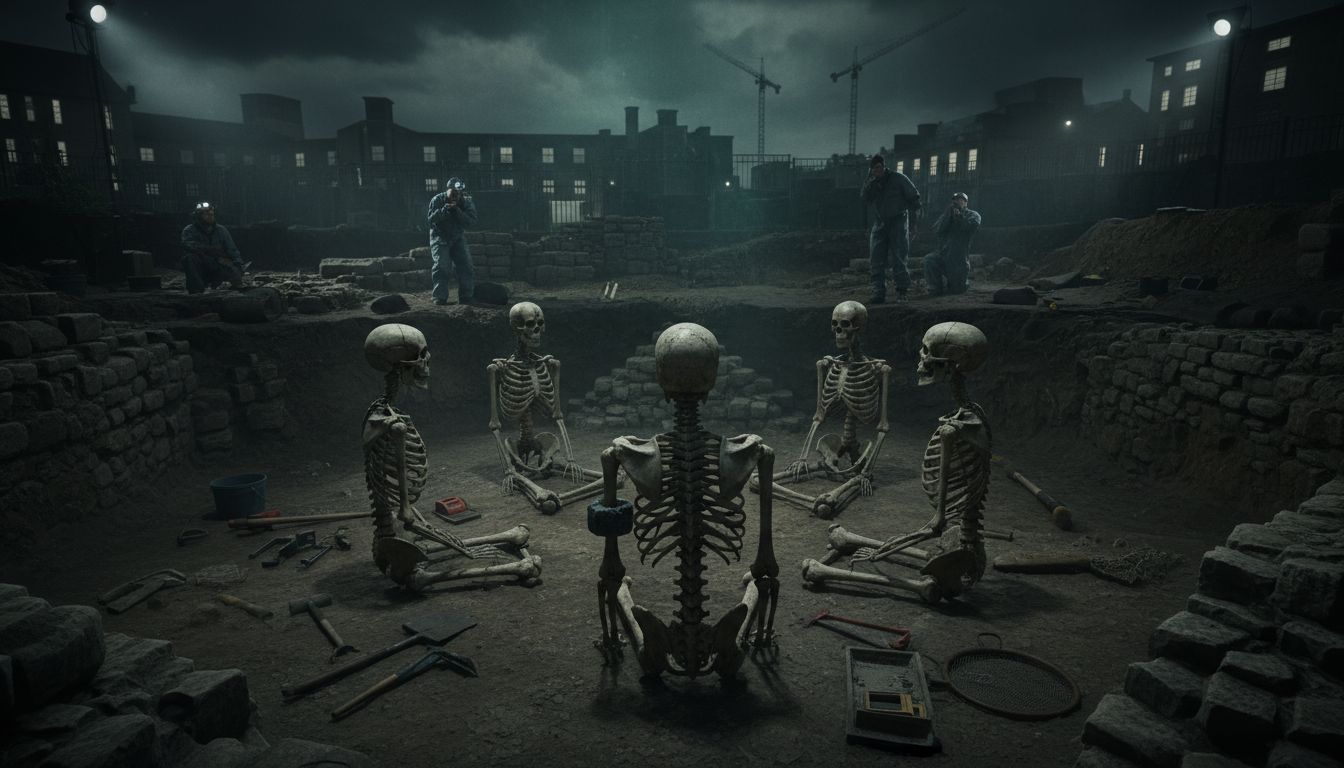
Researchers from the French National Institute for Preventive Archaeological Research (INRAP) announced the discovery of five Iron Age skeletons arranged in a seated position at the Joséphine Baker school in Dijon, France. The bodies, uncovered during a routine excavation in January 2025, were positioned on their buttocks with legs crossed, backs against an eastern wall and faces turned westward. Accompanying the adult remains, archaeologists also identified a nearby necropolis containing the remains of children dating to the Gallo‑Roman period, providing a rare glimpse into burial customs spanning several centuries.
Details of the Find
The five skeletons exhibit clear signs of violent death. Unhealed cuts on the humeri and a blunt‑force injury to one skull suggest intentional killing, though the specific weapons remain unknown. “These structures are generally well preserved despite significant erosion that has caused the displacement or even destruction of the less deeply buried bones,” the INRAP news release noted, underscoring the unusually intact state of the burials despite centuries of soil movement. Each individual was placed with arms resting along the torso and hands near the pelvis or femur, a uniformity that points to a deliberate ritual or punitive practice rather than a hasty interment.
A solitary black stone armband, dated to 300‑200 BCE through typological analysis, was the only personal artifact recovered. Its presence helped researchers link the remains to the Gallic (Gaulish) cultural sphere of the late Iron Age, a period marked by tribal societies that inhabited what is now modern France before Roman conquest.
Broader Archaeological Context
The Dijon site lies within a landscape already known for Gallo‑Roman activity. Adjacent to the adult burials, archaeologists uncovered a necropolis of roughly 20 infants and several children who likely died before their first birthday, with radiocarbon dates centering around the 1st century AD. This juxtaposition of Iron Age and Roman‑era burials illustrates a long‑term use of the area for funerary purposes, a pattern not uncommon in the Côte‑d’Or region where settlements were repeatedly re‑occupied over millennia.
Scholars note that seated burials are rare in Gallic contexts, where crouched or extended inhumations dominate the archaeological record. When seated positions do appear, they are often associated with ritualized sacrifice or execution, a hypothesis bolstered by the trauma evident on the bones. The orientation—facing west—mirrors certain Celtic cosmological beliefs that associate the setting sun with the afterlife, though definitive cultural interpretations remain tentative pending further analysis.
Significance and Next Steps
The discovery offers a unique data point for understanding social violence, funerary rites, and cultural continuity in pre‑Roman Gaul. By combining osteological assessment, artifact typology, and stratigraphic study, the team hopes to reconstruct the circumstances that led to the simultaneous burial of these individuals. Ongoing work includes DNA extraction to determine possible kinship among the five adults and isotopic analysis to infer diet and geographic origins.
INRAP plans to publish a comprehensive report later this year, and the site will be monitored to protect the surrounding necropolis from modern agricultural disturbances. As the French Ministry of Culture prepares a formal designation for the area, the findings underscore the importance of systematic archaeological monitoring at construction sites, where unexpected windows into the distant past can emerge beneath everyday structures such as a schoolyard.


