Overview
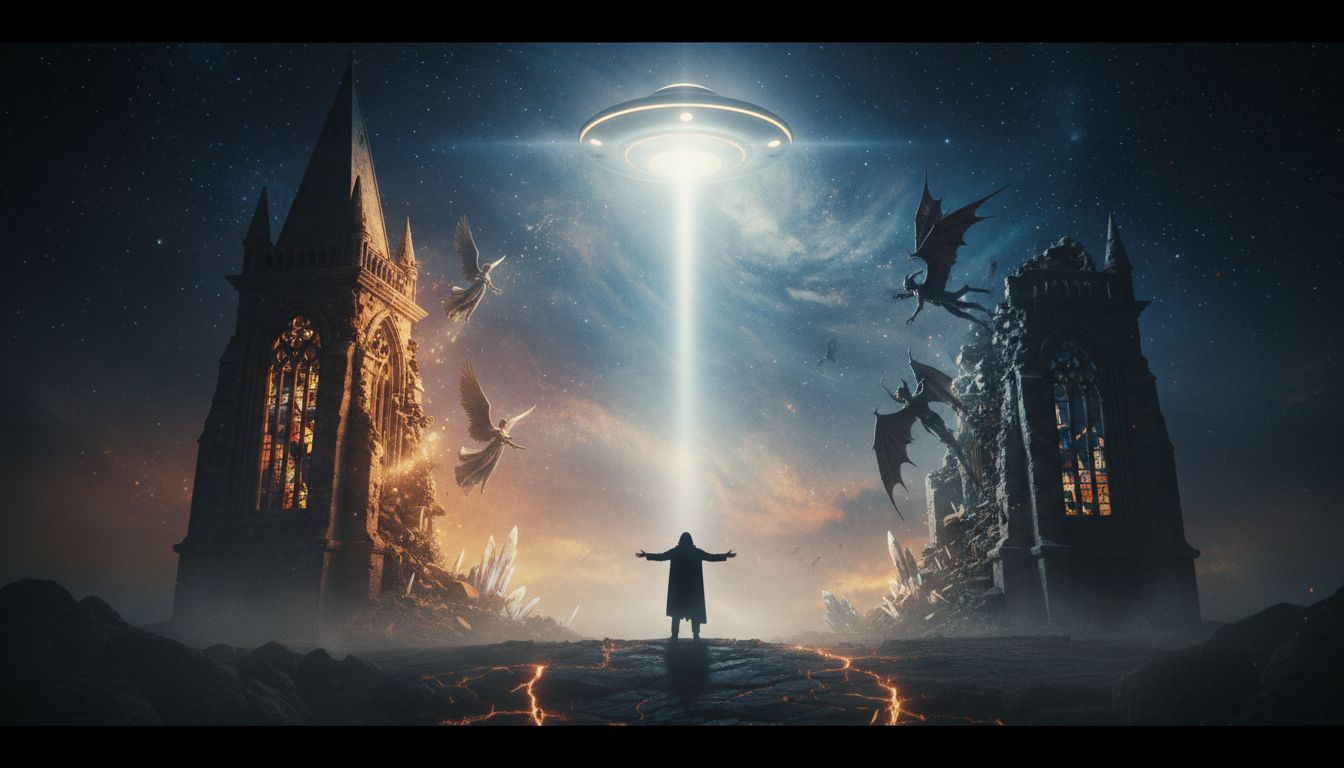
A wave of newly de‑classified government files on unidentified aerial phenomena (UAP) has reignited a debate that has long simmered at the intersection of science, politics, and faith. The releases, prompted by a directive from President Donald Trump in early May, contain more than 170 documents dating back to the 1940s, including farmer testimonies, military pilot videos, and internal agency analyses. While the material itself remains inconclusive about the existence of extraterrestrials, it has spurred a fresh round of theological reflection on whether such encounters belong to the realm of angels, demons, or something entirely new.
Historical Context
The tension between UFO sightings and religious doctrine is not new. As C.S. Lewis observed in his 1958 essay “Will We Lose God in Outer Space?”, every new scientific claim “is held at first to have the most wide‑reaching theological and philosophical consequences.” Lewis, a noted Oxford scholar and author of the Space Trilogy, warned that skeptics would seize any extraterrestrial hypothesis as a weapon against Christianity. Decades later, Jesuit astronomer Brother Guy Consolmagno echoed a similar caution in his 2014 book Would You Baptize an Extraterrestrial?, stating that “neither I, nor anyone I know, has any evidence that extraterrestrials exist.” These historical remarks underscore a persistent pattern: theologians are forced to confront the possibility of non‑human rational souls while lacking concrete proof.
Recent Political Catalysts
President Trump’s May 13 post on Truth Social—calling for the “identifying and releasing Government files related to alien and extraterrestrial life” and ending with “GOD BLESS AMERICA”—set the stage for the latest disclosures. The initial batch includes reports ranging from World War II‑era radar blips to the well‑known 2004 “Tic Tac” video captured by U.S. Navy pilots. Vice President J.D. Vance, appearing on a Benny Johnson podcast, added a theological spin, stating, “I don’t think they’re aliens, I think they’re demons anyway… Every great world religion… has understood that there are weird things out there.” Vance’s comments illustrate how political leaders are now framing UAP discussions in explicitly religious terms, a move that both amplifies public interest and complicates scholarly analysis.
Theological Reactions
Christian scholars are divided on how to interpret the new evidence. Some, like evangelical pastor Mark Hanson of the Institute for Faith and Science, argue that the phenomena could be manifestations of spiritual beings—“angels or demonic forces—acting within the physical world.” Others, such as Catholic theologian Dr. Maria López of the Pontifical Gregorian University, caution against conflating unexplained aerial events with doctrinal concepts of heaven and hell, noting that “the Church has always taught that the presence of evil does not preclude the existence of divine goodness.”
Religious studies scholar Diana Pasulka, whose research on medieval accounts of “orbs and discs” informed her 2019 book American Cosmic, sees a pattern of recurring imagery across centuries. “I found a lot of records of reported aerial sightings… People saw orbs, discs, and basically things that surprised them, flying around in the skies,” she told The European Conservative. Pasulka suggests that the modern UFO craze may be a contemporary expression of an age‑old human impulse to locate the divine—or the diabolical—within the unknown.
Looking Ahead
As the U.S. government continues to release additional files, scholars anticipate a more nuanced dialogue between science and religion. The next steps will likely involve interdisciplinary panels, such as the recently convened “UAP and Theology” symposium at Georgetown University, where physicists, theologians, and ethicists will assess the implications of any future credible evidence. For now, the consensus among experts remains cautious: without verifiable proof of extraterrestrial life, the theological questions remain speculative, but they are nonetheless shaping how believers and skeptics alike understand the cosmos.
The unfolding conversation underscores a broader cultural moment: humanity is once again asked to reconcile ancient spiritual narratives with the expanding frontier of the unknown. Whether the answer lies in angels, demons, or distant alien civilizations, the debate promises to influence both religious thought and public policy for years to come.


