Overview
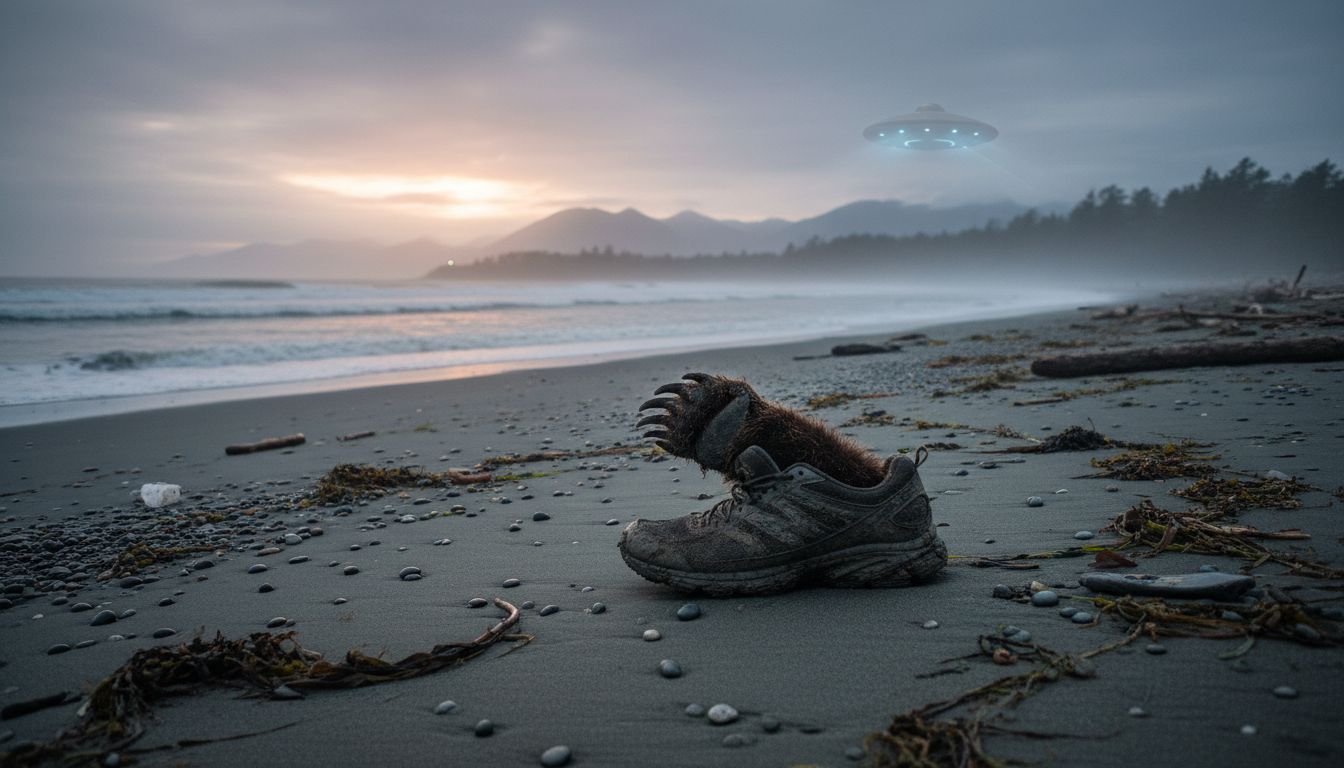
A single white Puma sneaker washed ashore on Dec. 9 at Port Williams Beach in Sequim, Washington, reigniting a bizarre series of beach‑side discoveries that have haunted the Pacific Northwest for years. Initial reports suggested the shoe contained a human foot, a scenario that typically triggers a full‑scale police and coroner response. Two days later, however, the Clallam County Sheriff’s Office confirmed that the tissue and bone fragments inside the sneaker belong to a bear, not a person. The find adds another chapter to a long‑running pattern of disembodied limbs emerging from the surf, while a separate, unrelated claim out of Florida—alleging a man “teleported” into a crashed BMW—highlights the increasingly surreal nature of recent paranormal‑themed reports.
Official Investigation
The incident was first logged by beachgoers who photographed the sneaker and called local authorities. “When the shoe was first recovered, the presence of organic material prompted a standard human‑remains protocol,” the department’s Dec. 11 press release read. Chief Criminal Deputy Amy Bundy later clarified that the shoe was treated as a potential crime scene until forensic analysis could determine the nature of the remains. “The Clallam County Coroner’s Office forwarded the sample to the King County Medical Examiner’s Office, which identified the tissue as bear in origin and found no human biological matter,” Bundy wrote. No additional items—such as clothing, personal effects, or other footwear—were located near the discovery site.
Forensic Findings
The King County Medical Examiner’s Office conducted a detailed osteological and histological examination. Microscopic analysis of the bone fragments matched the density and cellular structure typical of Ursus americanus, the North American black bear. DNA sequencing further corroborated the identification, ruling out any human DNA contamination. Investigators noted that the shoe’s interior showed signs of decomposition consistent with a short period of exposure to seawater, but they could not determine how the bear tissue entered the sneaker. “It is unknown how bear bone and tissue came to be located inside the shoe that washed ashore,” Bundy acknowledged, emphasizing that the case remains open but without any criminal implications.
Regional Pattern and Historical Context
The Port Williams find is not an isolated incident. Since 2008, dozens of shoes—often high‑visibility athletic sneakers—have been recovered along the coasts of Washington, Oregon, and British Columbia, sometimes containing human remains, other times animal tissue, and occasionally nothing at all. Notable precedents include a 2019 British Columbia beach where a shoe held a dismembered human foot, and a 2022 Washington shoreline where a sneaker yielded only sand and seawater. Researchers and folklorists point to a combination of factors: coastal erosion, river runoff, and the region’s prolific wildlife populations create a perfect storm for stray footwear to become vessels for organic debris. The phenomenon has even inspired a niche subculture of “shoe‑watchers” who catalog each new find, treating them as macabre weather‑related curiosities rather than evidence of foul play.
Parallel Outlandish Claims
While the bear‑in‑a‑sneaker case is grounded in forensic science, it surfaced alongside a far more fantastical report from Florida. An online forum post claimed that a man had “teleported” into the driver’s seat of a crashed BMW on a rural highway, emerging unscathed from the vehicle’s wreckage. No police records, eyewitness accounts, or medical reports have substantiated the claim, and local law enforcement has dismissed it as a hoax. The juxtaposition of a rigorously investigated wildlife incident with an unverified teleportation story underscores a growing trend: the internet’s rapid dissemination of sensational, unverified anecdotes alongside legitimate news. As journalists, we must continue to separate verified facts from speculative fiction, ensuring that the public receives accurate information even when the subject matter borders on the uncanny.