Overview
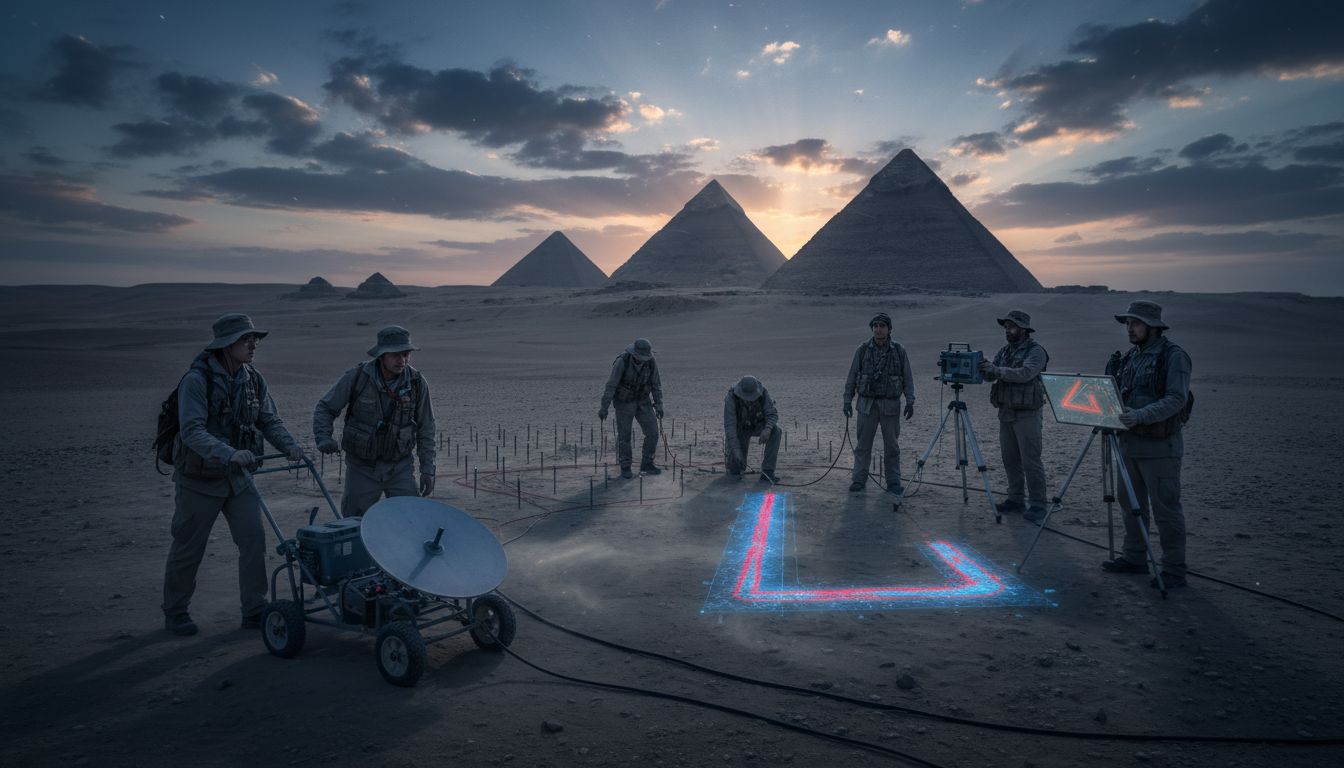
A joint team of Japanese and Egyptian archaeologists has reported the discovery of an L‑shaped subsurface anomaly in the western cemetery of the Giza plateau, a burial ground that lies just beyond the Great Pyramids. The feature, detected through ground‑penetrating radar (GPR) and electrical resistivity tomography (ERT), has been described in media releases as a possible “entrance to a deeper structure.” While the term “ancient portal” has captured public imagination, researchers stress that the anomaly is preliminary and requires further verification before any definitive conclusions can be drawn.
Methodology
The investigation employed two non‑invasive geophysical techniques that have become standard in modern Egyptian archaeology. Ground‑penetrating radar sends high‑frequency radio waves into the ground and records the reflected signals, revealing variations in density and composition. Electrical resistivity tomography measures how easily electrical currents flow through subsurface materials, highlighting voids or stone structures.
Dr. Hiroshi Tanaka, a geophysicist from the University of Tokyo, explained, “Combining GPR with ERT gives us a three‑dimensional picture of what lies beneath the surface without disturbing the ancient context. In the western cemetery, the data showed a consistent, L‑shaped high‑resistivity zone that aligns with a low‑amplitude radar reflection, suggesting a man‑made feature rather than a natural formation.”
Findings
The anomaly stretches roughly 12 meters in length and 4 meters in width, forming a right‑angled shape that appears to intersect a known cluster of tombs dating to the Fourth Dynasty (c. 2600 BC). The signal intensity indicates a possible stone-lined passage or chamber buried beneath a layer of sand and later debris. No surface markers or visible structures correspond to the anomaly, which is why it escaped detection in earlier surveys that relied primarily on visual inspection and limited excavation.
The research team has released high‑resolution imaging slices from the GPR and resistivity data, showing a clear, continuous interface that could represent a wall or façade. However, the resolution limits of the instruments mean that finer details—such as doorways, decorative elements, or internal compartments—remain indeterminate.
Interpretation
While the phrase “ancient portal” has appeared in headlines, the scientists involved caution against speculative language. “The word ‘portal’ is a metaphor we used internally to convey the idea of an access point to a deeper architectural complex,” said Dr. Laila Hassan, senior archaeologist with Egypt’s Ministry of Antiquities. “At this stage we can only say that the anomaly is consistent with a constructed feature, possibly a corridor or a hidden chamber, but we have no evidence of its purpose or contents.”
Historically, the western cemetery has yielded tombs of high officials and royal family members, many of which contain intricate burial shafts and subsidiary chambers. If the L‑shaped anomaly proves to be a concealed passage, it could reshape our understanding of burial logistics and security measures employed during the pyramid-building era. Nonetheless, alternative explanations—such as a natural limestone fissure filled with compacted sand—cannot be ruled out without direct investigation.
Next Steps
The team plans to conduct targeted micro‑excavation at the anomaly’s perimeter, a process that will involve removing a small amount of overburden to retrieve material samples for dating and compositional analysis. In parallel, they will run additional geophysical scans with higher‑frequency GPR units to improve resolution.
International collaboration continues to be a cornerstone of the project. “This discovery underscores the value of non‑invasive technologies in protecting fragile heritage while still expanding our knowledge,” noted Dr. Tanaka. “We hope the forthcoming field work will either confirm a previously unknown architectural element or, at the very least, refine our models of the cemetery’s layout.”
As the investigation proceeds, scholars and the public alike will be watching for concrete evidence that either substantiates or refutes the portal hypothesis, reminding us that even in the most studied landscapes, hidden complexities can still emerge.


