Overview
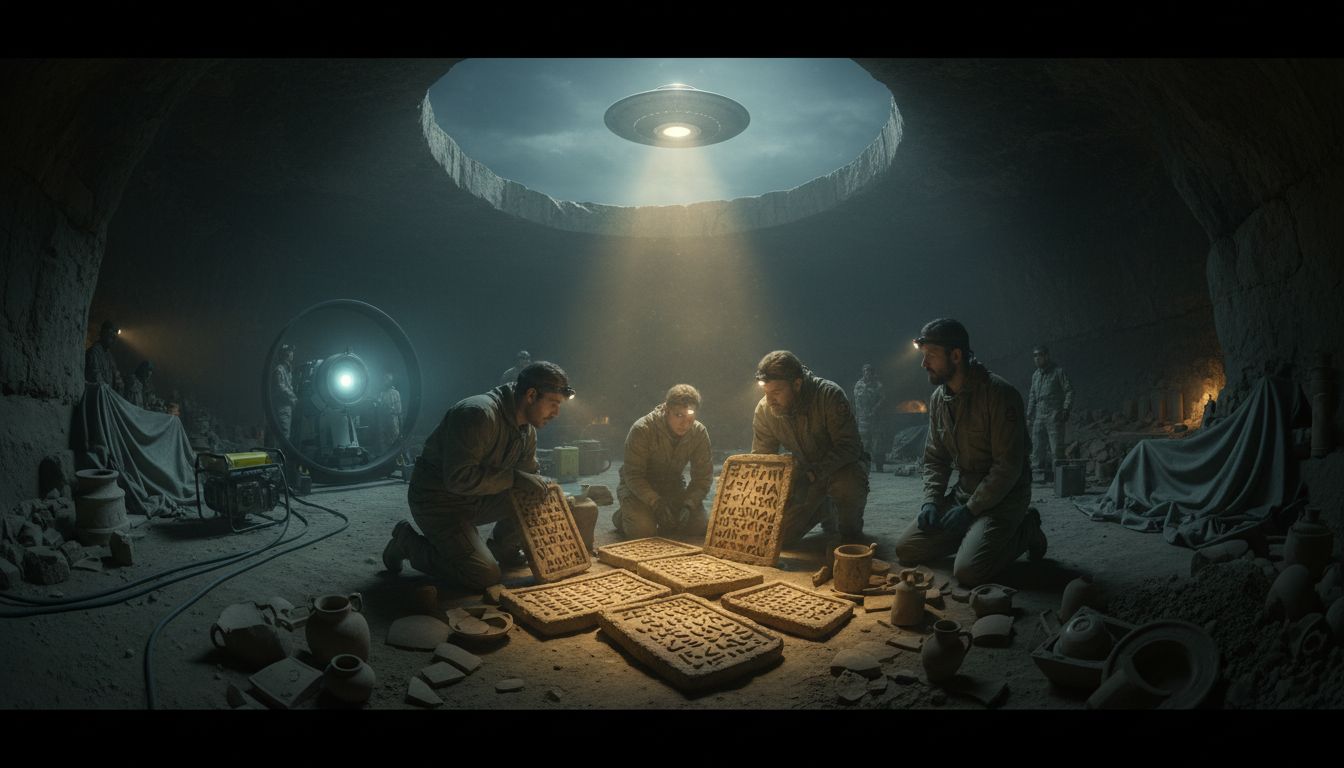
Archaeologists working at the Hittite capital of Boğazköy‑Hattusha have uncovered a cache of cuneiform tablets bearing an entirely unknown script. The find, announced on 12 January 2026, represents the first instance of a previously undocumented language emerging from a well‑studied Bronze‑Age empire. Lead excavator Dr. Leyla Kara of the Turkish Ministry of Culture described the tablets as “a linguistic time capsule that could rewrite our understanding of Hittite administration and its interactions with neighboring cultures.” The discovery has been hailed as a milestone for Near Eastern archaeology and epigraphy.
The Tablets and Their Script
The assemblage consists of 27 clay tablets, each ranging from a few centimeters to nearly a foot in length, recovered from a sealed archive room beneath the palace’s western wing. While the tablets are inscribed in the familiar wedge‑shaped cuneiform style, the individual signs do not correspond to any known Hittite, Akkadian, Luwian, or Hurrian symbol sets. Preliminary photogrammetric analysis shows systematic repetition of certain signs, suggesting grammatical structure rather than random markings. “We see clear patterns of verb‑like and noun‑like clusters, which is a strong indicator of a fully developed language,” noted epigrapher Prof. Michael Rosenberg of the University of Chicago.
Scholarly Implications
If deciphered, the new language could illuminate aspects of Hittite bureaucracy, trade, and diplomacy that have remained obscure. Historians have long debated the extent of Hittite influence in Anatolia and the eastern Mediterranean; a distinct linguistic layer might point to a previously unrecorded administrative class or a multilingual populace. Comparisons are already being drawn to the recent decipherment of the Indus script, where interdisciplinary methods—computational linguistics, statistical modeling, and comparative philology—proved essential. “This is an unprecedented opportunity to apply modern analytical tools to an ancient mystery,” said Dr. Kara, adding that a collaborative team of linguists, AI specialists, and conservators has been assembled.
Fringe Theories and Scientific Response
The announcement has inevitably attracted attention from fringe circles. Some internet forums have linked the tablets to speculative ideas such as an “Atlantis‑Greek war” narrative, while others cite the find as “evidence of Egyptian pyramid chemical‑plant technology” or the dubious “London Artifact” sold as an out‑of‑place‑artifact (OOPART). Scholars caution that extraordinary claims require extraordinary evidence. “There is no credible archaeological or textual basis for connecting these tablets to Atlantis or to any modern pseudo‑scientific hypothesis,” emphasized Prof. Rosenberg. The research team has publicly rejected such conjectures, focusing instead on rigorous peer‑reviewed analysis.
Future Work
The next phase involves high‑resolution 3D scanning of each tablet, followed by machine‑learning algorithms trained on known cuneiform corpora to identify possible lexical parallels. A symposium scheduled for the summer of 2026 at the International Congress of Near Eastern Archaeology will present preliminary findings and invite contributions from global experts. Should the language prove decipherable, textbooks on Bronze‑Age history may soon include a new chapter on the “Hattusha Script,” reshaping curricula and public understanding alike. For now, the tablets remain a silent testament to a civilization’s complexity, awaiting the moment when modern science can finally give them voice.


