Overview
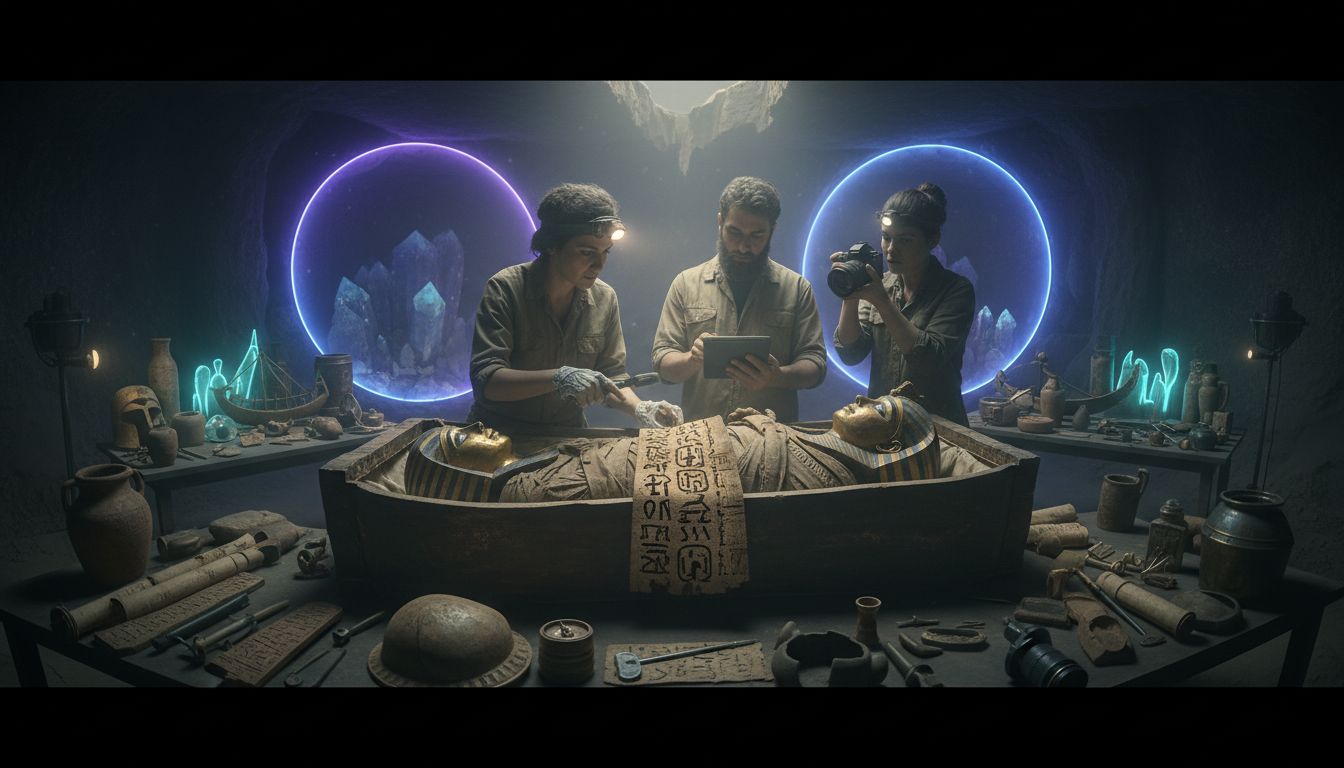
Archaeologists from the University of Barcelona’s Oxyrhynchus Archaeological Mission have announced the discovery of a 1,600‑year‑old papyrus fragment containing text from Homer’s Iliad that was found embedded in the abdomen of a Roman‑period Egyptian mummy. The fragment, which describes naval preparations for the legendary Trojan War, appears to have been deliberately placed as part of the embalming ritual in Tomb 65 of Sector 22 at the Al Bahnasa necropolis, a site identified with the ancient city of Oxyrhynchus. The find, reported on 2 May 2026, is the first known instance of an ancient Greek literary work being incorporated into Egyptian mummification practice.
Discovery Details
The research team, led by Professor Josep Padró, conducted its latest field season between November 2025 and February 2026. While excavating a funerary complex that includes three limestone chambers and several wooden sarcophagi, the team uncovered a well‑preserved mummy whose abdomen was wrapped in a thin strip of papyrus. Initial analysis could not identify the script, prompting a detailed palaeographic study. Radiocarbon dating placed the papyrus in the mid‑2nd century CE, aligning with the Roman occupation of Egypt.
Subsequent transcription revealed a passage from the Iliad (Book 5, lines 1‑12) that enumerates the Greek fleet’s ships and outlines the strategic preparations for the assault on Troy. “The presence of this text inside the mummy’s wrappings suggests a purposeful symbolic function, perhaps invoking heroic protection for the deceased,” the team explained in a formal statement. The fragment measures roughly 8 cm × 12 cm and is composed of the characteristic thin, fibrous material used for Greek papyri, confirming its origin outside the Egyptian scribal tradition.
Historical Context
Oxyrhynchus was a thriving metropolis in Greco‑Roman Egypt, renowned for the massive cache of papyri uncovered there in the late 19th century. The city’s cosmopolitan character facilitated the exchange of literary, religious, and administrative texts between Greek and Egyptian communities. However, no prior evidence has shown Greek literary works being integrated into Egyptian funerary rites. The Iliad itself was widely read across the Mediterranean, but its appearance in a burial context is unprecedented.
The find joins a series of recent cross‑cultural breakthroughs, such as the successful decoding of Linear Elamite and the identification of 10,000‑year‑old plaster flooring techniques that reveal shared technological knowledge across ancient societies. Together, these discoveries challenge long‑standing assumptions about the isolation of regional traditions in antiquity.
Significance
Scholars see the Iliad fragment as a tangible illustration of cultural syncretism in the late Roman Empire. Dr. Leila Mahmoud, a specialist in Egyptian funerary customs at the University of Cairo, notes, “The deliberate placement of a Greek epic within an Egyptian burial suggests that the deceased—or their family—identified with the heroic ideals embodied in the poem, perhaps seeking a protective narrative for the afterlife.”
The artifact also provides a rare textual witness to the transmission of Homeric literature in Egypt, complementing previously known Greek‑language papyri that were primarily administrative or literary copies stored in libraries. Its context within a mummy’s embalming process raises new questions about the role of literature in ritual practice, prompting a re‑examination of other burial assemblages that may contain overlooked textual elements.
Next Steps
The University of Barcelona team plans to conduct multispectral imaging of the papyrus to recover any faded characters and to compare the script with other Oxyrhynchus fragments housed in major museums. Collaborative work with conservators will aim to preserve the delicate material while allowing further scientific analysis, including DNA testing of the mummy to explore possible Greek ancestry or cultural affiliation.
In parallel, the mission will expand its survey of the Al Bahnasa necropolis, seeking additional instances of literary material in funerary contexts. As Professor Padró emphasizes, “Each new piece of evidence reshapes our understanding of how ancient peoples navigated identity, belief, and memory across cultural boundaries.” The Iliad fragment, now catalogued under the reference OAM‑2026‑Iliad, stands as a compelling reminder that the ancient world was far more interconnected than traditionally imagined.


