Overview
Archaeologists working in the rugged mountains of southeastern Uzbekistan have identified a previously unknown high‑altitude settlement that may correspond to the legendary “City of Iron.” The site, named Tugunbulak, sits at nearly 7,000 feet above sea level and shows evidence of sophisticated urban planning, extensive iron‑working facilities, and fortified walls. Findings from the excavation were published this week in Nature, prompting scholars to reassess the role of mountainous regions in the Silk Road’s economic and cultural networks.
Discovery Methods
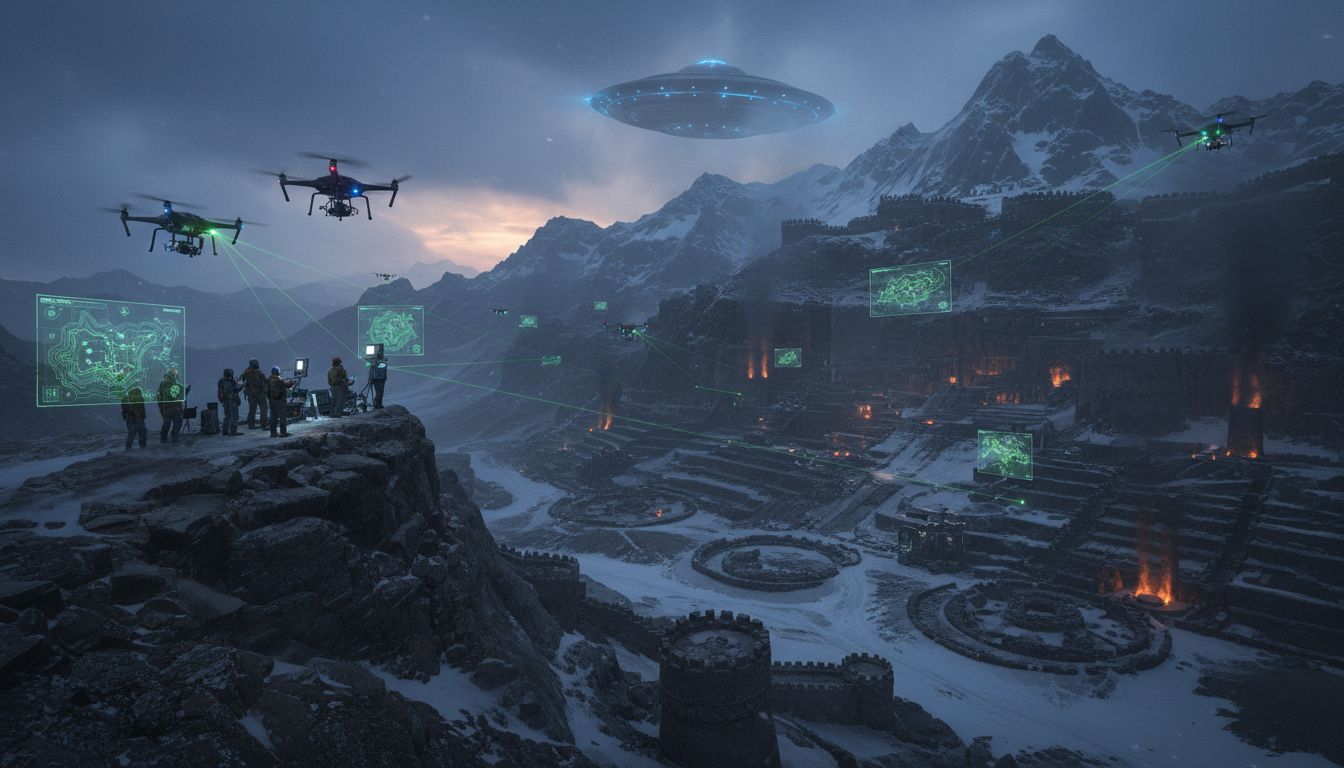
The research team employed more than 20 drone flights combined with high‑resolution LiDAR scanning to produce a three‑dimensional map of the terrain hidden beneath centuries of soil and vegetation. “These technologies let us see through the landscape in ways that were impossible a decade ago,” said Professor Michael Frachetti of Washington University in St. Louis. The aerial data revealed a grid‑like street pattern, stone fortifications, and a series of large, rectangular depressions later identified as iron furnaces. Ground‑penetrating radar and targeted test pits confirmed the presence of thick rammed‑earth walls up to three metres in height, indicating a deliberately constructed defensive and industrial complex.
Urban Layout and Infrastructure
Excavations have uncovered a planned street network intersecting a central plaza, surrounded by residential quarters and workshops. Stone foundations suggest multi‑room dwellings, while the discovery of water‑management features—such as clay-lined channels—points to a community capable of sustaining a sizable population in a harsh alpine environment. “The layout is unlike the organic growth seen in low‑land oasis towns; it reflects a level of civic organization more typical of major trade hubs,” Frachetti noted. The presence of a fortified enclosure implies that Tugunbulak served both commercial and military functions, protecting valuable metal resources and trade caravans passing through the region.
Iron Production as Economic Engine
The most striking aspect of Tugunbulak is its extensive iron‑working industry. Archaeologists have documented dozens of slag pits, crucibles, and furnace remnants, indicating large‑scale smelting operations that likely transformed local iron ore into steel for export. “Preliminary digging at one of the fortified structures suggests that the fortress—protected by three‑metre‑thick rammed‑earth walls—might have been a factory where local metalsmiths turned rich deposits of iron ore into steel,” Frachetti explained. Dr. Farhod Maksudov, director of Uzbekistan’s National Center of Archaeology, emphasized that the material culture—distinctive tools, decorative items, and weaponry—differs markedly from contemporaneous lowland societies, underscoring a nomadic pastoralist community that adapted high‑altitude resources to a thriving industrial economy.
Broader Significance
The discovery of Tugunbulak challenges long‑standing assumptions that the Silk Road’s primary arteries skirted mountainous terrain in favor of fertile valleys and river basins. Instead, the site illustrates how high‑altitude nomadic groups leveraged local mineral wealth to become integral participants in long‑distance trade. By producing and exporting iron goods, Tugunbulak likely supplied caravans traversing the Central Asian corridor, contributing to the region’s prosperity for over a millennium. As the Nature paper concludes, “the city demonstrates that the economic landscape of the Silk Road was far more heterogeneous than previously thought, with mountain‑top industrial centres playing a pivotal role alongside traditional oasis towns.” Future excavations at nearby sites such as Tashbulak are expected to shed additional light on the interconnectedness of these highland communities and the broader Silk Road network.


