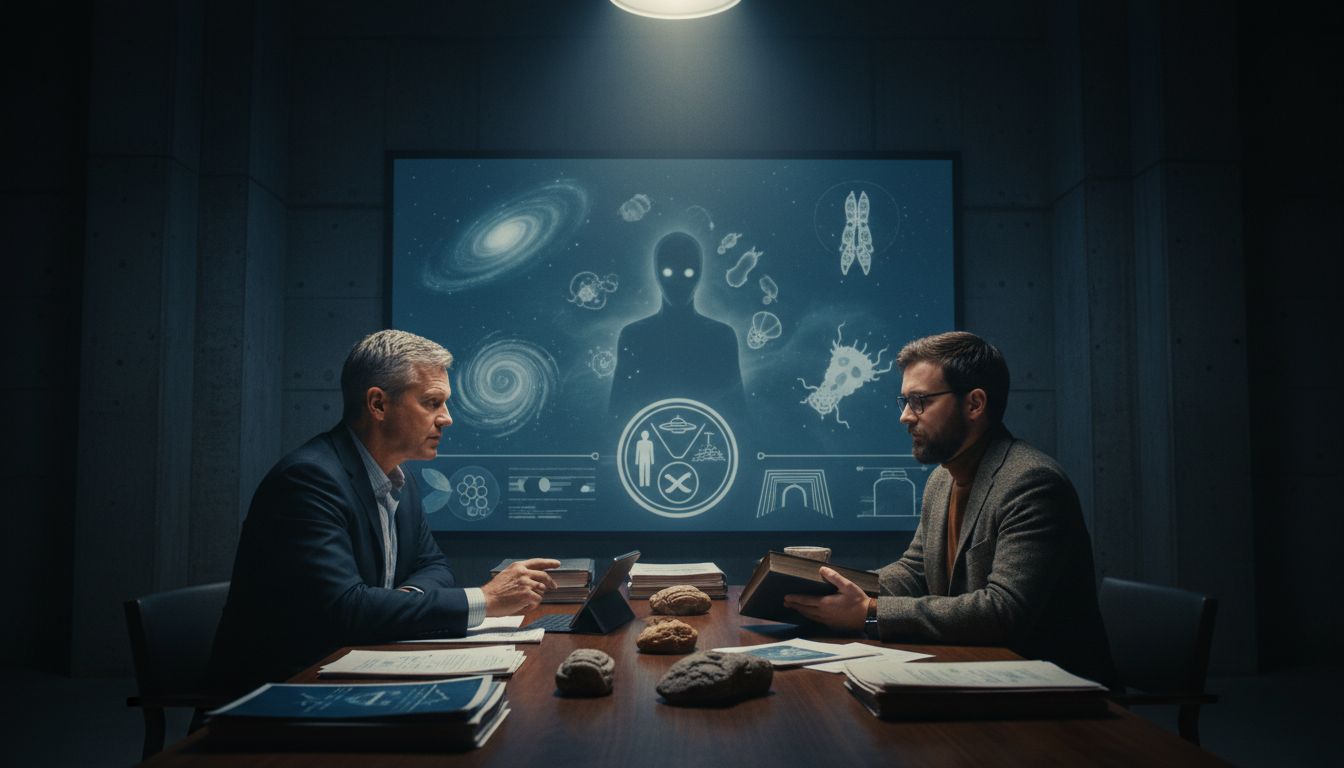
The ongoing debate over the nature and origins of unidentified aerial phenomena (UAP), commonly referred to as UFOs, took an intriguing turn during a recent interview between investigative journalist Ross Coulthart and Dr. Michael Masters, a biological anthropologist at Montana Tech University. The conversation, streamed in July 2024, delved into the "cryptoterrestrial" hypothesis—a theory suggesting that some UAP encounters may involve not extraterrestrial visitors, but advanced forms of life that either evolved on Earth or represent time-traveling future humans.
Dr. Masters, whose academic background includes a PhD in anthropology from Ohio State University, has spent years researching evolutionary anatomy and the possibility that the archetypal "gray alien" encountered in many UAP reports might, in fact, be a distant human descendant. According to Masters, similarities in anatomical features—what he refers to as "synapomorphies" or shared derived characteristics—could indicate a common evolutionary origin. "There were just an overwhelming number of characteristics that were similar," Masters explained, referencing his early fascination with the humanoid form depicted in Whitley Strieber’s book Communion and the accounts his own father shared of a personal UFO sighting.
Coulthart, himself no stranger to the topic, noted the persistent "humanoid bias" in both scientific speculation and popular culture, with science fiction often depicting aliens as two-legged, two-armed beings. Masters responded by emphasizing the need for scientific humility and open-mindedness in considering alternative hypotheses. "The extraterrestrial hypothesis intuitively has dominated the way we think about these things," he said, but cautioned against dismissing other possibilities, such as cryptoterrestrials or time-traveling humans, simply because they challenge conventional thinking.
Adding a new dimension to the discussion, Masters highlighted his recent involvement with a Harvard research paper (currently pending peer review) that proposes the existence of hidden life forms beneath the Earth’s surface, under the oceans, or even on the Moon. This "cryptoterrestrial" model expands the scope of the UAP debate, suggesting that some unexplained sightings may have origins much closer to home than previously assumed. The idea, while controversial, is gaining traction among some scientists and intelligence community insiders, who believe it merits serious consideration.
The interview also touched on the personal and legal challenges faced by those who come forward with UAP-related testimony. Coulthart cited the August 7, 2024, dismissal of whistleblower David Grusch’s lawsuit against the Loudoun County sheriff’s department as an example of the pressures and obstacles encountered by witnesses and researchers. The case, which involved allegations of retaliation and professional consequences following Grusch’s public statements about government UAP programs, underscores the risks inherent in pursuing such a contentious field.
As the scientific community continues to grapple with the unknowns surrounding UAPs, figures like Dr. Masters advocate for a multidisciplinary and open-minded approach. "We need to keep all these things in mind," he said, urging colleagues to resist cultural and psychological biases and to consider the full range of possibilities, however unconventional. The ongoing debate reflects not only the enduring mysteries of the skies, but also the evolving boundaries of scientific inquiry itself.


