Overview
As public curiosity about UFOs, UAPs and the possibility of alien life continues to move into the mainstream, a long-running question is resurfacing with new urgency: what would it mean for religion if life beyond Earth were confirmed? The AP report examines that tension from both sides — the anxiety that extraterrestrial contact could undermine faith, and the more measured view held by many religious leaders that belief systems are resilient enough to accommodate new scientific realities.
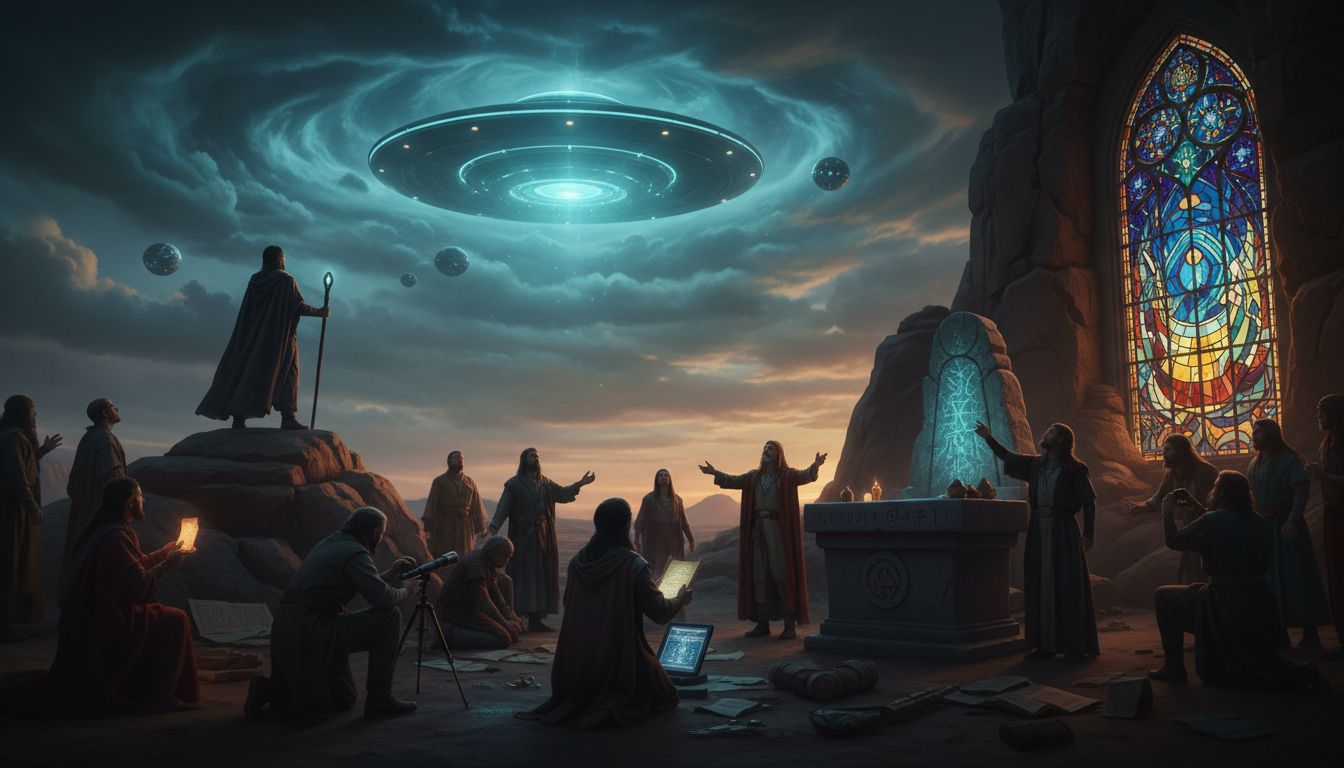
For some believers, the idea of intelligent beings elsewhere in the universe raises immediate theological questions. Would aliens have their own relationship with God? Would they share in humanity’s story of creation, sin and redemption? Would the discovery of extraterrestrial life diminish the significance of Earth and its religions, or simply broaden the scope of divine creation? These are not abstract thought experiments for theologians alone; as discussions about unidentified aerial phenomena have become more common in politics, science and the media, more people are confronting how faith might respond if the unknown becomes known.
Faith Traditions and Adaptation
The AP account suggests that many religious leaders do not see alien life as a threat to belief, but rather as a challenge that faith traditions can interpret within their existing frameworks. In this view, the universe’s vastness only deepens the question of creation instead of narrowing it. A creator capable of bringing life into being on Earth, supporters argue, could just as easily have created life elsewhere.
That perspective reflects a broader historical pattern: religious institutions have often adapted to new discoveries rather than collapsing under them. From astronomy to geology to evolutionary biology, major scientific advances have repeatedly forced believers to revisit literal interpretations while preserving core doctrines. The possibility of alien life may follow a similar path, prompting reinterpretation in some communities and reaffirmation in others.
Where Tensions Could Arise
Still, the article notes that not everyone is comfortable with the idea. For some adherents, the discovery of intelligent beings off-world could unsettle teachings about human uniqueness, salvation, and divine purpose. If life exists elsewhere, questions quickly follow about whether those beings share moral responsibility, whether they need redemption, and how sacred texts written for human audiences should be understood.
These concerns help explain why the issue is so emotionally charged. Religion is not just a set of abstract doctrines; for many people, it shapes identity, moral order and the meaning of existence. Any development that appears to shift humanity’s place in the cosmos can feel destabilizing, even if no direct conflict with faith is required.
A Broader Cultural Shift
What makes the current moment different is that UFO and alien-life discussions are no longer confined to fringe circles. Government hearings, scientific debates and high-profile media coverage have helped normalize questions that once seemed speculative. As a result, the religious implications are being discussed more openly and with greater nuance.
The AP framing suggests that the central issue is not whether religion will survive the discovery of alien life, but how it will interpret it. For some, the answer may be doctrinal adjustment; for others, it may be a reaffirmation that faith was never meant to be limited to Earth alone. Either way, the conversation reflects a larger cultural reality: as humanity looks outward with increasing seriousness, religious traditions are being asked to reconsider how large, and how shared, the universe may be.