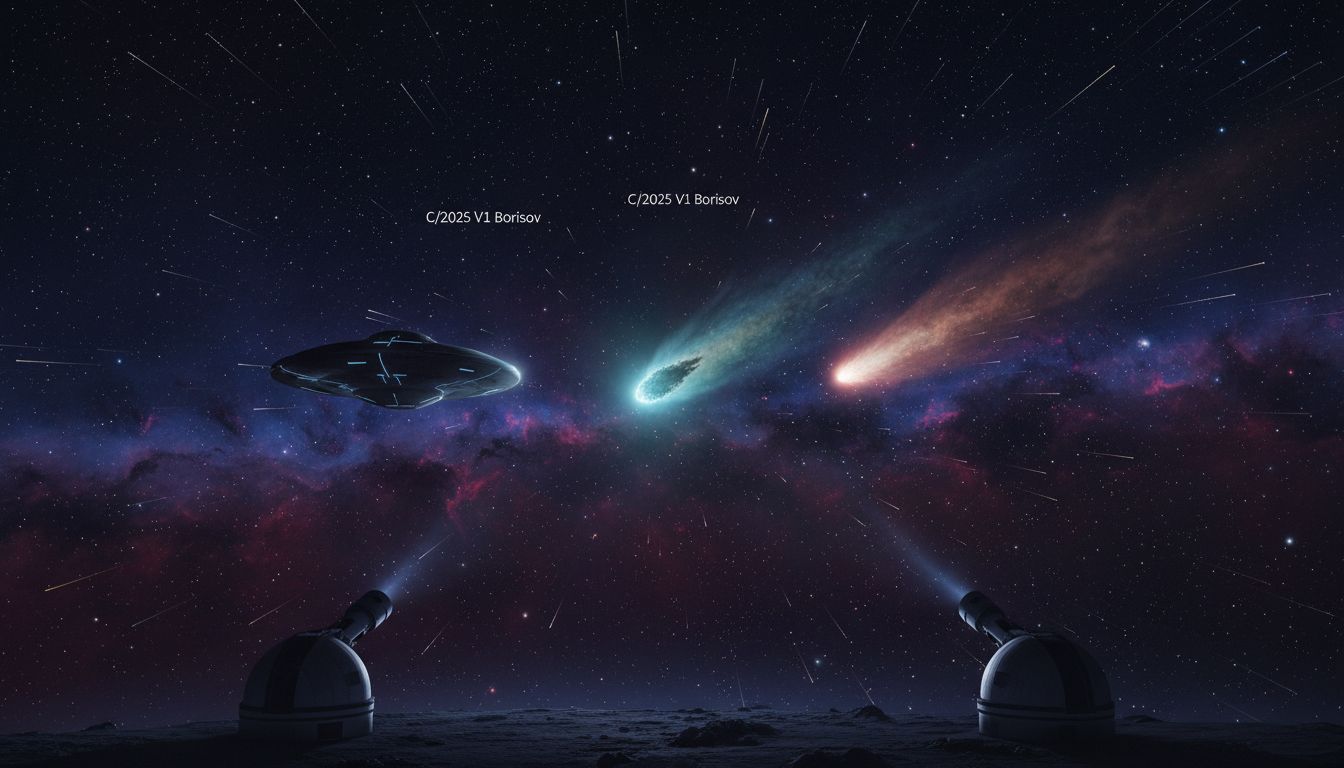
Astronomers announced the discovery of a new interstellar object, catalogued as C/2025 V1 Borisov, that is currently passing between Earth and the previously identified comet 3I/ATLAS. The object was first reported by the sky‑monitoring service The Sky Live in early November and is now estimated to be about 0.70 AU (approximately 105 million km) from our planet. Unlike typical comets, C/2025 V1 Borisov shows no visible coma or tail in optical observations, a characteristic that has prompted a range of hypotheses about its composition and origin. Its projected closest approach to Earth will occur on 11 November 2025 at roughly 0.68 AU, a distance that poses no collision risk but will allow ground‑based telescopes to track its trajectory for several weeks.
The find arrives on the heels of continued interest in 3I/ATLAS, an interstellar visitor first detected in July 2025 that has drawn attention for its unusual trajectory and spectral signatures. Harvard astronomer Avi Loeb, who has previously argued that a non‑negligible fraction of interstellar objects could be artificial, cited 3I/ATLAS as a candidate for further scrutiny. While Loeb has publicly criticized NASA for not releasing high‑resolution imagery of ATLAS captured by the Mars Reconnaissance Orbiter, the agency has clarified that the images remain classified pending a routine data‑release review, not because of any alleged concealment. “We are following standard procedures for data validation and public dissemination,” a NASA spokesperson said, adding that the agency remains open to independent analysis of any interstellar object that warrants it.
C/2025 V1 Borisov’s orbital parameters place it on a hyperbolic path that is consistent with an object arriving from outside the Solar System. Its designation follows the convention for comets (the “C” prefix) and references the well‑known interstellar comet 2I/2019 Borisov, discovered in 2019, though there is no indication that the two share a common origin. Spectroscopic measurements obtained by the European Southern Observatory’s Very Large Telescope have yet to reveal any gas emissions, reinforcing the visual observation that the object lacks a cometary tail. Dr. Elena Martínez of the Institute of Planetary Science, who is leading a follow‑up campaign, noted, “The absence of detectable outgassing could mean the body is an inert, rocky fragment, or it could be a low‑activity comet that has exhausted its volatiles during its journey.” She added that further infrared observations are planned to assess the object's albedo and size, which are currently uncertain.
The broader scientific community views the appearance of a second interstellar object in rapid succession as an opportunity rather than a cause for alarm. Since the detection of ‘Oumuamua in 2017, the rate of identified interstellar visitors has increased, a trend attributed to improvements in wide‑field survey capabilities such as the Vera C. Rubin Observatory, which is expected to discover dozens of such objects each year. “Each new interstellar object provides a natural laboratory for studying material that formed around other stars,” said Dr. Michael Chen, a planetary astronomer at the University of Arizona. “Even if C/2025 V1 Borisov turns out to be a mundane asteroid, its composition could reveal clues about the building blocks of distant planetary systems.”
Speculation about an artificial origin for C/2025 V1 Borisov has already circulated on social media, fueled partly by the proximity of the object to 3I/ATLAS, which some commentators have dubbed a “potentially hostile alien threat.” Scientists caution against jumping to conclusions, emphasizing that extraordinary claims require extraordinary evidence. As observations continue, the object will be monitored by a network of ground‑based observatories and space‑based assets, with data slated for public release through the Minor Planet Center later this month. Whether it will join the growing catalog of natural interstellar wanderers or prompt a revision of current models remains an open question, but for now the focus is on gathering rigorous measurements to determine its true nature.


