Overview
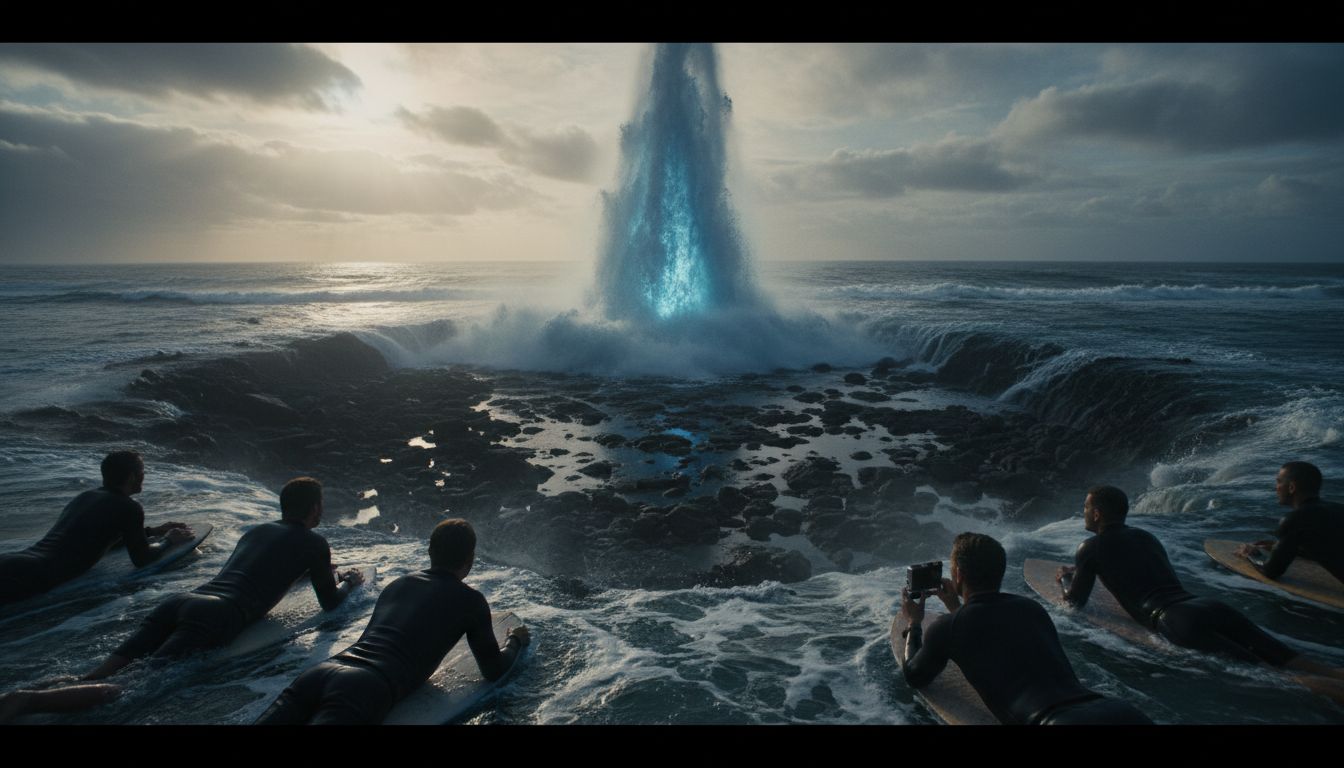
A short video captured by a group of bodyboarders off the eastern coast of Australia has sparked renewed interest in rare oceanic anomalies. The footage, posted on social media in early December, appears to show a sudden, vortex‑like disturbance that briefly parted the water’s surface, exposed a swath of seabed, and thrust a towering column of water upward before the sea returned to normal. While the clip has gone viral, scientists caution that the visual evidence does not fully corroborate the dramatic narrative that has accompanied it, and the phenomenon remains unexplained.
What the Footage Shows
The six‑second clip begins with a calm swell typical of the region’s summer surf. Without warning, a dark, rotating swirl forms near the shoreline, widening to roughly 15 metres in diameter. Within a heartbeat the water recedes, revealing sand and reef structure that are normally hidden beneath a few metres of sea. Almost simultaneously, a vertical plume of water—estimated at 10‑12 metres high—shoots upward, creating a brief, dramatic “water fountain” before the surface collapses back into its usual state. The bodyboarders, who were riding nearby, describe the event as “like a scene from a sci‑fi movie” and note that no seismic activity or weather warnings were reported at the time.
Scientific Perspective
Marine researchers have been quick to examine the video, but consensus is that the data is insufficient for a definitive classification. Dr. Emily Chen, an oceanographer with CSIRO, said, “We have never recorded a vortex of this visual character in the open ocean. The rapid exposure of the seabed suggests a very localized pressure change, but the mechanisms that could produce such a rapid, vertical displacement remain speculative.”
Other experts point to possible optical or recording artifacts. Prof. Mark Alvarez, a wave‑dynamics specialist at the University of New South Wales, cautioned, “The camera angle, lighting, and the inherent motion of the surf can create misleading impressions. It’s also possible that post‑production editing amplified the effect.”
Current hypotheses include a rare sub‑surface landslide that displaced water, a meteotsunami‑like atmospheric pressure pulse, or an unusual interaction between tidal currents and an underwater topographic feature. None of these explanations have been confirmed, and no tide gauge or seismic station in the vicinity recorded anomalous readings at the time of the incident.
Comparable Incidents
The Australian “ocean glitch” joins a growing catalog of unexplained wave events worldwide. In March 2024, a meteotsunami triggered by an intense squall line struck the Argentine coast, killing 12 people and injuring dozens. That event, later linked to rapid atmospheric pressure drops, demonstrated how atmospheric forces can generate tsunami‑scale waves without an earthquake.
Earlier, in 2022, surfers along the Oregon coast captured a “mystery wave” that rose abruptly from a calm sea, prompting investigations that ultimately pointed to a combination of offshore wind gusts and a hidden sandbar. Both cases underscore the difficulty of distinguishing rare natural phenomena from misinterpreted visual data, especially when observations rely heavily on amateur recordings.
Next Steps and Broader Implications
Australian maritime authorities have launched a preliminary review, requesting raw footage, GPS data, and any nearby instrument logs. The Bureau of Meteorology and Geoscience Australia have pledged to coordinate with university researchers to deploy additional pressure sensors and high‑resolution sonar surveys in the area.
Understanding such anomalies is more than an academic exercise; unexpected water column displacements can pose hazards to coastal infrastructure, marine navigation, and recreational users. As Dr. Chen notes, “Even if this proves to be a rare, benign occurrence, it reminds us that the ocean’s dynamics are still not fully mapped, especially in near‑shore zones where human activity is dense.”
The episode also highlights the growing role of citizen‑generated media in ocean science. While viral videos can amplify public curiosity, they also demand rigorous verification before they are accepted as evidence of new physical processes. Until a comprehensive, peer‑reviewed analysis is published, the Australian ocean vortex remains an intriguing, yet unverified, addition to the catalog of mysterious marine events.