Overview
In a March 2023 incident that has become a focal point for Australia’s civilian UFO research community, author Lynette Rule says she experienced a close encounter with an unidentified aerial phenomenon while traveling through the remote outback. The event, which she describes as “life‑changing,” sparked a three‑year investigation coordinated with MUFON Australia and ultimately led to the publication of her memoir, Redirected In Five Seconds. The case was revisited on the “UFO Talker” podcast on March 11 2026, where host Michael Ryan spoke with Rule and MUFON director Roger Stankovic about the investigation’s findings and the broader challenges facing organized ufology in the country.
The Encounter
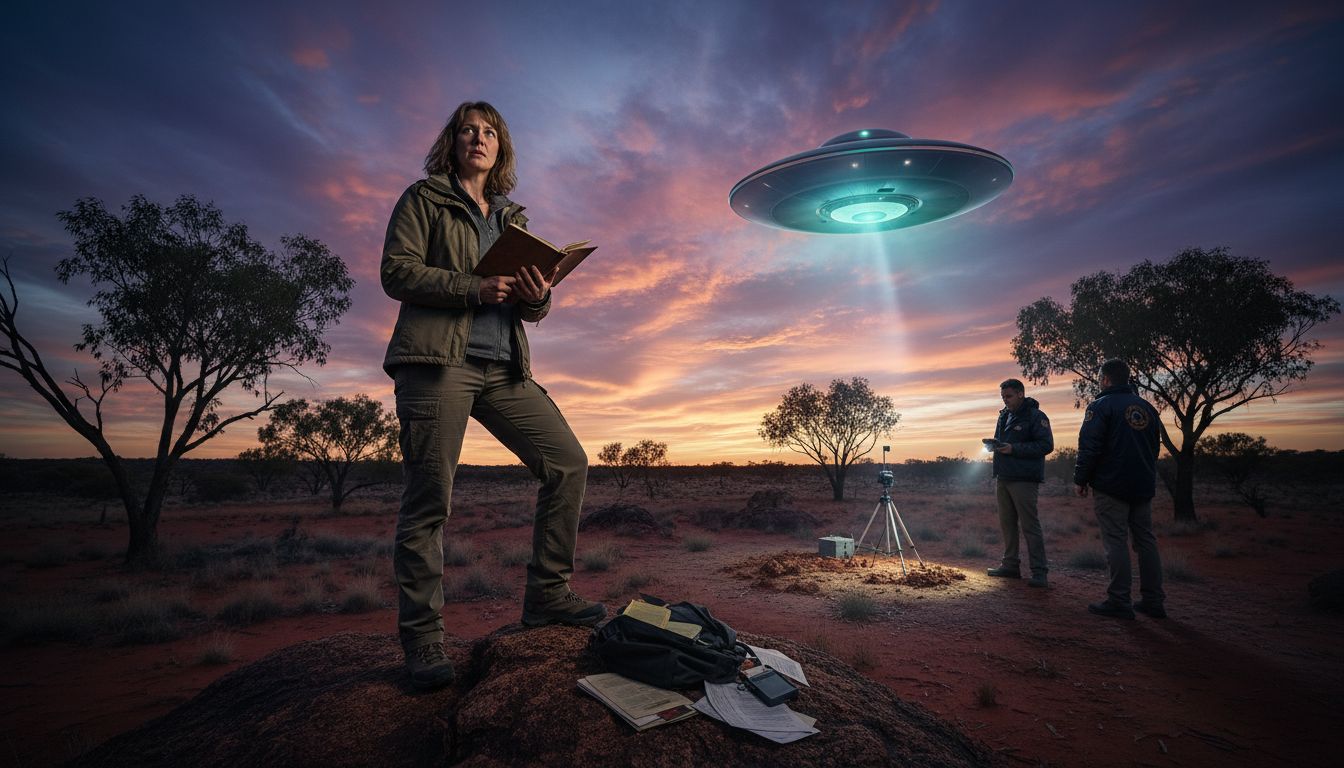
Rule was on a solo trek across the sun‑baked interior of New South Wales when she reported a sudden, luminous object hovering low over the red‑soil horizon. She recounts that the craft emitted a low‑frequency hum and “a cascade of light that seemed to pulse in time with my own heartbeat.” According to Rule, the phenomenon lingered for approximately five seconds before accelerating away at a speed she could not gauge. “It felt like the world paused for a moment, and then everything snapped back into motion,” she told Ryan during the interview. The encounter left her with physical symptoms—headaches, disorientation, and temporary memory gaps—that she later linked to reports of Havana‑type syndrome emerging in other UFO‑related cases.
Investigation and Findings
Following the sighting, Rule contacted MUFON Australia, which assigned a team of field investigators to corroborate her account. Over the next thirty‑six months, the investigators collected satellite imagery, interviewed local Aboriginal elders about similar sky phenomena, and performed a forensic analysis of Rule’s vehicle for electromagnetic anomalies. Stankovic noted that “while we did not recover any physical trace of the craft, the convergence of independent data points—thermal signatures on satellite passes, corroborating eyewitnesses, and the physiological effects reported by Lyn—creates a compelling case for further scientific scrutiny.” The investigation also explored the possibility that the encounter triggered a transient neuro‑physiological response akin to the symptoms documented in Havana syndrome, though no definitive causal link was established.
Book and Public Reception
Rule’s memoir, Redirected In Five Seconds, blends personal narrative with the investigative record, framing the experience as “part adventure, part science, part spiritual reckoning.” The book has attracted attention from both mainstream media and the niche UFO‑research community. Critics have praised its measured tone; Christine Scott, a literary reviewer featured on the podcast, highlighted the author’s “commitment to evidence‑based storytelling without descending into sensationalism.” Sales data released by the publisher indicate that the title has moved over 12,000 copies in its first month, a notable figure for a work in the specialized UFO genre.
Broader Implications for Australian Ufology
Stankovic used the platform to discuss systemic hurdles that Australian ufologists face, including limited funding, fragmented data‑sharing protocols, and a lingering stigma that hampers scientific collaboration. “Cases like Lyn’s illustrate the need for a national framework that can integrate civilian reports with academic research,” he said. He also warned that without coordinated effort, valuable evidence may be lost to time, especially in remote regions where sightings are most frequent but least documented. The conversation touched on the potential for international cooperation, citing recent joint studies between MUFON and European counterpart organizations aimed at standardizing incident reporting.
Looking Ahead
The Redirected In Five Seconds episode of “UFO Talker” underscores a growing appetite for rigorously documented UFO cases in the public sphere. As Rule prepares a speaking tour across Australian universities, she hopes her story will encourage “open‑minded inquiry rather than outright dismissal.” Whether future investigations will uncover definitive proof of extraterrestrial technology remains uncertain, but the collaboration between an individual witness, a civilian investigative body, and the media marks a notable step toward a more transparent and scientific approach to unidentified aerial phenomena in Australia.