Overview
Physicist and Harvard astronomer Avi Loeb is again pressing for a sober, evidence-based look at UAP reports—this time by asking whether some reported orb-like phenomena could be related to ball lightning, one of atmospheric science’s most elusive mysteries. In a recent Medium essay, Loeb framed the question as an open scientific problem rather than a jump to extraterrestrial conclusions, arguing that unusual luminous spheres in the sky should be examined against known natural processes before being assigned extraordinary origins. The premise is not that ball lightning explains every orb sighting, but that the comparison may help clarify which reports belong to the realm of meteorology and plasma physics, and which do not.
Why the Comparison Matters
Ball lightning has been described for centuries as a luminous, roughly spherical object often about the size of a basketball, appearing for seconds or, in some accounts, minutes. Loeb notes that typical reports place its diameter around 30 centimeters, with brightness comparable to a 100-watt lamp and a lifetime of roughly 10 seconds—far shorter than many UAP orb claims, which Pentagon and intelligence reports have described as lasting hours in some cases. The distinction is important: ball lightning is usually associated with thunderstorms and nearby strikes, while UAP orbs are often described in more varied conditions. Still, both are rare, difficult to predict, and notoriously hard to study in real time, which leaves eyewitness testimony as a major part of the evidence base.
What Ball Lightning Can Do
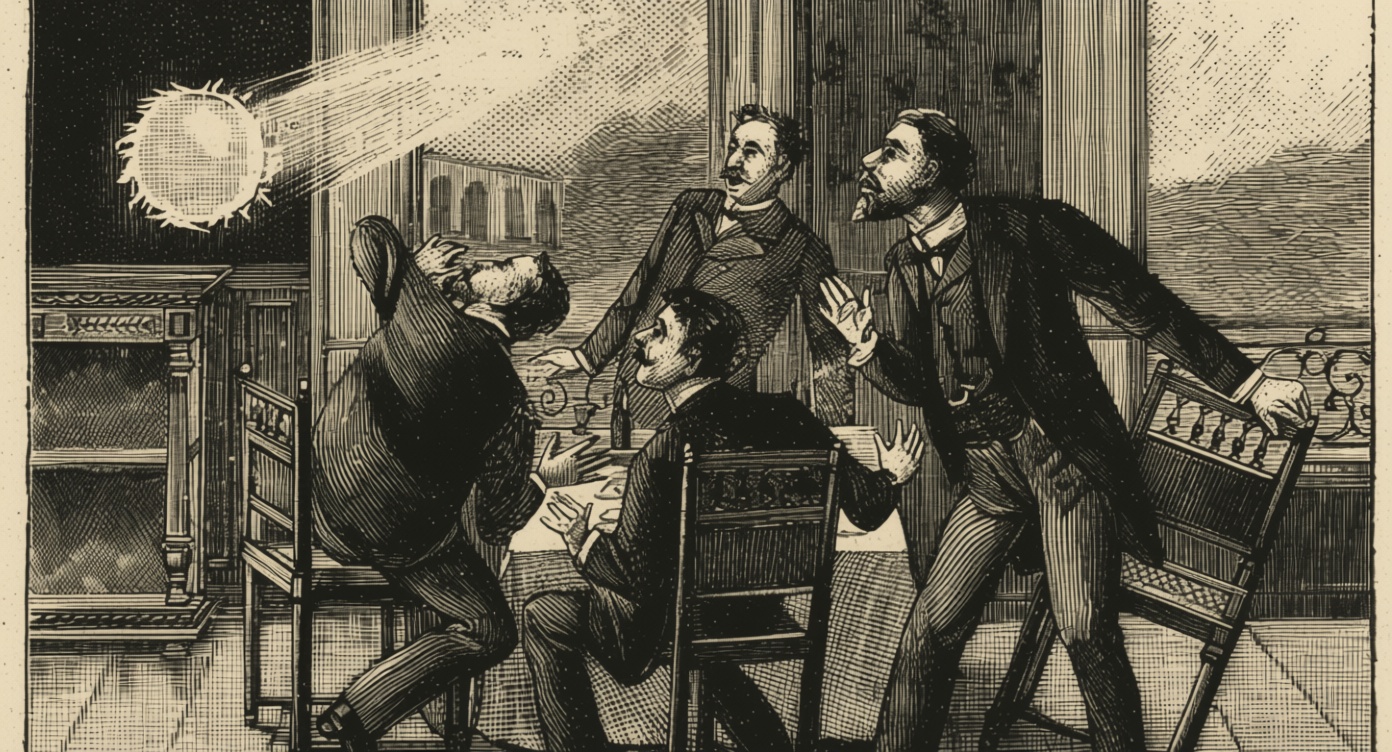
The historical record of ball lightning is one reason scientists continue to take it seriously. Witnesses have described glowing spheres moving horizontally, hovering briefly, drifting with air currents, entering through open windows or chimneys, and sometimes vanishing with a hiss or a small explosion. In rare cases, reports say the objects passed through glass or walls without visible damage. Those accounts have made ball lightning an atmospheric phenomenon that sits in a scientific gray zone: widely reported, difficult to reproduce, and still lacking a universally accepted physical model. Loeb’s point is that this uncertainty should encourage comparison, not dismissal, when similar orb-like sightings are reported in UAP investigations.
The Qinghai Breakthrough
A key advance came in 2012, when a natural ball lightning event was accidentally captured on video in Qinghai, China, during a field campaign studying ordinary lightning. For the first time, researchers obtained a quantitative emission spectrum from a real event rather than relying solely on eyewitness descriptions. A later paper in Physical Review Letters reported spectral features associated with silicon, iron, calcium, nitrogen, and oxygen. That result matters because it suggests a possible physical pathway involving vaporized soil or other materials energized by lightning. For scientists, it was a rare instance where a mysterious light in the sky could be analyzed with instruments, not just anecdote.
An Open Scientific Question
Loeb’s broader message is that UAP orb reports deserve the same disciplined scrutiny. If some sightings turn out to be natural phenomena, that would be an important scientific result in itself; if not, the remaining cases would be sharpened by elimination of terrestrial explanations. Either way, he argues, the answer will come from better data: synchronized imaging, spectroscopy, environmental measurements, and repeatable analysis. In that sense, his question is less about making a claim than about defining a research agenda—one that treats ball lightning and UAP orbs as unresolved phenomena worthy of careful study, not automatic assumptions.