Overview
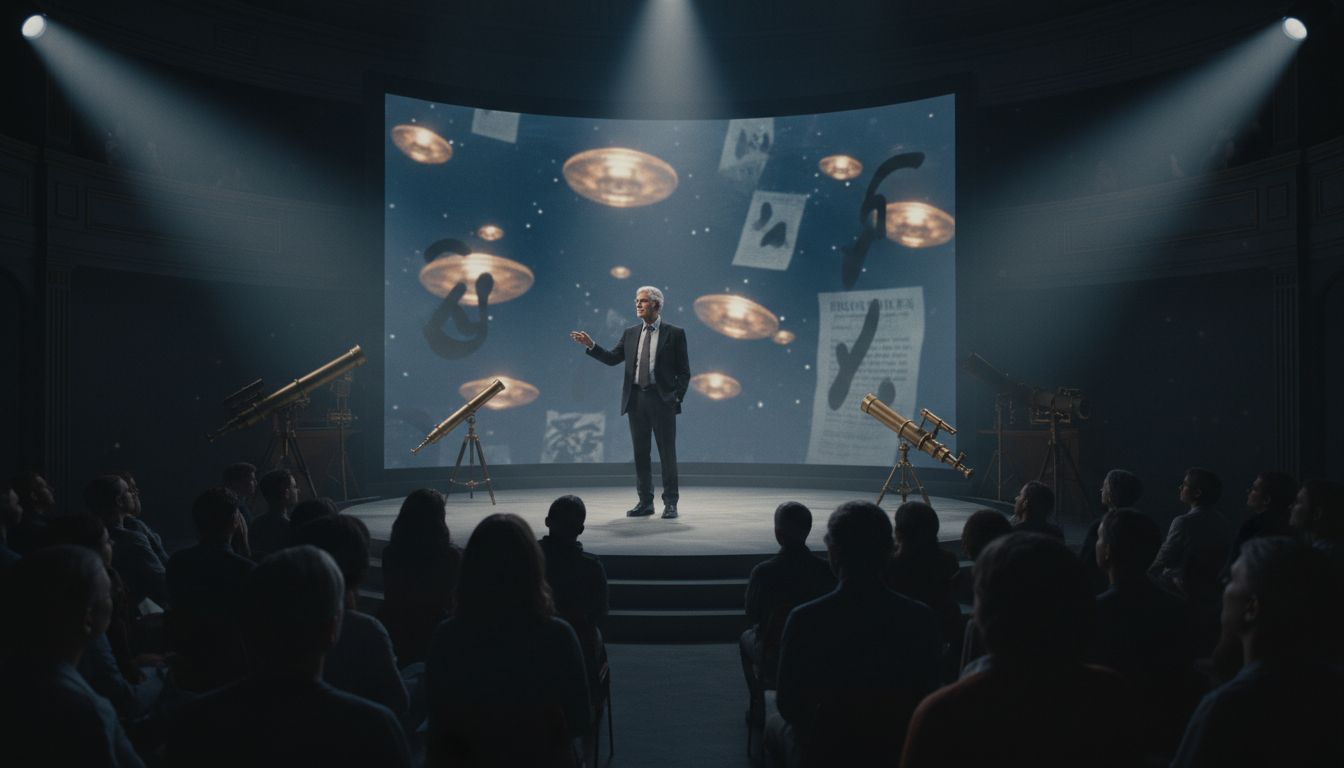
In a recent interview with Al Arabiya English, Harvard astrophysicist Avi Loeb examined the wave of declassified U.S. government material on unidentified aerial phenomena (UAP). The Pentagon’s release of audio, video and photographic records—some dating back to 1948—has sparked renewed public and scientific interest. Loeb, author of Interstellar: The Search for Extraterrestrial Life and Our Future in the Stars, argues that the data merit rigorous, open‑ended scientific investigation rather than automatic dismissal. “Our conception of reality should be driven by evidence,” he told the network, emphasizing that the files present a genuine research opportunity.
Key Details from the Files
Loeb highlighted several cases that he finds “most thrilling.” One involves a black sphere moving through clouds that did not resemble a conventional drone; its speed could not be determined because the distance to the object was unknown. Another report describes an object that accelerated far faster than any known aircraft, again hampered by missing range data. A senior intelligence officer recounted a helicopter mission that encountered a swarm of orbs, a testimony that, while compelling, lacks instrument‑based verification. Loeb stresses that these ambiguities are not merely academic—they point to gaps in current detection and identification capabilities.
Scientific Perspective
When asked about a widely shared video showing a “UFO being shot out of the sky,” Loeb identified the phenomenon as a balloon, likely similar to the Chinese high‑altitude surveillance balloon shot down earlier this year. He noted that civilian balloons can behave unpredictably, especially when they break apart over difficult terrain. Loeb also addressed astronaut Buzz Aldrin’s report of “flashes of light,” explaining that cosmic rays striking the retina can produce such visual artifacts, a well‑documented effect in spaceflight. By providing concrete, physics‑based explanations, Loeb demonstrates how many UAP sightings can be reconciled with known natural or technological sources, while still leaving a subset that remains unexplained.
National‑Security and Policy Implications
Loeb warns that the inability of U.S. intelligence agencies to identify certain aerial objects poses a serious national‑security concern. “If we cannot tell whether an object is a foreign drone, a balloon, or something else, we are blind to potential threats,” he said. The recent declassifications, he argues, should prompt systematic data collection and transparent analysis involving both government labs and the broader scientific community. Such collaboration could improve sensor calibration, distance estimation, and classification algorithms—tools essential for distinguishing benign phenomena from hostile technology.
Path Forward for the Scientific Community
The astrophysicist calls for the establishment of an independent, peer‑reviewed framework to evaluate UAP data. He suggests that universities, research institutions and space agencies be granted access to the raw recordings, sensor logs and radar tracks, enabling reproducible studies. “If any of these objects were of extraterrestrial origin, it would be the biggest discovery ever made by humanity,” Loeb remarked, underscoring the stakes. Yet he cautions against sensationalism, urging that any claim be supported by quantifiable measurements and subjected to the same scrutiny applied to other astronomical discoveries.
In the coming months, Loeb expects that a concerted, interdisciplinary effort—combining physics, aerospace engineering, and data science—will either demystify the current catalog of UAPs or, if evidence persists, compel a reevaluation of our understanding of the near‑Earth environment. The interview concludes with a call for openness: “Science thrives on curiosity and evidence; we should let both guide the conversation about these mysterious sightings.”


